
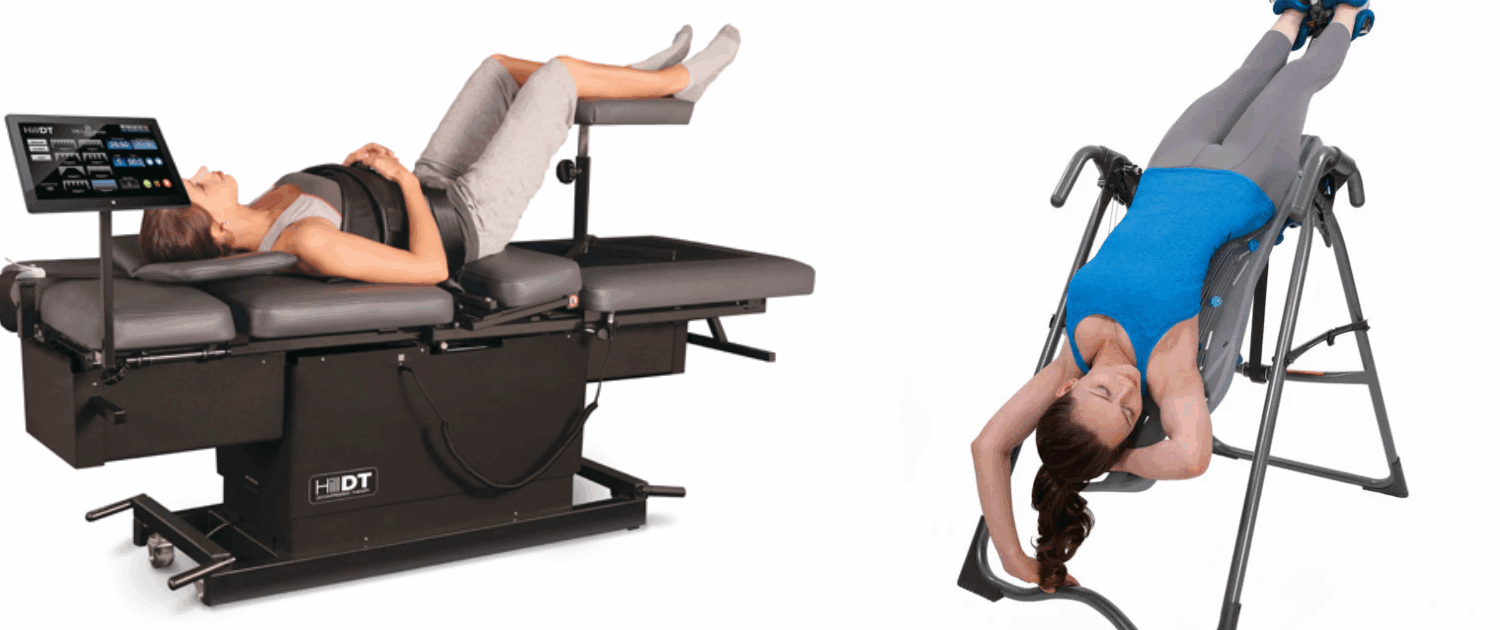
Spinal Decompression vs Inversion Table in Naperville: Which Actually Works for Back Pain?
“Can I just buy an inversion table and skip the doctor?”
I hear this question at least once a week. And honestly? I get it. Inversion tables cost a few hundred dollars. They’re sitting right there on Amazon with thousands of five-star reviews. You can use one in your basement while watching Netflix.
Professional spinal decompression therapy requires appointments, costs more, and takes you away from your busy life.
So why would anyone choose the more expensive, less convenient option?
Because here’s what those Amazon reviews don’t tell you: inversion tables and spinal decompression therapy aren’t even close to the same thing. They work differently, treat different problems, and deliver very different results.
After 25 years of treating disc problems at Synergy Institute in Naperville—including being the first clinic in Illinois to offer spinal decompression back in 2002—I’ve had a front-row seat to both approaches. I’ve seen patients try inversion tables first, then come to us when they didn’t work. I’ve also seen patients waste months on the wrong treatment.
So let me give you the straight answer: when should you use each one, and which actually fixes the problem?
Quick Facts: Spinal Decompression vs Inversion Table
| Factor | Professional Spinal Decompression | Inversion Table |
|---|---|---|
| How it works | Computer-controlled traction targets specific discs | Gravity-based stretch affects entire spine |
| Targeting | Precise—treats the exact disc causing pain | General—stretches everything equally |
| Success rate | 71-89% for disc conditions | Unknown; temporary relief reported |
| Negative pressure | Yes—creates vacuum to retract disc material | Minimal—relies on body weight only |
| Supervision | Professional monitoring, customized protocols | Unsupervised home use |
| Safety concerns | Few (contraindications screened) | Blood pressure, glaucoma, heart conditions |
| Cost | $1,500-3,000 (treatment course) | $150-500 (one-time purchase) |
| Best for | Herniated discs, sciatica, DDD, stenosis | Mild muscle tension, general stiffness |
| Duration of relief | Lasting (addresses root cause) | Temporary (doesn’t fix disc problems) |
What’s the Difference? The Short Answer
Spinal decompression therapy uses a computer-controlled system to create negative pressure inside specific spinal discs, which can help retract herniated or bulging disc material away from compressed nerves.
Inversion tables use gravity and your body weight to provide a general stretch across your entire spine.
The key difference: One targets the problem. The other stretches everything and hopes for the best.
Think of it this way: if you had a splinter in your finger, would you rather have someone carefully remove that specific splinter, or just soak your whole hand in warm water and hope it comes out on its own?
Both might provide some relief. But only one actually fixes the problem.
How Professional Spinal Decompression Actually Works
At Synergy Institute, we use the Back On Trac system by Ergo-Flex—and it’s nothing like the typical decompression table you might picture.
Here’s what makes it different:
You sit in what looks like a comfortable chair—not a flat table. The chair gently reclines you onto your back with full support for your arms and legs. There’s no harness. No pelvic belt. No strapping in. You’re never trapped or suspended.
The system then uses 21 fully automated protocols to provide:
- Axial distraction — gentle separation of the vertebrae
- Bilateral lateral flexion — side-to-side movement that releases tight muscles
- Heat therapy — built-in warming to relax tissues
- Vibration therapy — enhances muscle relaxation
This combination does something inversion tables simply can’t: it creates negative pressure inside the disc. That vacuum effect helps draw bulging or herniated disc material back toward the center, taking pressure off the nerve.
Each session takes 15-20 minutes. Most patients find it so relaxing they fall asleep.
How Inversion Tables Work (And Their Limits)
Inversion tables let you hang upside down (or at an angle) using your body weight and gravity to stretch your spine.
The theory makes sense: gravity compresses your spine all day, so reversing gravity should decompress it. And for some people—especially those with mild muscle tension or general stiffness—it does feel good.
But here are the limitations:
1. No targeting capability
Inversion tables stretch your entire spine equally. If you have a herniated disc at L4-L5, the inversion table doesn’t know that. It just stretches everything.
Professional decompression can target the exact disc causing your pain.
2. Insufficient force for disc retraction
Creating the negative pressure needed to actually retract disc material requires precise, calculated force applied at specific angles. Body weight alone typically doesn’t generate enough negative intradiscal pressure.
3. Blood rushes to your head
When you’re upside down, blood pressure in your head increases significantly. This makes inversion tables risky—and sometimes dangerous—for people with:
- High blood pressure
- Heart disease
- Glaucoma or eye conditions
- History of stroke
- Hiatal hernia
- Ear infections
- Pregnancy
4. Temporary relief only
Most people who use inversion tables report that any relief disappears within hours. That’s because the underlying disc problem hasn’t changed—you’ve just temporarily stretched the area.
The Real Comparison: Head-to-Head
| Feature | Spinal Decompression | Inversion Table |
|---|---|---|
| Can target specific disc | ✅ Yes | ❌ No |
| Creates negative intradiscal pressure | ✅ Yes | ⚠️ Minimal |
| Safe for blood pressure issues | ✅ Yes | ❌ No |
| Safe for glaucoma | ✅ Yes | ❌ No |
| Professional supervision | ✅ Yes | ❌ No |
| Customizable protocols | ✅ Yes (21 protocols) | ❌ No |
| Includes heat/vibration | ✅ Yes (Back On Trac) | ❌ No |
| Addresses root cause | ✅ Yes | ⚠️ Rarely |
| Comfortable position | ✅ Reclined on back | ⚠️ Upside down |
| At-home convenience | ❌ Requires appointments | ✅ Yes |
| Lower upfront cost | ❌ Higher investment | ✅ Yes |
Who Benefits From Each Treatment?
Spinal Decompression is Better For:
- Herniated or bulging discs
- Sciatica with disc involvement
- Degenerative disc disease
- Spinal stenosis
- Pinched nerves from disc compression
- Facet syndrome
- People who’ve tried other treatments without lasting relief
- Anyone with contraindications to inversion
Inversion Tables May Help With:
- Mild muscle tension
- General back stiffness after sitting too long
- Minor aches and pains (not disc-related)
- People who enjoy the sensation of stretching
Here’s what I tell my patients: If you have an actual disc problem—something visible on an MRI like a herniation, bulge, or degeneration—an inversion table is unlikely to fix it. It might feel good temporarily, but it won’t address what’s actually pressing on your nerve.
Who Should NOT Use an Inversion Table
This is the part most comparison articles skip, but it’s critical:
⚠️ Avoid Inversion Tables If You Have:
- High blood pressure — Inversion significantly increases pressure in your head
- Heart disease or cardiovascular issues — The position stresses your heart
- Glaucoma or retinal detachment risk — Increased eye pressure can cause damage
- Hiatal hernia — Upside-down position worsens the condition
- Pregnancy — Not safe for developing baby
- Ear infections or inner ear problems — Can worsen vertigo
- History of stroke — Blood pressure changes increase risk
- Obesity — May exceed weight limits; increased cardiovascular strain
- Recent eye surgery — Pressure changes dangerous during healing
- Blood clotting disorders — Risk of clot dislodging
Even if you don’t have these conditions, inversion tables can cause:
- Headaches
- Disorientation
- Muscle spasms (if your back muscles guard against the stretch)
- Worsening pain if you have significant disc damage
Professional spinal decompression avoids all these risks because you’re not inverted, your blood pressure stays normal, and a trained provider monitors your response.
The Synergy Approach: Why We Chose Back On Trac
When I started offering spinal decompression in 2002—the first practice in Illinois to do so—I had my choice of equipment. Over the years, I’ve worked with multiple systems.
We chose the Back On Trac system because it solves the problems with traditional decompression tables:
No harness or belt system. Patients don’t feel trapped or restricted.
Chair-based design. More comfortable than lying flat on a traditional table.
21 automated protocols. We can customize treatment to each patient’s specific condition.
Combined therapies. Heat, vibration, and lateral flexion are built in—not separate add-ons.
35-second setup. Patients aren’t waiting around.
But equipment is only part of it. What really matters is whether you’re a good candidate for decompression in the first place. That’s why we do a thorough evaluation before recommending treatment—and we’re upfront if we think another approach would serve you better.
Frequently Asked Questions
Is an inversion table as good as spinal decompression?
No. Inversion tables provide general stretching through gravity, while spinal decompression uses controlled traction to target specific discs and create negative pressure. For actual disc problems like herniations or bulges, spinal decompression is significantly more effective.
Can inversion tables make back pain worse?
Yes. If you have significant disc damage, the stretching can irritate already-inflamed tissues. The inverted position can also cause muscle guarding, where your back muscles tighten against the stretch—leading to spasms and increased pain.
How much does spinal decompression cost compared to an inversion table?
Inversion tables cost $150-500 as a one-time purchase. Professional spinal decompression typically runs $1,500-3,000 for a full treatment course (15-25 sessions). The difference is that decompression addresses the root cause, while inversion tables usually provide only temporary relief.
How many decompression sessions do I need?
Most patients need 15-25 sessions over 4-8 weeks. At Synergy Institute, we typically start with 3 sessions per week, then taper as you improve. Many patients notice improvement within the first few weeks.
Is spinal decompression painful?
No. Most patients describe gentle stretching and find it relaxing—many fall asleep during treatment. The Back On Trac system is particularly comfortable because you’re reclined in a supportive chair, not strapped to a flat table.
Does insurance cover spinal decompression?
Many insurance plans cover part of treatment, especially the chiropractic components. Coverage varies by plan. Call us at 630-454-1300 and we’ll verify your specific benefits before you start.
Can I use an inversion table if I have high blood pressure?
No. Inversion significantly increases blood pressure in your head and is contraindicated for anyone with hypertension, heart disease, or stroke risk. Professional spinal decompression doesn’t involve inversion and is safe for these patients.
Should I try an inversion table before professional treatment?
If you have mild muscle tension and no health contraindications, an inversion table won’t hurt. But if you have a diagnosed disc problem (herniation, bulge, DDD, stenosis), you’re likely delaying effective treatment. Most patients who come to us have already tried inversion tables without success.
The Bottom Line
Inversion tables and spinal decompression are not interchangeable treatments. They work differently, address different problems, and deliver different results.
Inversion tables may provide temporary relief for mild muscle tension and general stiffness. They’re convenient and affordable. But they can’t target specific discs, don’t create sufficient negative pressure for disc retraction, and carry significant safety risks for many people.
Professional spinal decompression is designed to treat actual disc problems—herniations, bulges, degeneration, stenosis. It’s targeted, controlled, and research supports success rates of 71-89% for disc-related conditions.
If you’re dealing with a real disc problem that’s affecting your quality of life, an inversion table is probably not the answer. And if you’ve already tried one without success, that doesn’t mean decompression won’t work—it just means you need a different approach.
📞 Questions About Which Treatment Is Right for You?
At Synergy Institute in Naperville, we’ll give you a straight answer about whether spinal decompression—or something else—is the right approach for your specific situation. Dr. Jennifer Wise has 25+ years of experience and was the first in Illinois to offer this treatment.
Call or text 630-454-1300 to schedule your evaluation.
Office: 630-355-8022
Synergy Institute Acupuncture & Chiropractic
4931 Illinois Route 59, Suite 121, Naperville IL 60564
References
1. Apfel CC, Cakmakkaya OS, Martin W, et al. Restoration of disk height through non-surgical spinal decompression is associated with decreased discogenic low back pain. BMC Musculoskelet Disord. 2010;11:155. URL:https://pubmed.ncbi.nlm.nih.gov/20615252/
2. Choi J, Lee S, Hwangbo G. Influences of spinal decompression therapy and general traction therapy on the pain, disability, and straight leg raising of patients with intervertebral disc herniation. J Phys Ther Sci. 2015;27(2):481-483.URL: https://pubmed.ncbi.nlm.nih.gov/25729196/
3. Gionis TA, Groteke E. Spinal decompression. Orthopedic Technology Review. 2003;5(6):36-39. URL: (No direct link available — this is a print journal article)
4. Ramos G, Martin W. Effects of vertebral axial decompression on intradiscal pressure. J Neurosurg. 1994;81(3):350-353. URL: https://pubmed.ncbi.nlm.nih.gov/8057141/
5. American Academy of Orthopaedic Surgeons. Inversion Therapy: Position Statement. 2020. URL: (No direct public link available — AAOS position statements are member-access)
6. Prasad KS, Gregson BA, Hargreaves G, et al. Inversion therapy in patients with pure single level lumbar discogenic disease: a pilot randomized trial. Disabil Rehabil. 2012;34(17):1473-1480. URL:https://pubmed.ncbi.nlm.nih.gov/22263648/
7. National Institute of Neurological Disorders and Stroke. Low Back Pain Fact Sheet. NIH Publication. 2024. URL:https://www.ninds.nih.gov/low-back-pain-fact-sheet
8. American Chiropractic Association. Spinal Decompression Therapy Guidelines. 2024. URL:https://www.acatoday.org/ (general site — specific guideline document requires member access)
Medical Disclaimer: This content is for informational and educational purposes only and does not constitute medical advice, diagnosis, or treatment. Always consult with a qualified healthcare provider before making any medical decisions or beginning any treatment program. Never delay or disregard professional medical advice based on information from this article.
The content on this page represents the experience and opinions of Synergy Institute Acupuncture & Chiropractic and Dr. Jennifer Wise, DC. Individual results may vary.
If you are experiencing a medical emergency, call 911 immediately.