
Exercises for Sciatica: What Helps, What Doesn’t, and When You Need More Than Stretching
You’ve been doing the stretches. The knee-to-chest, the piriformis stretch, maybe the cat-cow you found on YouTube. Ten minutes every morning, just like the articles said.
But that shooting pain down your leg? Still there. The numbness in your foot that makes you stumble? Hasn’t budged.
Here’s what most exercise articles won’t tell you: stretches can help manage sciatica symptoms, but they can’t fix a herniated disc. They can’t realign a misaligned vertebra. And they can’t decompress a nerve being compressed by damaged tissue.
I’m Dr. Jennifer Wise, and I’ve been treating sciatica in Naperville for over 25 years. The problem isn’t that you’re doing exercises wrong. The problem is that exercises alone can’t address structural causes of sciatica.
In this article, I’ll show you which exercises help sciatica, which make it worse, and—most importantly—how to know when you need professional intervention. Because if your pain stems from a herniated disc, spinal misalignment, or nerve compression, you’ll need treatments like spinal decompression, chiropractic care, or acupuncture alongside exercises.
Quick Facts: Sciatica and Exercise
| What You Should Know | The Details |
|---|---|
| How common is sciatica? | Affects up to 40% of people at some point in their lives |
| Will it go away on its own? | 80-90% improve within 4-6 weeks with proper care, but 30% become chronic without intervention |
| Do exercises help? | Yes—for symptom management, mobility, and prevention. But they can’t fix structural problems like herniated discs or spinal misalignments. |
| When do you need more than exercises? | If pain persists beyond 3-4 weeks, worsens, or includes numbness/weakness despite consistent stretching |
| Most effective treatment approach | Exercises PLUS professional care (decompression for discs, chiropractic for alignment, acupuncture for nerve inflammation) |
| Emergency warning signs | Loss of bladder/bowel control, progressive leg weakness, numbness in groin area—seek immediate care |
What Is Sciatica?
Sciatica isn’t a diagnosis—it’s a symptom. It refers to pain radiating along the sciatic nerve, which runs from your lower back through your hips and buttocks and down each leg. The sciatic nerve is the longest nerve in your body, formed by nerve roots exiting your lumbar and sacral spine (L4, L5, S1, S2, S3).
Common symptoms:
- Sharp, shooting pain from lower back down one leg
- Burning or electric-shock sensations
- Numbness or tingling in leg or foot
- Weakness in the affected leg
- Pain worsening with sitting
- Difficulty standing from seated position
Two types matter for treatment:
Mechanical sciatica occurs when something physical compresses the nerve—a herniated disc, bone spur, or narrowed canal. This is structural compression.
Inflammatory sciatica happens when swelling from injury, pregnancy, or infection puts pressure on the nerve.
Most sciatica is mechanical. And this is where the limitations of exercises become clear.
What Causes Sciatica—And Why It Matters for Exercise Selection
Understanding what’s causing YOUR sciatica determines whether exercises will help—or whether you need structural intervention.
Herniated or Bulging Disc
This is the most common cause of sciatica. The soft inner material of a spinal disc pushes through a tear in the outer layer, compressing the nerve root.
Why this matters: Stretches cannot retract a herniated disc. They can help manage pain and maintain mobility, but they don’t address the mechanical compression. Spinal decompression therapy creates negative pressure that can actually pull the disc material back into place.
Spinal Stenosis
This is narrowing of the spinal canal, usually from age-related changes, bone spurs, or thickened ligaments.
Why this matters: Stretches may temporarily relieve symptoms, but they don’t widen a narrowed canal. Spinal stenosis requires decompression therapy and chiropractic care to create more space for the nerve.
Degenerative Disc Disease (DDD)
As discs lose height and moisture over time, they can no longer properly cushion the vertebrae. This can lead to nerve compression.
Why this matters: While strengthening exercises help support the spine, they don’t restore disc height. Degenerative disc disease responds best to decompression therapy, which can rehydrate discs and increase the space between vertebrae.
Piriformis Syndrome
The piriformis muscle, located deep in your buttock, can become tight or inflamed and compress the sciatic nerve as it passes underneath.
Why this matters: This is one cause where stretching CAN be highly effective, because it’s a muscle problem rather than a structural spinal issue. The piriformis stretch specifically targets this muscle. However, stubborn cases may still benefit from treatments like SoftWave therapy to release deep muscle tension.
Spinal Misalignment
When vertebrae shift out of proper position, they can narrow the spaces where nerves exit the spine.
Why this matters: No amount of stretching can realign a misaligned vertebra. This requires chiropractic adjustment to restore proper spinal mechanics.
Spondylolisthesis
This occurs when one vertebra slips forward over the one below it, potentially compressing nerve roots.
Why this matters: Severe cases may actually be worsened by certain exercises. This needs professional assessment and treatment.
Why This Matters for Your Exercise Plan
Here’s the bottom line: exercises are most effective for piriformis syndrome and for maintaining improvements after structural issues have been addressed professionally.
If your sciatica is caused by a herniated disc, stenosis, or spinal misalignment, exercises alone are unlikely to provide lasting relief. You’ll need treatments that address the structural problem—then exercises help maintain those improvements and prevent recurrence.
Why Exercise Helps Sciatica (When Done Right)
Exercise plays an important role in sciatica recovery despite its limitations. Here’s what it actually does:
1. Improves Blood Flow – Movement increases circulation, delivering oxygen and nutrients that support healing.
2. Reduces Muscle Tension – Pain causes muscles to tighten protectively, creating additional pressure. Stretching releases this tension.
3. Maintains Nerve Mobility – Your sciatic nerve needs to glide smoothly. “Nerve flossing” exercises prevent the nerve from becoming stuck.
4. Strengthens Supporting Muscles – Core muscles, hip stabilizers, and glutes support your spine and take pressure off compromised discs.
5. Releases Natural Pain Relievers – Exercise stimulates endorphin release, helping manage pain levels.
6. Prevents Recurrence – Regular exercise maintains strength and flexibility to prevent future episodes.
But here’s the critical point: these benefits support healing. They don’t replace structural correction. If your car’s alignment is off, keeping the tires inflated helps—but it doesn’t fix the underlying problem.
When Exercises Aren’t Enough: Structural Problems Need Structural Solutions
This is the honest conversation most exercise articles skip. So let me be direct with you.
If you’ve been doing sciatica exercises consistently for 3-4 weeks and you’re still in significant pain, it’s a sign your sciatica needs more than stretching.
What Exercises Cannot Fix
Exercises cannot:
- Retract a herniated disc
- Decompress a nerve root
- Realign misaligned vertebrae
- Widen a narrowed spinal canal
- Heal degenerative disc disease
- Reduce bone spurs
These are structural, mechanical problems. They require structural, mechanical solutions.
What Professional Treatment Addresses
Spinal Decompression Therapy: Creates negative pressure within the disc space, allowing herniated material to retract away from the nerve. This is a mechanical intervention that stretching simply cannot accomplish. At Synergy Institute, we use the Back On Trac system for non-surgical spinal decompression, which gently creates space in the spine while you recline comfortably in a specialized chair.
Chiropractic Care: Restores proper alignment to vertebrae that have shifted out of position. When the spine is properly aligned, nerve compression is reduced and the body can heal more effectively. Gentle chiropractic adjustments address what stretches can’t—the position of the bones themselves.
Acupuncture: Calms nerve inflammation and helps regulate pain signals. While exercises move muscles, acupuncture in Naperville works at a deeper level to modulate the nervous system’s response to injury.
HT Cellular Reset: Our high-frequency therapy (4,000-12,000 Hz, far beyond standard TENS units) penetrates deep into tissue to restore cellular function and reduce nerve inflammation. This addresses the bioelectric dysfunction that exercises can’t reach.
The Integration That Works
Here’s what I’ve observed over 25 years: patients who combine professional treatment with exercises get better faster and stay better longer than those who try either approach alone.
Treatment addresses the structural problem. Exercises maintain the improvements and prevent recurrence. Together, they create lasting results.
Signs Your Sciatica Needs Professional Care
You should consider treatment beyond exercises if:
- Pain has persisted more than 3-4 weeks despite consistent stretching
- Symptoms are worsening rather than improving
- You have numbness or weakness in your leg or foot
- Pain is severe enough to interfere with sleep or daily activities
- You’ve had sciatica before and it keeps coming back
- Your exercises provide temporary relief but pain returns within hours
At Synergy Institute, I review every patient’s history and imaging personally. If I don’t think we can help you, I’ll tell you directly. I’d rather refer you to someone who can help than provide treatment that won’t work for your specific situation.
Best Stretches for Sciatica Relief
Now let’s get to the exercises themselves. These stretches help manage pain, maintain mobility, and support healing—especially when combined with professional treatment for structural causes.
Important: If any stretch increases your pain or causes sharp shooting pain, stop immediately. Stretches should create a mild pulling sensation, not pain.
1. Piriformis Stretch (Figure-4)
Targets the piriformis muscle deep in your buttock, which can compress the sciatic nerve when tight.
- Lie on your back with knees bent, feet flat
- Cross right ankle over left knee (figure-4 shape)
- Grasp behind left thigh with both hands
- Pull left thigh toward chest until you feel a stretch in right buttock
- Hold 30 seconds, switch sides
- Do 2-3 reps per side
2. Knee-to-Chest Stretch
Relieves pressure on the sciatic nerve by stretching lower back and glutes.
- Lie on back with legs extended
- Bend right knee toward chest
- Clasp hands behind thigh or on top of knee
- Gently pull knee closer to chest
- Hold 30 seconds, switch legs
- Do 2-3 reps per side
Modification: Can be done seated in a chair.
3. Seated Spinal Twist
Improves spinal mobility and releases lower back tension.
- Sit with legs extended
- Bend right knee, place right foot outside left knee
- Place left elbow outside right knee
- Gently twist torso right, looking over shoulder
- Hold 30 seconds, switch sides
- Do 2-3 reps per side
4. Cat-Cow Stretch
Mobilizes entire spine and relieves pressure on nerves.
- Start on hands and knees (tabletop position)
- Cow: Arch back, drop belly, lift head and tailbone (5 seconds)
- Cat: Round back, tuck chin and pelvis (5 seconds)
- Flow between positions for 10-15 reps
5. Standing Hamstring Stretch
Reduces tension on sciatic nerve by lengthening hamstrings.
- Place right foot on elevated surface at or below hip height
- Keep leg straight, toes pointing up
- Keep back straight, hinge forward from hips
- Hold 30 seconds when you feel stretch in back of thigh
- Switch legs, do 2-3 reps per side
6. Child’s Pose
Gently lengthens spine and releases lower back tension.
- Start on hands and knees
- Sit hips back toward heels
- Extend arms forward on floor
- Rest forehead on floor (or pillow)
- Hold 30-60 seconds, repeat 2-3 times
Frequency:
- During acute pain: 2-3 times daily
- For maintenance: Once daily or 3-4 times weekly
- Stop if pain increases
Strengthening Exercises for Long-Term Relief
Stretching helps immediate relief, but strengthening builds the foundation for preventing recurrence. Start these only after acute pain subsides.
1. Glute Bridge
Strengthens glutes, hamstrings, and lower back.
- Lie on back, knees bent, feet flat hip-width apart
- Tighten core, press through heels
- Lift hips to form straight line from shoulders to knees
- Hold 5 seconds, lower slowly
- Do 10-15 reps, 2-3 sets
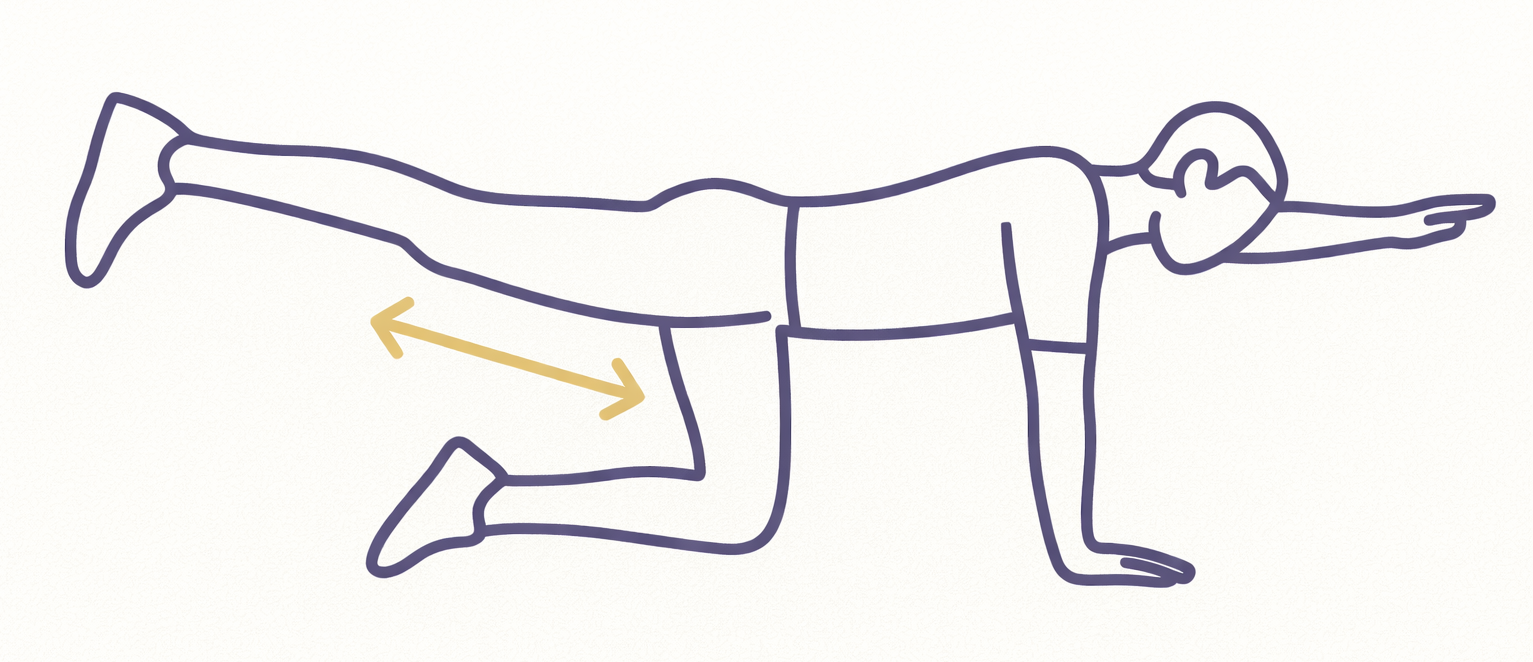
2. Bird Dog
Builds core stability and coordination.
- Start on hands and knees
- Tighten core to keep back flat
- Extend right arm forward and left leg back simultaneously
- Keep hips level
- Hold 5-10 seconds, return to start
- Repeat opposite side
- Do 8-10 reps per side, 2-3 sets
3. Clamshells
Strengthens hip abductors and stabilizers.
- Lie on side, knees bent 90 degrees, feet together
- Keep hips stacked
- Lift top knee, keeping feet together
- Hold 2 seconds, lower
- Do 12-15 reps per side, 2-3 sets
4. Modified Plank
Builds core endurance without excessive back stress.
- Start on hands and knees
- Walk hands forward slightly
- Tighten core, hold body straight from head to knees
- Don’t let hips sag
- Hold 10-30 seconds
- Rest and repeat 3-5 times
Frequency: 2-3 times weekly on non-consecutive days. Warm up with stretches first.
Exercise Protocols by Sciatica Type
Not all sciatica responds to the same exercises. Tailor your routine based on your underlying cause.
For Disc Herniation
Focus: Extension and neutral spine; avoid flexion (forward bending).
Best exercises: Prone press-ups (McKenzie method), standing back extensions, cat-cow (emphasize extension), bird dog, modified plank
Avoid: Toe touches, sit-ups, deep forward bends
Why: Extension can help move disc material away from the nerve. But remember: a herniated disc often requires disc decompression to create the mechanical conditions for healing. Exercises support but don’t replace professional treatment.
For Spinal Stenosis
Focus: Flexion-based movements to open the spinal canal.
Best exercises: Knee-to-chest, pelvic tilts, cat-cow (emphasize flexion/cat phase), child’s pose
Avoid: Prolonged standing, walking downhill, back extensions
Why: Flexion temporarily widens the canal. But stenosis is structural narrowing that exercises can’t fix permanently.
For Piriformis Syndrome
Focus: Stretches targeting piriformis and hip external rotators.
Best exercises: Piriformis stretch (figure-4), seated spinal twist, pigeon pose, hip flexor stretches, clamshells
Good news: This often responds well to dedicated stretching. If symptoms persist beyond 4-6 weeks, shockwave therapy can release deep muscle tension.
For Spinal Misalignment
Best approach: See a Naperville chiropractor FIRST to restore alignment, then use exercises to maintain it.
Supporting exercises: Core stabilization (bird dog, modified plank), glute bridges, gentle cat-cow
Avoid: Twisting movements until alignment is stable
Why: Exercising through misalignment reinforces poor patterns. Get aligned first, then strengthen.
Exercises to AVOID with Sciatica
Certain movements can worsen sciatica. Here’s what to skip:
1. Heavy Lifting – Puts significant spinal compression on discs and nerves. Avoid: deadlifts, heavy squats, bent-over rows. Safe alternative: bodyweight exercises, light resistance.
2. High-Impact Activities – Jarring movements aggravate inflamed nerves. Avoid: running (especially on hard surfaces), jumping jacks, plyometrics. Safe alternative: walking, swimming, cycling.
3. Twisting Under Load – Rotation with weight stresses the spine. Avoid: golf (during acute phase), tennis, weighted rotational exercises. Safe alternative: gentle seated twists without weight.
4. Straight-Leg Toe Touches – Excessive lower back strain. Avoid: standing toe touches with straight legs. Safe alternative: seated hamstring stretches.
5. Full Sit-Ups – Creates significant disc compression. Avoid: traditional sit-ups, straight-leg crunches. Safe alternative: modified planks, bird dog.
6. Prolonged Sitting – Increases disc pressure by 40-90%. Strategy: stand or walk 2-3 minutes every 20-30 minutes.
7. Overstretching – Aggressive stretching increases nerve irritation. Principle: stretch to mild tension, never to sharp pain.
🚨 Red Flags: When to Stop Exercising and Seek Immediate Care
Most sciatica is not an emergency. But certain symptoms indicate serious nerve compression that requires urgent medical attention.
Seek immediate emergency care if you experience:
- Loss of bladder or bowel control (inability to urinate, incontinence, constipation with loss of sensation)
- Numbness in the groin or rectal area (“saddle anesthesia”)
- Progressive leg weakness that’s getting worse over hours or days
- Severe weakness where you can’t lift your foot or stand on your toes
- Bilateral symptoms (both legs affected simultaneously with numbness/weakness)
- Sudden severe pain after trauma (fall, accident)
These symptoms may indicate cauda equina syndrome—compression of the nerve bundle at the end of the spinal cord. This is a medical emergency that can cause permanent nerve damage if not treated quickly.
Call your doctor promptly (not emergency) if:
- Pain is severe and not improving after 1-2 weeks of home care
- Numbness or tingling is worsening despite exercises
- You’re unable to perform daily activities
- Pain consistently wakes you at night
- Over-the-counter pain medication isn’t providing relief
Synergy’s Integrative Approach: Exercise + Professional Treatment
At Synergy Institute in Naperville, I’ve treated sciatica since 1999. Here’s what I’ve learned: patients get better fastest when we address the structural problem professionally AND support healing with appropriate exercises.
How We Match Treatment to Your Sciatica
I personally review your history and imaging to determine what’s causing your sciatica. Then we create a treatment plan for YOUR specific cause.
For disc-related sciatica:
Spinal Decompression (primary) – Our Back On Trac system creates negative pressure that allows herniated material to retract. You recline comfortably in a specialized chair—no harness, no restraints. Sessions are 15-20 minutes.
HT Cellular Reset – Our high-frequency therapy (4,000-12,000 Hz) reduces nerve inflammation and restores cellular function.
Exercises – Once we’ve addressed the disc and nerve, exercises maintain improvements and prevent recurrence.
For alignment-related sciatica:
Chiropractic Care (primary) – Gentle adjustments restore vertebral alignment, reducing nerve compression. I’m a Palmer College graduate with 25+ years of experience.
Exercises – After alignment is restored, core strengthening maintains proper spinal mechanics.
For nerve inflammation:
Acupuncture – Calms nerve irritation and modulates pain signals.
HT Cellular Reset – Works alongside acupuncture to restore nerve function.
Why the Integrative Approach Works
We don’t rely on a single treatment. We have spinal decompression, chiropractic care, acupuncture, HT Cellular Reset, and SoftWave therapy—all under one roof. This means we match the exact combination to your specific sciatica cause.
And exercises? They’re prescribed based on what we’re treating and where you are in your healing process.
Timeline
Weeks 1-2: Intensive phase (3-5 visits/week) – pain reduction, gentle stretches only Weeks 3-6: Corrective phase (2-3 visits/week) – structural correction, progressive stretching, begin strengthening Weeks 7-8+: Stabilization (1-2 visits/week) – maintain improvements, full exercise program
Most patients see significant improvement within 4-6 weeks.
What to Expect at Synergy Institute
If you’re tired of exercises that aren’t working, here’s what happens at our Naperville clinic:
Your First Visit:
- Comprehensive evaluation – symptoms, duration, what you’ve tried
- MRI/imaging review – I personally examine what’s causing your sciatica
- Physical examination – range of motion, reflexes, strength
- Honest assessment – you’ll know if you’re a good candidate
- Treatment plan – may begin same day if appropriate
My commitment: If I don’t think we can help you, I’ll tell you directly. I’d rather refer you to someone who can help than waste your time and money.
Location: 4931 Illinois Route 59, Suite 121, Naperville, IL 60564
Serving: Naperville, Plainfield, Bolingbrook, Aurora, Oswego, and surrounding DuPage and Will County communities
Frequently Asked Questions
Can exercises cure sciatica?
Exercises help manage symptoms and support healing, but they cannot “cure” structural problems like herniated discs or spinal misalignments. Piriformis syndrome (a muscle problem) may fully resolve with stretching. For disc problems, stenosis, or misalignment, you need professional treatment—then exercises maintain improvements.
How long should I do sciatica exercises before seeing results?
You should notice some improvement within 7-10 days if exercises are helping. If you’ve done exercises consistently for 3-4 weeks without improvement—or symptoms are worsening—it’s a sign you need professional intervention.
Should I exercise if my sciatica is severe?
During severe, acute sciatica, gentle movement beats complete bed rest—but limit “exercise” to gentle stretches and short walks. Avoid strengthening until pain subsides. If pain is so severe you can’t walk or function, see a provider before attempting exercises.
What is the best stretch for sciatica?
The piriformis stretch (figure-4) is widely considered most effective because it targets the piriformis muscle, a common source of compression. However, the “best” stretch depends on your cause. Disc-related sciatica may benefit more from extension-based movements; stenosis may respond better to flexion-based stretches.
Can I do these exercises every day?
Yes, gentle stretching can be done daily—even 2-3 times daily during acute pain. Strengthening exercises should be done 2-3 times weekly on non-consecutive days for recovery. Listen to your body: if exercises consistently increase pain, reduce frequency or intensity.
Will walking help or hurt my sciatica?
Walking is generally helpful—it promotes blood flow, maintains mobility, and releases endorphins. Start with short walks (10-15 minutes) on flat surfaces. If walking significantly increases leg pain, shorten duration or try water walking. Avoid hills during acute pain.
Why do my exercises work temporarily but pain comes back?
This is a classic sign that exercises are managing symptoms but not addressing the structural cause. If stretches provide relief for a few hours then pain returns, you likely have a mechanical problem (herniated disc, misalignment, stenosis) needing professional treatment.
When should I see a chiropractor for sciatica?
Consider chiropractic care if: sciatica persists beyond 2-3 weeks, you have a history of back problems, you suspect spinal misalignment (pain with certain movements), or exercises provide only temporary relief.
Can a herniated disc heal with exercise alone?
A small herniation may gradually improve with conservative care including exercises—but most moderate to large herniations require professional intervention. The body CAN reabsorb some herniated material over time (usually 3-6 months), but exercises don’t accelerate this. Spinal decompression creates the mechanical conditions that help discs heal faster.
Is yoga good for sciatica?
Gentle yoga can help, particularly poses promoting spinal mobility and hip flexibility. Avoid: deep forward folds, loaded twisting, any position increasing leg pain. Focus on child’s pose, cat-cow, modified pigeon. If you’re new to yoga or have severe sciatica, work with an instructor who understands your condition.
Should I stretch if my leg is numb?
Yes, gentle stretching is usually safe with numbness. However, numbness means the nerve is compressed or not functioning properly. While stretching may provide temporary relief, persistent or worsening numbness requires professional evaluation. Progressive numbness or numbness with weakness needs prompt medical attention.
How do I know if I need spinal decompression instead of just exercises?
Consider spinal decompression treatment if: sciatica is caused by herniated/bulging disc or DDD (confirmed on MRI); you’ve done exercises consistently 4+ weeks without lasting relief; pain interferes with daily activities or sleep; you have numbness or weakness; or you’ve had multiple sciatica episodes. At Synergy, we review your imaging and give honest assessment of whether decompression will help your specific situation.
Ready to Get Real Relief from Sciatica?
If you’ve been doing exercises faithfully but you’re still in pain, it’s time to address what stretching can’t fix.
At Synergy Institute in Naperville, we’ve helped thousands of patients find lasting relief from sciatica treatment by treating the actual cause—not just managing symptoms. Whether it’s a herniated disc that needs decompression, a spinal misalignment that needs chiropractic care, or nerve inflammation that needs acupuncture, we’ll match the right treatment to your specific situation.
Call or text (630) 454-1300 to schedule your consultation.
What to expect at your first visit:
- Personal review of your history and imaging by Dr. Wise
- Complete evaluation to determine what’s causing your sciatica
- Honest assessment of whether we can help
- Clear treatment plan—or referral if we’re not the right fit
- Same-day treatment if appropriate
Synergy Institute Acupuncture & Chiropractic 4931 Illinois Route 59, Suite 121 Naperville, IL 60564
Serving Naperville, Plainfield, Bolingbrook, Aurora, Oswego, and surrounding communities.
Medical Disclaimer
This content is for informational and educational purposes only and does not constitute medical advice, diagnosis, or treatment. Always consult with a qualified healthcare provider before beginning any exercise program, especially if you have sciatica or other health conditions. Individual results may vary. The information provided here should not be used as a substitute for professional medical advice.
If you experience sudden loss of bladder or bowel control, progressive leg weakness, or numbness in the groin area, call 911 or seek emergency medical care immediately.
Last reviewed by Dr. Jennifer Wise, DC—February 2026
References
- Konstantinou K, Dunn KM. Sciatica: review of epidemiological studies and prevalence estimates. Spine. 2008;33(22):2464-2472. https://pubmed.ncbi.nlm.nih.gov/18923325/
- Ropper AH, Zafonte RD. Sciatica. New England Journal of Medicine. 2015;372(13):1240-1248. https://www.nejm.org/doi/full/10.1056/NEJMra1410151
- Jacobs WC, van Tulder M, Arts M, et al. Surgery versus conservative management of sciatica due to a lumbar herniated disc: a systematic review. European Spine Journal. 2011;20(4):513-522. https://pubmed.ncbi.nlm.nih.gov/20949289/
- Rhee JM, Yoon T, Riew KD. Cervical radiculopathy. Journal of the American Academy of Orthopaedic Surgeons. 2007;15(8):486-494. https://journals.lww.com/jaaos/
- Luijsterburg PA, Verhagen AP, Ostelo RW, et al. Effectiveness of conservative treatments for the lumbosacral radicular syndrome: a systematic review. European Spine Journal. 2007;16(7):881-899. https://pubmed.ncbi.nlm.nih.gov/17415595/
- Chou R, Qaseem A, Snow V, et al. Diagnosis and treatment of low back pain: a joint clinical practice guideline from the American College of Physicians and the American Pain Society. Annals of Internal Medicine. 2007;147(7):478-491. https://www.acpjournals.org/
- Hahne AJ, Ford JJ, McMeeken JM. Conservative management of lumbar disc herniation with associated radiculopathy: a systematic review. Spine. 2010;35(11):E488-E504. https://pubmed.ncbi.nlm.nih.gov/20473117/
- Wilbourn AJ, Aminoff MJ. AAEM minimonograph 32: the electrodiagnostic examination in patients with radiculopathies. Muscle & Nerve. 1998;21(12):1612-1631. https://pubmed.ncbi.nlm.nih.gov/9843055/
- Bogduk N. On the definitions and physiology of back pain, referred pain, and radicular pain. Pain. 2009;147(1-3):17-19. https://pubmed.ncbi.nlm.nih.gov/19762151/
- Mayo Clinic. Sciatica – Symptoms and causes. Mayo Clinic Health Information. 2024. https://www.mayoclinic.org/diseases-conditions/sciatica/symptoms-causes/syc-20377435
- American Academy of Orthopaedic Surgeons. Lumbar Spinal Stenosis. OrthoInfo. Updated 2021. https://orthoinfo.aaos.org/en/diseases–conditions/lumbar-spinal-stenosis/
- National Institute of Neurological Disorders and Stroke. Low Back Pain Fact Sheet. NINDS. Updated 2023. https://www.ninds.nih.gov/health-information/disorders/low-back-pain
- Macario A, Pergolizzi JV. Systematic literature review of spinal decompression via motorized traction for chronic discogenic low back pain. Pain Practice. 2006;6(3):171-178. https://pubmed.ncbi.nlm.nih.gov/17147591/
- Apfel CC, Cakmakkaya OS, Martin W, et al. Restoration of disk height through non-surgical spinal decompression is associated with decreased discogenic low back pain. BMC Musculoskeletal Disorders. 2010;11:155. https://pubmed.ncbi.nlm.nih.gov/20626862/
- Cleveland Clinic. Sciatica: What It Is, Causes, Symptoms & Treatment. Cleveland Clinic Health Library. 2024. https://my.clevelandclinic.org/health/diseases/12792-sciatica