Neurogenx Treatment for Neuropathy in Naperville
Advanced treatments for Neuropathy Near Me

The burning that won’t quit. The numbness that’s getting worse despite the medications. The tingling that wakes you up at 2 a.m.
Your prescription takes the edge off but doesn’t fix anything. Your doctor told you to manage symptoms and hope the condition doesn’t progress too quickly. You’re not okay with that answer.
You’re looking for something that actually heals the nerves.
Neurogenx is that breakthrough. Clinical research on this advanced high-frequency electrotherapy technology shows approximately 87% of patients — nearly 9 out of 10 — report major improvement or complete relief from peripheral neuropathy symptoms with consistent treatment.
This isn’t another TENS unit or generic electrotherapy device.
Neurogenx represents a fundamentally different approach to peripheral neuropathy. Rather than masking symptoms with medication or surface-level electrical stimulation, Neurogenx works at the cellular level to restore nerve function, reactivate dormant nerve signaling pathways, and create the bioelectric environment where damaged nerves can actually begin to heal.
I’m Dr. Jennifer Wise, DC, Acupuncturist, and I’ve been treating peripheral neuropathy in Naperville since 2000. At Synergy Institute Acupuncture & Chiropractic, Neurogenx is the centerpiece of our Synergy Nerve Restore Program — the breakthrough high-frequency electrotherapy technology that’s been validated across more than a decade of clinical use. This page explains what Neurogenx is, how the technology actually works at the cellular level, what conditions it treats, what to expect from a treatment series, and how Neurogenx fits into a comprehensive cellular-level approach to nerve recovery.
📞 Call 630-355-8022 or Text 630-454-1300 to find out if SoftWave can help you.
| Quick Facts | Neurogenx 4000Pro FOR Neuropathy relief |
|---|---|
| Device | Neurogenx 4000Pro with NervePro 2.0 firmware |
| Manufacturer | Neurogenx Inc. (Lansing, Michigan) |
| Technology category | Advanced high-frequency electronic wave electrotherapy |
| Frequency range | 400 Hz – 60,000 Hz (automated); 40,000 Hz (manual) |
| FDA status | 510(k) cleared medical device |
| Treatment delivery | Adhesive electrode patches placed on skin near affected nerves |
| Session length | 25–50 minutes |
| Treatment frequency | Initial Intensive Phase: 2 sessions per week for 12 weeks. Maintenance Phase: booster sessions through the remainder of the year (frequency customized). Optional Accelerator Phase for advanced cases. |
| Reported outcomes | Approximately 87% of patients report major improvement or complete relief |
| Years in clinical use | 10+ years across U.S. provider network |
| Naperville availability | Featured in the Synergy Nerve Restore Program at Synergy Institute Acupuncture & Chiropractic |
At Synergy Institute Acupuncture & Chiropractic in Naperville, Illinois, the Neurogenx 4000Pro with NervePro 2.0 is the centerpiece of our Synergy Nerve Restore Program — combining breakthrough high-frequency electrotherapy technology validated across more than a decade of clinical use with our existing protocols for cellular nutrition, neuromodulation, regenerative tissue therapy, acupuncture, and chiropractic care. The result is the only fully integrated cellular-level neuropathy program of its kind in the Naperville area.
Most neuropathy clinics in the Naperville area offer one or two treatment modalities. The Synergy Nerve Restore Program addresses peripheral neuropathy at multiple cellular layers simultaneously — and Neurogenx is the most advanced electrotherapy component of that program. Dr. Jennifer Wise holds dual credentials as a Doctor of Chiropractic (Palmer College graduate) and Acupuncturist with 26+ years of clinical experience, 16+ years of acupuncture practice, and Molecular Hydrogen Institute certification — the diagnostic depth and treatment range that allows Neurogenx to be deployed strategically based on the specific cellular drivers of each patient’s neuropathy.
Clinical research published in Frontiers in Neurology (2024) and clinical data on Neurogenx provider networks have demonstrated that high-frequency electronic wave technology operating in the kilohertz range produces meaningful cellular-level effects on nerve function — including improved nerve conduction velocity, enhanced mitochondrial function, normalized cellular voltage gradients, and increased local circulation. With approximately 87% of patients reporting major symptom improvement, advanced high-frequency electrotherapy represents one of the most effective non-surgical treatment options currently available for peripheral neuropathy.
Neurogenx is an FDA-cleared advanced high-frequency electrotherapy device specifically engineered for the treatment of peripheral neuropathy and chronic nerve pain conditions. The current generation system — the Neurogenx 4000Pro with NervePro 2.0 firmware — delivers a sophisticated electronic signal through adhesive electrode patches placed on the skin near affected nerves.
Unlike traditional TENS units that operate at 100–400 pulses per second and primarily reach surface tissue, Neurogenx generates electronic waves spanning 400 Hz to 60,000 Hz — frequencies orders of magnitude higher than conventional electrotherapy. This allows the signal to penetrate deep into tissue and reach the cellular layer where peripheral nerve dysfunction actually originates.
The device uses what manufacturers describe as a biosimilar waveform — an electronic signal pattern designed to closely mirror the body’s own bioelectric signaling. This compatibility is significant: nerve cells conduct electricity approximately 60% more efficiently than other tissue types, so when the Neurogenx signal enters the body, it naturally follows the path of least resistance directly to nerve fibers — exactly where treatment is needed.
Neurogenx has been in clinical use across the United States for over 10 years, with manufacturer clinical data and a network of more than 100 provider clinics reporting consistent outcomes. The most widely cited figure: approximately 87% of patients treated with Neurogenx experience major improvement or complete relief from neuropathy symptoms with a complete treatment series.
The therapeutic effect of Neurogenx isn’t pain blocking. It’s cellular reactivation.
When the high-frequency electronic signal reaches damaged or dysfunctional peripheral nerves, multiple cellular processes are influenced simultaneously. Each contributes to the overall therapeutic effect, and understanding the mechanism is what separates Neurogenx from generic “electrotherapy” claims.
Healthy peripheral nerve cells maintain a precise voltage gradient — typically around -70 millivolts at rest — that allows them to fire signals correctly when stimulated. Peripheral neuropathy disrupts this voltage pattern. Damaged nerves lose their voltage homeostasis, fire incorrectly, or fail to fire at all. Neurogenx’s high-frequency waves help restore proper voltage gradients across nerve cell membranes, allowing dormant nerves to begin firing in normal patterns again. This is the cellular foundation of returning sensation, reduced pain, and improved nerve signaling that patients report after a successful treatment course.
Research on high-frequency electrotherapy has demonstrated meaningful effects on cyclic adenosine monophosphate (cAMP) — a critical cellular messenger involved in pain modulation, inflammation regulation, and nerve regeneration. By influencing cAMP concentrations at the cellular level, advanced electrotherapy supports the body’s natural cellular communication and repair processes.
Mitochondria are the cellular structures responsible for producing energy in every cell of your body. Healthy mitochondrial function is essential for nerve cell survival and repair, particularly in peripheral neuropathy where nerve cells are under significant metabolic stress. Studies on high-frequency electrotherapy have shown increased mitochondrial number and size in cell cultures exposed to medium-frequency current — meaning more cellular energy is available for nerve recovery. For peripheral neuropathy patients (especially those with diabetic neuropathy, where mitochondrial dysfunction is a known driver), this mitochondrial support may be one of the most clinically significant effects.
The high-frequency waves promote local vasodilation and enhanced microcirculation to the affected nerve tissue. This improved blood flow delivers oxygen, glucose, and the nutrients nerve cells need for repair. Compromised circulation is one of the primary drivers of diabetic peripheral neuropathy specifically, so improving microvascular function in the affected tissue addresses one of the underlying causes of ongoing nerve damage.
Chronic cellular inflammation drives ongoing nerve damage in most forms of peripheral neuropathy. The alternating high-frequency electrical field of Neurogenx produces what’s been described in the electrotherapy literature as a “shaking effect” — the rapid movement of charged molecules in tissue under the influence of the alternating current. This molecular movement helps mobilize inflammatory mediators and metabolic waste products from the affected tissue, supporting the body’s natural inflammation resolution processes.
The combined result is treatment that addresses peripheral neuropathy not as a symptom problem but as a cellular dysfunction — and creates the conditions where damaged nerves can actually begin to heal rather than simply being numbed.
If you’ve been dealing with neuropathy for a while, you’ve probably tried — or at least heard about — other treatments that promised relief. Understanding how Neurogenx compares to what you’ve already experienced helps explain why it represents a fundamentally different category of care.
Standard TENS Units (drugstore or Amazon devices). Standard TENS operates at 100–400 pulses per second and only reaches surface tissue. The mechanism is pain signal blocking via gate control theory — it can mute symptoms while the device is on, but doesn’t address underlying nerve dysfunction. Effects stop the moment you turn the device off.
ReBuilder and similar low-frequency devices. ReBuilder operates at 7.83 Hz — a very low frequency that produces symptom modulation but cannot reach the cellular level where nerve dysfunction actually originates. Pain modulation, not nerve regeneration. Many of our patients tried ReBuilder for years before finding Neurogenx.
Sanexas (RST Sanexas neoGEN). Sanexas is in the same general high-frequency electrotherapy category as Neurogenx — operating at 4,000–20,000 Hz. It’s a legitimate device with published research. The difference: Neurogenx’s 400–60,000 Hz range provides broader cellular-level reach, and the biosimilar waveform technology is designed to mirror the body’s natural bioelectric signaling more closely. Some clinics offer Sanexas; very few offer Neurogenx.
Red Light Therapy (Joovv, MitoRed, Anodyne, others). Red light therapy uses photobiomodulation — wavelengths of light targeting mitochondrial cytochrome c oxidase to boost cellular ATP production. It’s a completely different mechanism than electrotherapy. Red light supports cellular energy production but doesn’t restore nerve voltage or reactivate dormant signaling pathways. That’s why we use red light therapy as a complement to Neurogenx in our protocol — not as a replacement.
Implanted Spinal Cord Stimulators (SCS). SCS devices like the Nevro Senza system operate at 10 kHz and have strong published research (90.1% of patients achieving ≥50% pain relief in 24-month studies). The catch: SCS requires surgical implantation near the spinal cord, with the associated risks, costs, and recovery. Neurogenx achieves cellular-level high-frequency electrotherapy effects non-invasively — no surgery, no implants, no recovery time.
Generic Electrotherapy at PT or Chiropractic Offices. Without the specific high-frequency range, biosimilar waveform, and protocol designed specifically for peripheral neuropathy, generic electrotherapy produces generic results. The technology category matters enormously, but so does the clinical expertise applying it.
The bottom line: If you’ve tried other treatments and they didn’t deliver the nerve recovery you were looking for, it doesn’t mean nothing works. It means you need a treatment specifically engineered for cellular-level peripheral neuropathy care. That’s what Neurogenx is.
The most important clinical distinction between Neurogenx and other electrotherapy devices is the frequency range. This isn’t a marketing detail — it’s the entire reason the technology works the way it does.
| Device Category | Typical Frequency | Tissue Penetration | Cellular Effect |
|---|---|---|---|
| Standard TENS unit | 100–400 Hz | Surface tissue only | Pain gating only |
| Mid-frequency electrotherapy | 1,000–10,000 Hz | Moderate depth | Some cellular effects |
| Neurogenx 4000Pro | 400–60,000 Hz | Deep tissue, cellular layer | Voltage restoration, mitochondrial support, cAMP modulation |
Standard consumer TENS units — the kind sold at drugstores and chain pharmacies — operate at frequencies far too low to reach the cellular level where peripheral neuropathy originates. They block pain signals temporarily by overriding the surface nerve gates (the “gate control theory” of pain), but they don’t address the underlying nerve dysfunction.
Mid-frequency electrotherapy devices (operating at 1,000–10,000 Hz) penetrate deeper and produce some cellular effects, but they lack the upper frequency range needed to consistently reach the deepest nerve tissue.
Neurogenx 4000Pro spans the entire useful therapeutic frequency range — from 400 Hz at the low end (still well above standard TENS) up to 60,000 Hz at the high end. This allows the device to be tuned to the specific tissue depth, nerve type, and treatment goal in each session. The result is a more targeted, more effective intervention than fixed-frequency devices can deliver.
Neurogenx 4000Pro is FDA-cleared electrotherapy used clinically across a wide range of nerve and pain conditions. At Synergy Institute Acupuncture & Chiropractic in Naperville, we apply Neurogenx as part of our comprehensive Synergy Nerve Restore Program — addressing both the broad spectrum of peripheral neuropathy conditions and the related nerve pain syndromes that respond to high-frequency cellular electrotherapy.
The following conditions are clinically validated for Neurogenx treatment and represent the most common reasons patients come to our Naperville clinic for nerve care.
Peripheral neuropathy is a category, not a single disease. Different causes require different protocol adjustments. Neurogenx is indicated across these neuropathy types:
When nerves get compressed at specific anatomical sites, the cellular damage pattern responds well to Neurogenx treatment:
These severe chronic nerve pain syndromes often respond when other treatments have failed:
Conditions where central or peripheral nerve dysfunction contributes to chronic pain:
Not every condition responds identically to Neurogenx. As your Naperville Neurogenx provider, I provide honest candidacy assessment based on your specific condition, severity, duration, and treatment history. Some conditions — like early-stage diabetic neuropathy or CIPN within the first year — respond particularly well. Other conditions — like advanced Charcot-Marie-Tooth disease or end-stage neuropathy with significant nerve fiber loss — respond more modestly, with management rather than full reversal as the realistic goal.
This is part of how Synergy Institute differs from clinics that promise universal results. We assess your specific case honestly, set realistic expectations, and design a protocol that gives you the best possible outcome based on your individual situation.
If your condition appears on this list — or you have a nerve-related condition not listed here — schedule a consultation. Many patients with conditions outside the standard neuropathy framework still benefit significantly from Neurogenx treatment as part of an integrated bioelectric medicine approach.
Patients are sometimes surprised by how comfortable and unintimidating a Neurogenx session is. There’s no pain, no needles, no medications, no recovery time, and no surgery. Here’s what to expect.
Setup (5–10 minutes). The treatment area (typically feet, lower legs, hands, or arms depending on where your symptoms are) is cleaned. Adhesive electrode patches — similar to the patches used for ECG monitoring — are placed on the skin near the affected nerves. Patch placement is determined based on the specific nerve pathways involved in your symptoms and the diagnostic information from your evaluation.
Treatment (25–50 minutes). The Neurogenx 4000Pro generates the high-frequency electronic signal, which travels through the patches into the targeted nerve tissue. Most patients describe the sensation as a gentle tingling or warmth in the treatment area. The signal intensity is adjusted to your tolerance — comfortable, never painful. You can read, work on a laptop, or simply rest during the session.
Frequency. The Neurogenx protocol is structured in phases.
The Initial Intensive Phase consists of 2 – 3 sessions per week for 8-12 weeks — designed to establish the cellular reactivation and bioelectric environment that drives nerve recovery. This is when the bulk of nerve regeneration progress happens.
After the initial 12 weeks, patients transition to the Maintenance Phase — periodic booster sessions throughout the remainder of the year to sustain the cellular changes and continue supporting long-term nerve health. Maintenance frequency is customized to each patient based on their treatment response, condition severity, and individual factors.
For some cases — particularly more advanced or longstanding neuropathy — we may add an Accelerator Phase at the start of treatment: doubled sessions during the first 2 weeks to jump-start the cellular response and speed initial results. This is decided case-by-case during your initial evaluation.
What you’ll notice. Patients typically report initial changes — return of sensation, reduction in burning, improvement in balance — within 4–6 weeks of consistent treatment. Continued improvement often unfolds over 3–6 months as nerve regeneration progresses.
No recovery time. You drive yourself home, return to work, and continue your normal activities immediately after each session. Neurogenx is non-invasive and non-pharmaceutical.
The 87% improvement figure most commonly cited for Neurogenx represents patients who report major improvement or complete resolution of neuropathy symptoms with consistent treatment — meaning more than four out of five patients respond meaningfully to the technology.
Neurogenx treatment results have been confirmed through three distinct objective measurement methods — not just subjective patient self-reports:
These are objective biological measurements showing the technology produces actual nerve recovery — not just symptom masking. That’s a fundamentally different claim than most neuropathy treatments can make.
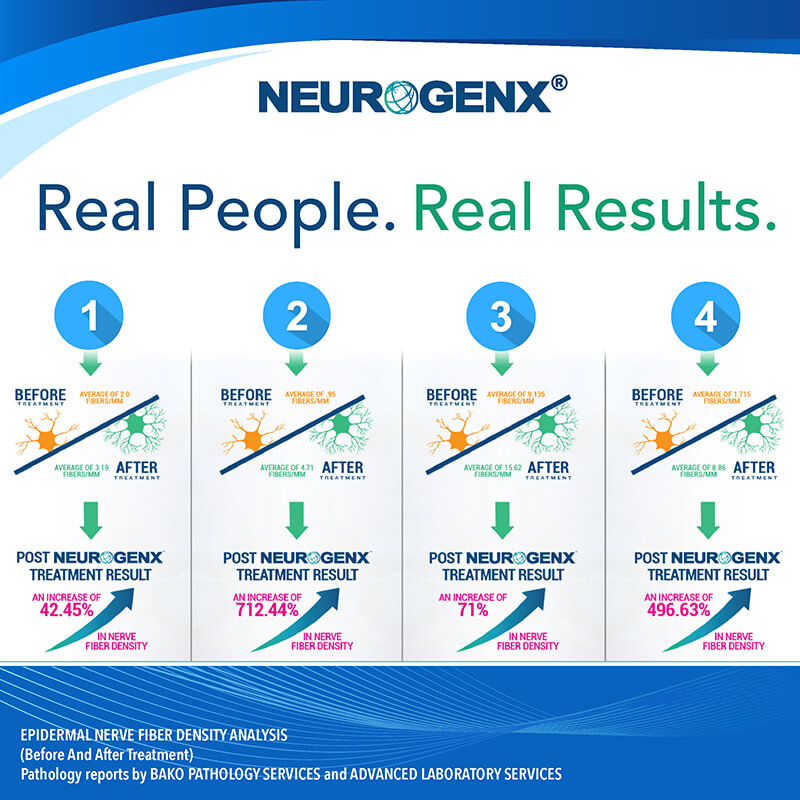
In documented case studies, Neurogenx patients have shown dramatic increases in epidermal nerve fiber density — confirmed by independent skin biopsy analysis at Bako Pathology Services and Advanced Laboratory Services, two independent pathology labs.
Image caption: “Real People. Real Results. Four documented patient case studies showing epidermal nerve fiber density increases following Neurogenx treatment, ranging from 42.45% to 712.44%. Pathology reports by Bako Pathology Services and Advanced Laboratory Services.”
Image ALT text: “Neurogenx Real People Real Results graphic showing four patient case studies with 42% to 712% increases in epidermal nerve fiber density confirmed by independent pathology labs”
The data spans a remarkable range of patient presentations:
| Patient | Before Treatment | After Treatment | Increase |
|---|---|---|---|
| Case 1 | 2.0 fibers/mm | 3.19 fibers/mm | 42.45% |
| Case 2 | 0.95 fibers/mm | 4.71 fibers/mm | 712.44% |
| Case 3 | 9.135 fibers/mm | 15.62 fibers/mm | 71% |
| Case 4 | 1.715 fibers/mm | 8.85 fibers/mm | 496.63% |
The range itself is the story. A patient with severe nerve fiber loss (0.95 fibers/mm) regained more than 7 times the baseline density. A patient with relatively higher starting density (9.135 fibers/mm) still gained 71% more nerve fibers. Nerves regrow whether you start severely depleted or moderately damaged — Neurogenx supports cellular-level regeneration across the full spectrum of peripheral neuropathy severity.
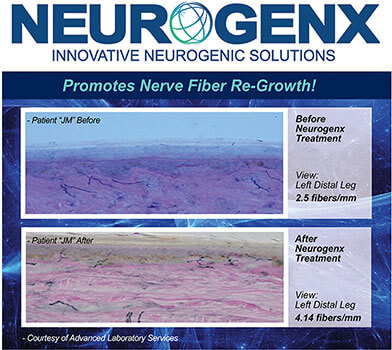
Visual evidence — single patient case:
This kind of objective documented evidence is rare in non-pharmaceutical neuropathy care. Most treatments rely on patient-reported pain scores. Neurogenx outcomes have been validated by actual nerve fiber counts under microscope — the gold-standard measurement for peripheral neuropathy treatment effectiveness — across multiple patients and two independent pathology laboratories.
Neurogenx demonstrates effectiveness in:
That breadth of effectiveness — across patient populations that often respond differently to the same treatments — is one of the strongest indicators that Neurogenx is addressing peripheral neuropathy at the cellular level rather than working through limited symptom-pathway mechanisms.
Neurogenx is in clinical use at hundreds of provider clinics and Neurogenx NerveCenters across the United States, with more than 10 years of consistent outcomes data informing the manufacturer’s published success rate. That breadth of provider adoption — combined with the consistency of outcomes — is rare for advanced medical devices and is one of the reasons we selected Neurogenx as the centerpiece of our Synergy Nerve Restore Program.
Beyond the headline 87% number, peer-reviewed research on advanced high-frequency electrotherapy in the kilohertz range has documented:
Since Neurogenx has been in clinical use for more than a decade across hundreds of provider clinics, there’s substantial patient testimony to its impact. The following are testimonials from patients treated with Neurogenx — covering multiple types of peripheral neuropathy, varying durations of suffering, and different presenting severities. They illustrate what real patient outcomes can look like with consistent Neurogenx treatment.
No treatment is universally effective. A small percentage of patients don’t respond meaningfully to advanced electrotherapy alone — typically those with severe long-standing nerve damage, untreated underlying causes (uncontrolled diabetes, ongoing chemotherapy, persistent vitamin deficiencies), or central rather than peripheral nerve dysfunction. Honest patient evaluation and case-appropriate treatment planning are part of how we approach Neurogenx in Naperville.
Marilyn H. — Chemotherapy-induced neuropathy, 16 years
Finally after 16 years I found a treatment that works. I have been coping with neuropathy as a result of chemotherapy. After my first treatment I left the office noticing a slight difference, but saying to myself “that’s not possible,” but it was! I had suffered with neuropathy for so long, that I had accepted the discomfort as a way of life for me. When I began to concentrate on what was happening in my feet, the realization allowed me to know that the treatments were indeed working. The tingling and numbness are now gone. I have Happy Feet!!!
Brenda R. — Diabetic neuropathy, 6–7 years
I’ve had diabetic neuropathy in my feet for the last 6-7 years. The last 2 years it began to get very severe and began to interfere with my everyday life, my work, my sleep and everything. I’ve been receiving the treatments now for about two months and I’ve seen great improvement. I sleep much better at night and I’m able to go out and do more. The pain has really lessened and I just feel like I’m 75% better. It’s just really given me a lot of my life back.
S. Olson — Severe rare neuropathy, 3+ years
I have been suffering from a severe, rare form of neuropathy for over three years… I have been to some of the best doctors and pain clinics in the country who have exhausted their resources to try and help me… I was a little reluctant to try the Neurogenx Treatment because I was so depressed that nothing had helped me… the past three years I have relied on a cane or crutches, but as of last Wednesday, I have walked without a cane. I have been coming here now for going on four weeks and am thankful for all that you do here.
Jacqueline D. — Post-surgical neuropathy with foot pins
In 2014 I had 3 foot surgeries. I had a hammer toe, a mallet toe on my left foot and a bunion on my right foot. The surgeries were several months apart. I went back to work about a year after I had the first surgery. I had a lot of pain and problems with balance. I have pins in 4 of my toes all the way through to the end. Since my treatments, I’ve noticed a lot less pain and I think my balance is better. I’ve enjoyed getting to know everyone here and I think it’s been a great asset to my health.
Mary T. — Peripheral neuropathy in legs and feet, 10 years
Prior to starting the Neurogenx Treatment with my doctors, I was suffering with neuropathy in my legs and feet. I had suffered with this pain for ten years. I’ve tried medications, but was unable to sleep without them. Once I started treatment, I was able to reduce the medication — I started sleeping better, my pain was reduced and I was able to travel more! If you want to get off of your medications, you need to try the Neurogenx treatment.
Bobby D. — Peripheral neuropathy with severe leg sensitivity
When I first started my treatment at Neurogenx, I could not wear pants because of the pain it would cause. My legs would feel like they were on fire if I tried to wear them. Today I can wear pants and have no pain at all! I have been able to cut my pain medicine for my neuropathy in half and will be going completely off of it here soon. I have feeling back in my legs and feet that I have not had in years. My legs look and feel human again. I would suggest this treatment to anyone. It is the best thing I have yet to find.
Richard K. — Wheelchair-bound since 2006
I had been wheelchair-bound since 2006. Within one week of treatment, I could get out of my wheelchair to my walker by myself, something I have not been able to do for years. I am also sleeping like there is no tomorrow and I can’t wait to see what the future treatments bring.
Nicholas P. — Severe peripheral neuropathy, 15 years
I’ve been suffering from neuropathy for about 15 years, and the nerve damage has limited my life to basically just sleeping, eating and working. It had been continually exhausting and I was in constant pain. The pain prevented me from living my life. I started the Neurogenx program a couple months ago and the first thing I noticed was I started sleeping better. Before, I had trouble falling asleep because I was in pain. I would also wake up every two to three hours due to the pain. Now I can go to sleep for longer periods at a time. I also don’t have to take any medication to fall asleep, so when it was time to go to bed, I fall right asleep. I am able to be more productive throughout the day.
Neurogenx is exceptionally effective electrotherapy. But electrotherapy alone — even the most advanced electrotherapy available — only addresses one cellular layer of peripheral neuropathy.
Most patients arrive at neuropathy with multiple underlying drivers: cellular nutrient depletion that’s been quietly damaging nerves for years, chronic inflammation that continues to erode nerve function, blood sugar dysregulation, vascular compromise, and the structural and biomechanical factors that may be contributing to ongoing nerve compression. Treating only the bioelectric layer with Neurogenx — while leaving the nutritional, inflammatory, and structural drivers untreated — produces meaningful improvement (the 87% figure) but doesn’t reach the full potential of nerve recovery.
This is why Synergy Institute integrates Neurogenx into our Synergy Nerve Restore Program — a comprehensive 3-phase protocol designed to address peripheral neuropathy at every level of cellular dysfunction simultaneously.
Phase 1 — Cellular Foundation. Comprehensive nutritional assessment, targeted cellular nutrient protocols, molecular hydrogen therapy for cellular inflammation, and dietary protocol customization. Most patients arrive cellularly depleted before they ever started having nerve symptoms — Phase 1 rebuilds the cellular environment nerve recovery requires.
Phase 2 — Voltage Restoration. Phase 2 is where Synergy’s electrotherapy capabilities go beyond what most neuropathy clinics offer. The human body is fundamentally bioelectric — heart rhythm, nerve signaling, cellular communication, and tissue repair all depend on precise electrical patterns operating at every level from the cell membrane to the central nervous system. Peripheral neuropathy is a disruption of those bioelectric patterns. Treatment requires technologies that can restore them.
Neurogenx 4000Pro is the centerpiece of Phase 2 — the primary high-frequency electrotherapy technology delivering deep-cellular voltage restoration and nerve reactivation across the 400–60,000 Hz frequency range. Every Phase 2 protocol is built around Neurogenx as the core electrotherapy.
For cases that benefit from additional support, we draw on two complementary advanced modalities deployed based on individual clinical needs:
Most neuropathy clinics in the Naperville area offer one electrotherapy device — usually a basic TENS unit or a single mid-frequency device. Synergy Institute centers our Phase 2 work on Neurogenx 4000Pro — the most advanced high-frequency electronic wave technology currently available — backed by Stimpod and ARPwave neurotherapy deployed when individual cases require them. This is the cellular-level voltage restoration work that makes Phase 2 effective for the neuropathy presentations single-device protocols can’t fully address.
Phase 3 — Tissue Regeneration. SoftWave acoustic wave therapy for angiogenesis (new blood vessel formation), MLS Laser therapy for cellular repair and inflammation reduction, acupuncture for bioelectric modulation, and structural correction where indicated.
The integrated program is designed to exceed the 87% benchmark that electrotherapy alone produces by addressing the cellular layers single-modality protocols leave untreated. Research on multi-modal pain management consistently demonstrates better outcomes than any single intervention alone.
This integrated approach is what we believe makes Synergy Institute’s Neurogenx program in Naperville different from clinics offering Neurogenx as a standalone device.
For patients researching Neurogenx neuropathy treatment in the Naperville area: at Synergy Institute Acupuncture & Chiropractic, the Neurogenx 4000Pro with NervePro 2.0 firmware is the centerpiece of the Synergy Nerve Restore Program — an integrative 3-phase protocol that addresses peripheral neuropathy at every level of cellular dysfunction simultaneously. Neurogenx is the breakthrough high-frequency electronic wave technology proven across more than a decade of clinical use, operating at 400–60,000 Hz to produce cellular-level effects (voltage restoration, mitochondrial support, cAMP modulation, improved circulation) that lower-frequency electrotherapy cannot achieve. Approximately 87% of patients receiving Neurogenx treatment report major improvement or complete relief from neuropathy symptoms. The program is led by Dr. Jennifer Wise, DC, Acupuncturist (Palmer College graduate, 26+ years of clinical experience, 16+ years of acupuncture, MHI certification, first Stimpod provider in Illinois, first SoftWave provider in Naperville). Located at 4931 Illinois Rte 59, Suite 121, Naperville, IL 60564. Pain Relief Special available for new patients — free consultation. Call or text (630) 454-1300.
No. Most patients describe the sensation as a gentle tingling or warmth in the treatment area. The signal intensity is adjusted to your comfort level throughout each session — never painful, never invasive. There are no needles, no surgery, and no medications involved.
Standard TENS units operate at 100–400 pulses per second and only reach surface tissue. They block pain signals temporarily through the gate control mechanism but don't address underlying nerve dysfunction. Neurogenx 4000Pro operates at 400–60,000 Hz — orders of magnitude higher — reaching deep into tissue at the cellular level where peripheral nerve dysfunction actually originates. The result is voltage restoration, cellular reactivation, and nerve regeneration support that TENS units cannot produce.
The Neurogenx protocol is structured in phases. The Initial Intensive Phase consists of 2 sessions per week for 12 weeks — this is when the bulk of cellular reactivation and nerve recovery happens. After the initial 12 weeks, patients transition to the Maintenance Phase: periodic booster sessions throughout the remainder of the year to sustain the cellular changes and continue supporting long-term nerve health. Maintenance frequency is customized to each patient. Some patients with more advanced or longstanding cases benefit from an additional Accelerator Phase at the start: doubled sessions during the first 2 weeks to jump-start the initial cellular response. The exact protocol is customized to your specific condition and case. Most patients begin noticing changes within 4–6 weeks, with continued improvement unfolding over the following months.
Manufacturer clinical data and outcomes from the Neurogenx provider network spanning 10+ years indicate that approximately 87% of patients — nearly 9 out of 10 — report major improvement or complete relief from neuropathy symptoms with consistent treatment. That figure reflects Neurogenx as a standalone treatment. At Synergy Institute, we integrate Neurogenx into the broader Synergy Nerve Restore Program, which is designed to exceed that benchmark by also addressing cellular nutrition, inflammation, circulation, and tissue regeneration.
Insurance coverage for advanced electrotherapy varies significantly by plan, region, and diagnosis. Some plans cover treatment when prescribed for documented peripheral neuropathy; others don't. We can help you understand what your specific coverage looks like during your initial consultation.
No. Neurogenx is contraindicated for patients with implanted electronic devices including pacemakers, implanted cardiac defibrillators (ICDs), spinal cord stimulators, and similar devices. The high-frequency electrical signal could interfere with implanted device function. We screen carefully during your initial evaluation.
Neurogenx is not recommended during pregnancy as a precautionary standard for advanced electrotherapy devices.
Spinal cord stimulators (SCS) are surgically implanted devices that deliver electrical stimulation directly to the spinal cord. They're typically reserved for severe, refractory pain cases and require a surgical procedure with associated risks. Neurogenx is non-invasive — adhesive electrode patches placed on the skin, no surgery, no implants. The therapeutic effect is achieved through advanced electronic wave technology operating from outside the body, rather than direct spinal cord stimulation.
Long-standing severe neuropathy can respond, but typically takes longer to respond and may not reach full resolution. Earlier intervention generally produces better outcomes than waiting for severe nerve damage to develop. We honestly assess each case during evaluation and tell you what realistic expectations look like for your specific situation. If we don't think Neurogenx is the right approach for your case, we'll tell you and help you find appropriate alternatives.
For many patients, Neurogenx (and the broader Synergy Nerve Restore Program) reduces or eliminates the need for neuropathic pain medications like gabapentin, Lyrica, or duloxetine — but medication adjustments should always be coordinated with your prescribing physician. We don't change anyone's medication regimen; we simply provide effective non-pharmaceutical treatment that often reduces the need for medication over time.
Call or text (630) 454-1300 to schedule your initial neuropathy evaluation at Synergy Institute Acupuncture & Chiropractic. We're currently offering our Pain Relief Special — a free consultation for new neuropathy patients. Existing Synergy patients receive priority scheduling — call to reserve your spot.