Non-Surgical Shoulder Pain Treatment in Naperville IL
Rotator Cuff Tears • Frozen Shoulder • Impingement • Arthritis • Post-Surgical Pain

Shoulder Pain Treatments Naperville – If you’re searching for non-surgical shoulder pain treatment in Naperville, you’ve likely already tried the standard sequence — ibuprofen, ice, rest, maybe physical therapy or a cortisone injection — and the pain still isn’t gone. Reaching overhead, sleeping on that side, putting on a jacket, fastening a seatbelt: each one has become a calculated maneuver. You’re tired of being told to wait it out or push through.
That’s exactly the patient population Synergy Institute Acupuncture & Chiropractic was built to serve.
I’m Dr. Jennifer Wise, DC, Acupuncturist, owner of Synergy Institute in Naperville. For 26+ years — since 2000 — I’ve been treating shoulder pain as both a Doctor of Chiropractic (Palmer College graduate) and a Diplomate-credentialed Acupuncturist, and as the first provider in Naperville to offer SoftWave therapy since August 2021.
Synergy Institute Acupuncture & Chiropractic is a shoulder pain treatment clinic located in Naperville, Illinois. We offer a complete non-surgical shoulder care system through the Synergy Shoulder Restore Program — a three-phase protocol combining SoftWave therapy, MLS laser therapy, acupuncture, chiropractic care, and ARPwave neuromuscular therapy — designed to address tissue healing, joint mechanics, and the underlying causes that produced your shoulder pain in the first place.
What separates this clinic from every other shoulder pain practice in Naperville is sequencing — applying the right tools, in the right order, calibrated to the specific cause of your pain. For a complete overview of treatment options, see our Best Treatments for Shoulder Pain in Naperville hub.
Our office sits on Illinois Route 59 near the 111th Street intersection in Naperville, serving patients throughout Naperville, Aurora, Plainfield, Bolingbrook, and Oswego. Call or text (630) 454-1300 — or call our office directly at (630) 355-8022— to schedule a free Pain Relief Special consultation.
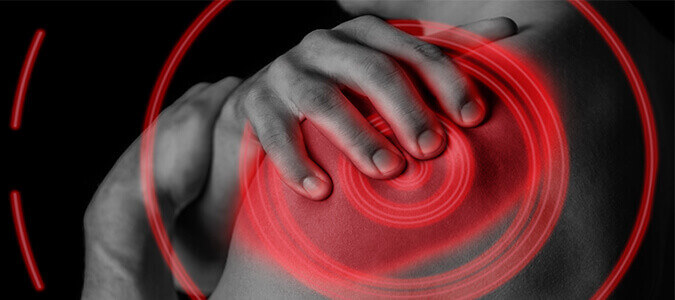
Shoulder pain is rarely one problem — and the right treatment depends entirely on the right diagnosis. At Synergy Institute, we evaluate and treat the full range of shoulder conditions through integrative non-surgical care.
Rotator Cuff Tears and Tendinopathy — partial tears, tendinosis, calcific tendonitis, and many small full-thickness tears respond well to regenerative care. SoftWave therapy and MLS laser address the actual degenerative tissue process rather than just masking pain. For a complete breakdown of tear types and what treatment matches each, see our Best Treatments for Rotator Cuff Tears hub.
Frozen Shoulder (Adhesive Capsulitis) — stage-based treatment is critical. Aggressive stretching during the freezing stage makes it worse. Our protocol calibrates treatment to which stage you’re in (freezing, frozen, or thawing). Most patients see meaningful improvement in 6 to 12 weeks rather than the natural 1- to 3-year timeline. See our Best Treatments for Frozen Shoulder hub for the complete framework.
Shoulder Impingement — usually a posture and biomechanics problem dressed up as a tendon problem. Forward head posture and rounded shoulders narrow the subacromial space and compress the rotator cuff every time you raise your arm. Treatment that ignores the kinetic chain gets nowhere.
Labral Tears (SLAP Lesions) — candidacy matters. Asymptomatic labral findings on MRI are common and don’t require treatment. Symptomatic SLAP tears with mechanical catching may respond to integrative care; some genuinely need surgical evaluation.
Biceps Tendinitis — often coexists with rotator cuff problems. Up to 76% of rotator cuff tears overlap with biceps tendinopathy, which is why we evaluate both together.
Shoulder Bursitis — almost always downstream of an underlying rotator cuff or impingement problem. Treating the bursa without addressing the cause produces only temporary relief.
Shoulder Arthritis — mild to moderate cases respond to MLS laser, acupuncture, and joint decompression. Severe end-stage arthritis with bone-on-bone changes may require shoulder replacement evaluation.
Post-Surgical Shoulder Pain — patients who had rotator cuff repair, labral repair, or shoulder replacement and still have residual pain often respond to SoftWave, MLS laser, and ARPwave neuromuscular therapy.
Here’s something most patients with shoulder pain are never told: a significant percentage of “shoulder pain” is actually neck pain in disguise.
If both of your shoulders hurt — bilateral shoulder pain — the source is almost always cervical, not the shoulder joints themselves. True bilateral rotator cuff tears or true bilateral frozen shoulder happening simultaneously is statistically rare. When both shoulders are involved, it’s usually nerve referral from the cervical spine, upper thoracic dysfunction, or trigger points referring pain into the shoulder region.
Even unilateral shoulder pain can be cervical in origin. Cervical disc problems and pinched nerves at C5, C6, C7, and C8 produce specific shoulder and arm pain patterns that mimic rotator cuff problems. Patients often dismiss this possibility because their neck doesn’t hurt — but cervical referred pain frequently happens without any neck symptoms at all. The pain shows up downstream, in the shoulder.
This is why so many patients have “treatment-resistant shoulder pain” that hasn’t responded to PT, cortisone, or even surgery. The shoulder isn’t actually the problem.
At Synergy Institute, every shoulder evaluation includes a cervical spine and upper thoracic assessment. As both a Doctor of Chiropractic and Acupuncturist, Dr. Wise evaluates referred pain patterns, nerve root involvement, and biomechanical drivers from the neck — components that are commonly missed when shoulder pain is treated as an isolated joint problem. If your shoulder pain is actually a neck problem, identifying that is the first step in actually getting better. For more on cervical spine treatment, see our Neck Pain treatment page.
Standard shoulder care fails so often because chiropractic adjustments are performed before tissue heals, or laser is applied without addressing the kinetic chain, or acupuncture is offered without any mechanical correction. Each piece can help. None of them, alone, fixes the problem. The sequence matters as much as the treatments themselves.
The Synergy Shoulder Restore Program is our three-phase protocol that addresses tissue healing, joint mechanics, and movement re-education in the right order.
Phase 1 — Tissue Healing and Inflammation Modulation. This phase establishes the regenerative foundation. SoftWave therapy with the TRT OrthoGold 100 device delivers true electrohydraulic shockwaves that recruit mesenchymal stem cells and stimulate angiogenesis directly in damaged tendons, capsules, and ligaments. MLS laser therapy runs alongside to reduce the chronic inflammatory environment. Acupuncture and electroacupuncture modulate pain signals while the tissue rebuilds. We also investigate underlying contributors — medications affecting tendon health, nutritional status, metabolic factors, and chronic mechanical stressors. Most patients spend 4 to 6 weeks in Phase 1.
Phase 2 — Joint Mechanics and Alignment Correction. Once tissue has begun healing, we address the mechanical drivers — cervical spine alignment, thoracic mobility, scapular positioning, and shoulder joint mechanics. Chiropractic adjustments and targeted mobilization happen here, not before. Adjusting a shoulder while the underlying tissue is still inflamed creates compensation patterns that don’t hold. This is why so many shoulders “feel better for a few days” after standard chiropractic and then return to baseline.
Phase 3 — Neuromuscular Re-education and Long-Term Function. The shoulder mechanics and movement patterns that produced your injury haven’t disappeared just because the tendon has healed. ARPwave neuromuscular therapy retrains proper rotator cuff and scapular firing patterns. The Matrix Scanner gait analysis identifies any residual compensation patterns. This phase is what makes the results durable.
The Synergy Shoulder Restore Program is the only sequenced shoulder protocol in Naperville that integrates regenerative therapy, mechanical correction, and movement re-education into a single coordinated system.
We’ll tell you the truth about candidacy upfront.
You are likely a good candidate if you have rotator cuff tendinopathy or partial tear that hasn’t responded to PT or cortisone, frozen shoulder in any stage, shoulder impingement driven by posture and mechanics, chronic shoulder pain that imaging hasn’t fully explained, post-surgical shoulder pain that hasn’t resolved, biceps tendinitis or bursitis, mild to moderate shoulder arthritis, or shoulder pain combined with cervical spine dysfunction.
You are likely not a candidate for non-surgical care alone if you have a complete full-thickness rotator cuff tear with significant retraction, recurrent shoulder dislocations from a Bankart lesion, severe end-stage glenohumeral arthritis with bone-on-bone changes, or an active shoulder infection. We will tell you directly if surgery is the right path for your case, and we have surgeon referrals we trust.
Approximately 15 to 25% of patients we evaluate are referred elsewhere — to a surgeon, to specific imaging, or to a different specialist — because conservative integrative care isn’t the right answer for them. That’s not a failure. It’s the integrity that makes our approach work for everyone else.
Most shoulder pain is musculoskeletal and not urgent. But certain presentations require immediate evaluation, not a chiropractic visit.
🚨 Call 911 or go to the emergency room if you experience: sudden severe shoulder pain with chest pain, jaw pain, or shortness of breath (possible cardiac event); shoulder pain after significant trauma with visible deformity; complete loss of arm function or sudden severe weakness; numbness or tingling extending down the entire arm; signs of shoulder dislocation; or fever and severe shoulder pain (possible joint infection).
For non-emergent shoulder pain that’s been worsening, lasted more than 6 weeks, or hasn’t responded to conservative care — that’s exactly the patient population our integrative approach was designed for.
For comprehensive shoulder evaluation across the entire treatment spectrum — chiropractic, acupuncture, MLS, decompression where indicated, and SoftWave — our Pain Relief Special is a free initial consultation to determine which protocol fits your case.
For patients specifically interested in starting with SoftWave therapy, our $49 Discovery Session includes a full evaluation, review of your imaging and history, and your first SoftWave treatment so you can experience the technology.
Most insurance plans cover chiropractic and acupuncture services. SoftWave is generally not covered by insurance but is significantly less expensive than surgery and post-surgical recovery time. We verify benefits at your initial consultation and offer transparent payment plans for non-covered services. HSA and FSA funds can be used for most treatments. Call or text (630) 454-1300 for current pricing options, or call our office directly at (630) 355-8022.
If you’ve been managing shoulder pain for weeks or months — and standard care hasn’t moved the needle — there’s a reason. Generic shoulder treatment fails because it doesn’t differentiate between rotator cuff, frozen shoulder, impingement, labral, cervical-driven, and arthritic shoulder problems. The Synergy Shoulder Restore Program does.
Synergy Institute Acupuncture & Chiropractic is a shoulder pain treatment clinic located in Naperville, Illinois at 4931 Illinois Rte 59, Suite 121, near the 111th Street intersection. We serve patients throughout Naperville, Aurora, Plainfield, Bolingbrook, and Oswego.
Schedule your free Pain Relief Special consultation today. Call or text (630) 454-1300, or call our office directly at (630) 355-8022.
Yes — bilateral shoulder pain is almost always cervical in origin. True bilateral rotator cuff tears or true bilateral frozen shoulder happening simultaneously is statistically rare. When both shoulders hurt at the same time, the source is usually cervical disc problems, pinched nerves at C5 through C8, upper thoracic dysfunction, or trigger points referring pain into the shoulder region. Many patients dismiss this possibility because their neck doesn't hurt — but cervical referred pain frequently happens without any neck symptoms at all. A complete shoulder evaluation must include cervical spine and upper thoracic assessment.
Yes, the majority of shoulder pain cases can resolve without surgery when the underlying cause is correctly identified and treated in the right sequence. Rotator cuff tendinopathy and partial tears, frozen shoulder in any stage, impingement, biceps tendinitis, bursitis, and most arthritis cases respond well to integrative non-surgical care. Surgery is genuinely indicated for complete full-thickness retracted tears in active patients, recurrent shoulder dislocations, and severe end-stage arthritis. We evaluate honestly and refer to surgeons when surgery is the right answer.
The two most reliable warning signs of a rotator cuff tear are persistent pain at night when lying on the affected shoulder, and weakness when lifting your arm overhead or out to the side. A third common sign is deep aching pain that may radiate down the upper arm with overhead reaching. Not every rotator cuff problem requires surgery — many partial tears and tendinopathy cases respond well to non-surgical regenerative care including SoftWave therapy.
Most patients see meaningful improvement within 4 to 8 weeks of beginning the Synergy Shoulder Restore Program. Rotator cuff tendinopathy typically resolves over 6 to 12 weeks. Frozen shoulder is condition-stage dependent — early-stage cases often resolve in 6 to 8 weeks, while frozen-stage cases may require 12 to 16 weeks. Chronic conditions present for over a year typically need a longer treatment arc. We reassess every 4 to 6 visits and adjust the protocol based on response.
A surgical consultation is appropriate for complete full-thickness rotator cuff tears with significant retraction in active patients, recurrent shoulder dislocations from a Bankart lesion, severe glenohumeral arthritis with bone-on-bone changes and failed conservative care, acute traumatic injuries with visible deformity or significant functional loss, and chronic shoulder pain that has not responded to a complete trial of integrative non-surgical care over 12 or more weeks. We work with trusted orthopedic surgeons and refer when surgery is genuinely indicated.
Coverage varies by plan and treatment type. Chiropractic services are covered by most insurance plans. Acupuncture coverage has expanded — many plans now cover acupuncture for musculoskeletal pain. SoftWave therapy is typically not covered by insurance, similar to most regenerative therapies, but is significantly less expensive than surgery and post-surgical recovery costs. We verify benefits at your initial consultation and offer transparent payment plans for non-covered services. HSA and FSA funds can be used for most treatments.