
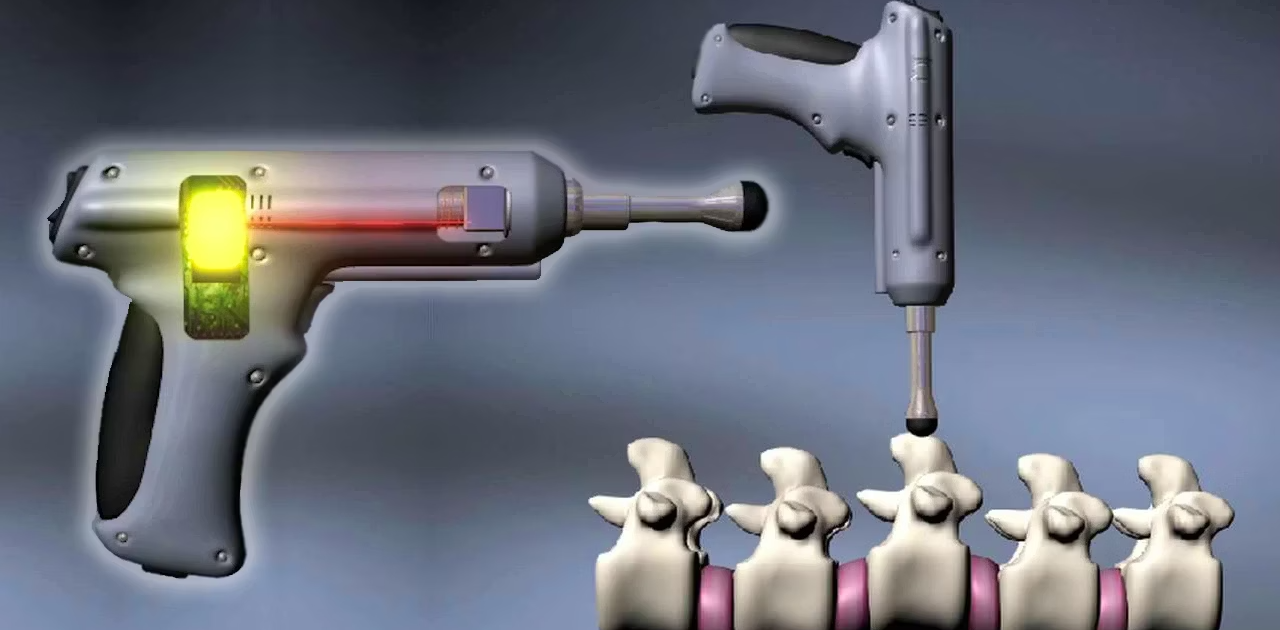
Gentle Chiropractic Without Twisting, Popping, or Cracking in Naperville
You’ve been putting off seeing a chiropractor. Maybe for months. Maybe for years.
It’s not that you don’t think it could help — you know your back hurts, your neck is stiff, and something isn’t right. But every time you picture a chiropractic adjustment, you imagine someone twisting your neck until it pops, or pressing down on your spine until it cracks. And that image alone is enough to keep you scrolling past every chiropractic care clinic in Naperville.
I hear this from patients every week. And I want you to know something: you’re not being dramatic. Your concern is completely valid — and you have options you probably don’t know about.
I’m Dr. Jennifer Wise, a Doctor of Chiropractic and Acupuncturist with over 26 years of experience and a graduate of Palmer College of Chiropractic. At Synergy Institute in Naperville, I use four different adjustment techniques — some involve the traditional “crack,” and some don’t involve any twisting, popping, or cracking at all. The technique I choose depends entirely on what your spine actually needs, not on a one-size-fits-all protocol.
This article explains what that cracking sound really is, why you don’t always need it, and how gentle chiropractic techniques — including computer-guided instruments — can deliver effective results without a single pop.
Quick Facts: Gentle Chiropractic at Synergy Institute
| What You Should Know | The Details |
|---|---|
| Doctor | Dr. Jennifer Wise, DC, Acupuncturist |
| Education | Palmer College of Chiropractic |
| Experience | 26+ years |
| Gentle technique available? | Yes — Impulse iQ Adjuster (FDA-registered, computer-guided) |
| Manual techniques also available? | Yes — Gonstead, Diversified, Thompson Drop Table |
| On-site digital x-ray? | Yes — imaging drives technique selection |
| How technique is chosen | Based on x-ray findings, exam, and clinical judgment — not patient preference alone |
| Same-day treatment? | Yes, when clinically appropriate |
| Insurance accepted? | Yes — most major plans |
| Phone | Call or text (630) 454-1300 · Office (630) 355-8022 |
What That Cracking Sound Actually Is
Let’s start with the elephant in the room: the crack.
That popping sound you hear during a traditional chiropractic adjustment isn’t bone breaking. It isn’t cartilage tearing. And it isn’t anything being forced out of place.
The technical term is cavitation — and here’s what’s actually happening. Your joints are surrounded by a capsule filled with synovial fluid, which acts as a lubricant. That fluid contains dissolved gases — mostly carbon dioxide and nitrogen. When a chiropractor applies a quick, controlled thrust to a joint, the capsule stretches slightly and the pressure inside drops. That sudden pressure change causes those dissolved gases to form tiny bubbles that rapidly collapse.
That’s the pop. It’s a gas release. Nothing more.
Research published in PLOS ONE has confirmed this mechanism — it’s the same process that occurs when you crack your knuckles. The sound doesn’t mean the adjustment “worked,” and the absence of sound doesn’t mean it failed. It’s simply a byproduct of one particular type of joint manipulation.
So why do some people love it and others dread it?
For many patients, it’s the twisting and positioning that bothers them more than the noise. Traditional high-velocity, low-amplitude (HVLA) adjustments often require the chiropractor to rotate your neck or position your body in specific ways before delivering the thrust. For patients with disc problems, osteoporosis, or simply a healthy respect for their spine, that positioning can feel uncomfortable — or just plain scary.
Here’s what I tell my patients: the crack isn’t the goal. Restoring proper joint motion is the goal. And there’s more than one way to get there.
Why Some Patients Prefer No Twisting, Popping, or Cracking
If you’d rather skip the crack, you’re in good company. And it’s not just about preference — there are solid clinical reasons why gentle chiropractic techniques are sometimes the better choice.
Fear or anxiety about chiropractic. This is the most common reason, and it’s nothing to be embarrassed about. If anxiety prevents you from getting treatment you need, the anxiety itself becomes a barrier to healing. A gentle approach removes that barrier entirely.
Prior bad experience. Some patients had a rough adjustment elsewhere — too much force, no explanation, or a reaction that left them sore for days. That experience doesn’t have to define chiropractic for you.
Disc herniations or bulging discs. When disc material is compromised, aggressive rotational forces can make things worse. Instrument-assisted adjustments deliver precise force without the twisting that can irritate damaged discs.
Osteoporosis or low bone density. Bones that have lost density require a more measured approach. The Impulse iQ Adjuster has adjustable force settings — the lowest setting is lighter than any spring-loaded device on the market.
Age. Children, elderly patients, and anyone with fragile or compromised structures often respond better to instrument-assisted techniques.
Acute pain or inflammation. When you’re in severe pain, the last thing you want is aggressive positioning. Gentle adjustments can be performed in a neutral, face-down position without moving you into painful postures.
Post-surgical spine. Patients with previous spinal surgery have altered anatomy that requires precise, controlled force — not broad rotational maneuvers.
The point isn’t that manual adjustments are bad. They’re not — they’re effective, well-researched, and I use them daily. The point is that you should never avoid chiropractic care entirely because you’re afraid of one technique when alternatives exist.
Gentle Chiropractic Techniques That Don’t Crack
Not all chiropractic adjustments are created equal. Here’s how the approaches I use at Synergy compare:
| Technique | Type | Cracking/Popping? | How It Works | Best For |
|---|---|---|---|---|
| Gonstead | Manual | Yes | Precise, specific thrust based on x-ray analysis | Targeted misalignments identified on imaging |
| Diversified (Palmer) | Manual | Yes | Classic chiropractic thrust to restore joint motion | General spinal restrictions, healthy spines |
| Thompson Drop Table | Table-assisted | Minimal to none | Segmented table drops when force is applied — gravity assists the adjustment | Pelvic alignment, patients needing less force |
| Impulse iQ Adjuster | Instrument (computer-guided) | None | FDA-registered device delivers controlled impulses while monitoring spine’s response in real time | Disc conditions, osteoporosis, elderly, children, anxious patients, acute pain |
Here’s what matters: I don’t choose a technique based on what’s fastest or easiest. I choose based on what your x-rays show, what your exam reveals, and what will get the best result with the least risk for your specific situation.
And yes — I frequently use more than one technique in the same visit. I might manually adjust your lumbar spine where you have a straightforward restriction, then use the iQ on your cervical spine where imaging shows disc thinning. Every region of your spine may need a different approach.
The Impulse iQ Adjuster: Beyond Basic Instrument Adjusting
If you’ve heard of instrument-assisted chiropractic, you’ve probably heard of the Activator — a small, spring-loaded tool that’s been around for decades. It’s a solid instrument, and plenty of chiropractors use it effectively. The Impulse iQ is a different animal entirely.
Developed by Dr. Christopher Colloca, a biomechanist who has published extensively in peer-reviewed journals, the iQ is an FDA-registered, computer-guided instrument with technology that no spring-loaded device can match:
Auto-Sense Technology (patented). The iQ contains an embedded accelerometer — a motion sensor — that measures how your spine responds during each impulse. As the joint becomes more mobile and your muscles relax, the instrument automatically adjusts its pulse rate in real time to match your spine’s changing motion pattern. When maximum mobility is achieved, it stops firing on its own. No other adjusting instrument does this.
Controlled, measurable force. Three precise force settings allow me to match the force to the patient and the region. The low setting is lighter than any spring-loaded device — ideal for upper cervical spine, children, and fragile patients. The high setting delivers force comparable to a manual lumbar adjustment, but through a tiny contact point rather than body weight.
Research-validated results. A study published in the Journal of Manipulative and Physiological Therapeutics found that the Impulse instrument produced nearly three times greater vertebral motion than the Activator during chiropractic adjustments. A separate systematic review of eight clinical trials found that instrument-assisted adjustments provided comparable clinical benefits to manual adjustments for spinal pain and TMJ dysfunction.
What patients feel: A light tapping sensation. No popping. No twisting. No cracking. No repositioning — you stay face-down in a comfortable, neutral position the entire time. Most patients are genuinely surprised at how gentle and quick the process is.
How I Decide Which Technique You Need
This is where most “gentle chiropractic” articles stop. They tell you gentle options exist, but never explain when or why a doctor would choose one over the other. Here’s my actual process:
Step 1: Your history. Before I touch your spine, I want to know what brought you here, what you’ve already tried, and what your concerns are. If you tell me you’re terrified of cracking, that’s important clinical information — because anxiety and muscle guarding can actually make traditional adjustments less effective.
Step 2: Imaging. I review existing imaging you bring in or take digital x-rays on-site when clinically indicated. X-rays show me alignment patterns, disc spacing, degeneration, structural anomalies, and bone density clues. What I see on imaging directly influences my technique selection.
Step 3: Physical examination. Range of motion testing, palpation, orthopedic and neurological screening pinpoint where the dysfunction is and how severe it is.
Step 4: Technique selection. Based on everything above — not based on what I prefer, what’s fastest, or what you saw on a YouTube video — I select the technique or combination of techniques that gives you the best chance at a good outcome.
Here’s what that looks like in practice:
- Healthy spine, straightforward restriction? Manual adjustment is often the most efficient choice.
- Disc herniation with nerve compression? iQ on that segment — precise force without rotational stress.
- Elderly patient with osteoporosis? iQ on low setting, possibly combined with Thompson drop table.
- Young athlete with acute muscle spasm? Start with iQ to reduce guarding, then follow with manual once the area loosens.
- Patient who’s avoided chiropractic for years due to fear? Start gentle. Build trust. Adjust the approach as comfort grows.
The key point: I don’t let one tool define my practice. I match the tool to the problem. That’s something clinics that only offer one technique can’t do.
Conditions That Respond Well to Gentle Adjustments
Gentle chiropractic — particularly instrument-assisted adjustments — isn’t just a comfort preference. For certain conditions, it’s the clinically superior choice:
Disc herniations and bulging discs. Damaged discs don’t respond well to rotational forces. The iQ delivers linear impulses along a specific line of drive without rotating the joint. Combined with spinal decompression, gentle adjustments address both the structural misalignment and the disc compression simultaneously.
Degenerative disc disease. Research published in Spine has shown that disc degeneration changes how vertebrae respond to mechanical force. The iQ’s Auto-Sense technology detects these changes in real time, making it uniquely suited for degenerative spines.
Osteoporosis and osteopenia. Lower force settings accommodate reduced bone density while still restoring joint motion. Many patients with osteoporosis avoid chiropractic entirely because they assume it requires aggressive force — it doesn’t.
Sciatica. When sciatica stems from a structural cause — herniated disc, misalignment compressing the nerve — gentle adjustments can address the root cause without aggravating the irritated nerve.
Neck pain and cervical conditions. The cervical spine is where most patients are most nervous about adjustments. The iQ allows me to address cervical restrictions without any neck twisting or rotation.
Headaches and migraines. Many chronic headaches originate from cervical spine dysfunction. Gentle cervical adjustments can address the underlying cause without the neck manipulation that scares patients away from treatment.
Pediatric and elderly patients. Developing spines and aging spines both respond well to low-force adjustments. The iQ’s lowest setting is lighter than any spring-loaded instrument on the market.
Post-surgical and acute pain patients. Altered anatomy after surgery requires extreme precision, and severe acute pain responds better to techniques that work with your body’s protective mechanisms rather than against them. Less force means less post-treatment soreness and faster recovery.
When Manual Adjustments Are Actually Better
I want to be direct about this: gentle chiropractic isn’t always the best choice. Some conditions respond better to the specific joint mobilization that only a manual adjustment provides.
Here’s what I’ve seen in 26 years of practice:
Healthy, mobile spines with acute fixations. A joint that’s simply locked up in an otherwise healthy spine often responds fastest to a single, precise manual thrust. In and out, problem solved.
Athletes and active patients. Many athletes prefer — and respond better to — manual adjustments. Their muscles are strong, their joints are mobile, and their bodies handle the force well.
Certain pelvic and sacroiliac problems. Some SI joint dysfunctions respond best to specific manual techniques that instruments can’t fully replicate.
Patients who respond well to manual care. If you’ve had positive experiences with traditional adjustments, there may be no reason to change. The sound doesn’t mean anything bad is happening — and for some patients, the immediate mobility improvement after a manual adjustment is exactly what they need.
The point of this article isn’t to convince you that cracking is bad. It’s to show you that if cracking is what’s keeping you from getting help, you have effective alternatives backed by research.
What to Expect at Your First Visit
No surprises. Here’s exactly what happens:
Consultation. We talk. I want to understand your condition, your history, your concerns, and your goals. If you tell me you don’t want any twisting or cracking, that goes into my clinical notes.
Imaging review. If you have existing x-rays or MRI, bring them. If you need imaging, we can take digital x-rays on-site. What I see on imaging directly determines which technique I’ll use.
Examination. Range of motion, palpation, orthopedic tests, and neurological screening as needed.
Findings and recommendations. I explain what I found, what I think is causing your problem, and what treatment approach I recommend — including which technique and why.
Same-day treatment. When appropriate, we begin treatment the same day. If I’m using the iQ, you’ll lie face-down in a comfortable position. You’ll feel a light tapping sensation, hear the instrument change speed as it adapts to your spine, and hear a beep when maximum mobility is reached. The whole thing takes minutes.
Are You a Good Candidate for Gentle Chiropractic?
You May Be a Good Candidate If:
- You’ve avoided chiropractic care because of fear of cracking, twisting, or popping
- You have disc herniations, bulging discs, or degenerative disc disease
- You have osteoporosis or low bone density
- You’re in acute or severe pain
- You’ve had spinal surgery
- You’re a child, teenager, or elderly patient
- You want chiropractic care but have anxiety about manual adjustments
- You’ve had a bad experience with aggressive chiropractic elsewhere
- You’re pregnant and need gentle spinal care
You May NOT Be a Good Candidate If:
- You have an unstable spinal fracture (requires emergency care, not chiropractic)
- You have a spinal tumor or infection (requires medical/surgical intervention first)
- You have severe vascular conditions affecting the cervical spine
- You have a condition that requires surgical intervention that you’ve been postponing
If I don’t think we can help you, I’ll tell you directly. I’d rather refer you to someone who can help than waste your time and money. Not everyone is a good candidate, and that’s okay — honest assessment is the foundation of everything we do at Synergy.
🚨 Seek Immediate Medical Care If You Experience:
- Sudden loss of bladder or bowel control
- Progressive weakness in both legs
- Numbness in the groin or inner thigh area (saddle anesthesia)
- Severe, sudden headache unlike any you’ve had before
- Loss of coordination or balance with neck pain
These symptoms may indicate a serious neurological condition and require emergency evaluation — call 911 or go to your nearest emergency room immediately.
Why Choose Synergy for Gentle Chiropractic in Naperville
Four techniques, one doctor. Gonstead, Diversified, Thompson Drop Table, and the Impulse iQ give me the flexibility to match the technique to your situation — not force your situation into the only technique I know.
Dual credentials. As both a Doctor of Chiropractic and an Acupuncturist, I can combine adjustments with acupuncturewhen your condition benefits from both — without referring you to another provider.
Technology beyond adjustments. When gentle chiropractic alone isn’t enough, we have SoftWave therapy, MLS laser therapy, spinal decompression, and advanced electrotherapy.
26+ years of clinical experience. I’ve performed tens of thousands of adjustments and know when each approach is right. That experience is something no technology can replace.
Imaging-guided decisions. On-site digital x-ray means I can see your spine’s alignment, disc spacing, and structural integrity before making a treatment decision.
Frequently Asked Questions
Does chiropractic always involve cracking?
No. Many chiropractic techniques produce no cracking or popping at all. At Synergy, I offer both manual techniques (which may produce a pop) and instrument-assisted techniques (which don’t). The technique I choose depends on your clinical needs, not on a default approach.
What is the cracking sound during a chiropractic adjustment?
The sound is called cavitation. It’s caused by gas bubbles forming and collapsing inside the synovial fluid that lubricates your joints. It’s the same mechanism as cracking your knuckles. It’s not bones breaking or cartilage tearing, and research shows it doesn’t cause joint damage.
Is chiropractic without cracking as effective as traditional adjustments?
Yes. A systematic review published in the Journal of the Canadian Chiropractic Association found that instrument-assisted adjustments provided comparable clinical outcomes to manual adjustments for spinal pain, TMJ dysfunction, and trigger point issues. Effectiveness depends on proper diagnosis and technique selection — not on whether the joint pops.
What is the Impulse iQ Adjuster?
The Impulse iQ is an FDA-registered, computer-guided chiropractic instrument that delivers controlled impulses to your spine while monitoring the joint’s response in real time through patented Auto-Sense technology. Unlike spring-loaded instruments, the iQ adjusts its pulse rate automatically as your spine responds and stops firing when maximum mobility is achieved.
Is gentle chiropractic safe for seniors and children?
Yes. The iQ’s lowest force setting is lighter than any spring-loaded adjusting instrument on the market, making it appropriate for elderly patients with bone density concerns and children with developing spines. I adjust the force based on the patient’s size, age, and condition.
Can I get adjusted without my neck being twisted?
Absolutely. The Impulse iQ allows me to adjust your cervical spine while you’re lying face-down in a neutral position. There’s no rotation, no side-bending, and no sudden movements. This is particularly important for patients with cervical disc problems or those who are simply uncomfortable with neck manipulation.
How do you decide which technique to use on me?
I base that decision on three things: your imaging (x-rays or MRI), your physical examination, and your clinical history. If your x-rays show disc thinning, I’ll likely use the iQ in that area. If you have a straightforward joint restriction in an otherwise healthy region, manual adjusting may be more efficient. Many patients receive both approaches in the same visit.
What if I need manual adjusting but I’m afraid of it?
We start where you’re comfortable. Many patients begin with instrument-only adjustments, build trust over a few visits, and eventually become open to manual techniques in certain areas. No pressure, no judgment — and truthfully, patients who are tense and guarding don’t respond as well anyway.
Do you accept insurance for gentle chiropractic care?
Yes. Gentle chiropractic adjustments are billed the same way as any chiropractic adjustment. We accept most major insurance plans and can verify your coverage before treatment begins.
How many visits will I need?
That depends on your condition. Some patients with a simple acute restriction feel significantly better after one or two visits. Chronic conditions and disc problems typically require a structured plan over several weeks. I’ll give you a realistic timeline after your evaluation — no vague open-ended treatment plans.
Can gentle chiropractic help with herniated discs?
Yes — and for herniated discs, gentle instrument-assisted adjustments are often the preferred technique. The iQ delivers precise linear force without the rotational stress that can aggravate disc injuries. I frequently combine gentle adjustments with spinal decompression for disc patients, addressing both the joint dysfunction and the disc compression.
What’s the difference between the Impulse iQ and an Activator?
The Activator is a spring-loaded mechanical instrument that delivers a single impulse at a fixed force. The iQ is an electromechanical, computer-guided instrument with an embedded accelerometer sensor that measures your spine’s response during the adjustment and adapts in real time. Research shows the Impulse produces nearly three times greater vertebral motion than the Activator. The iQ also delivers multiple impulses per adjustment cycle — research indicates this increases vertebral motion by over 25% compared to single-thrust instruments.
Take the Next Step
Fear of cracking, twisting, or popping shouldn’t keep you from getting the help your spine needs. At Synergy Institute in Naperville, you have options — real ones, backed by research and guided by 26 years of clinical experience.
If I don’t think we can help you, I’ll tell you directly — and help you find someone who can. No pressure, no sales pitch, just honest answers about what your spine actually needs.
Call or text (630) 454-1300 to schedule your consultation. Office: (630) 355-8022
What to expect at your first visit:
- Complete evaluation of your condition
- Review of your imaging (bring existing x-rays or MRI)
- Honest assessment of your treatment options
- Same-day treatment if appropriate
Synergy Institute Acupuncture & Chiropractic 4931 Illinois Route 59, Suite 121 Naperville, IL 60564
Serving Naperville, Plainfield, Bolingbrook, Aurora, Oswego, and surrounding communities.
References
- Kawchuk GN, et al. Real-time visualization of joint cavitation. PLOS ONE. 2015;10(4):e0119470. https://journals.plos.org/plosone/article?id=10.1371/journal.pone.0119470
- Shearar KA, Colloca CJ, White HL. A randomized clinical trial of the Activator instrument versus manual manipulation in the treatment of cervical spine dysfunction. Journal of Manipulative and Physiological Therapeutics. 2005;28(1):7-14. https://pubmed.ncbi.nlm.nih.gov/15726029/
- Huggins T, Boras AL, Gleberzon BJ, et al. Clinical effectiveness of the activator adjusting instrument in the management of musculoskeletal disorders: a systematic review of the literature. Journal of the Canadian Chiropractic Association. 2012;56(1):49-57. https://pmc.ncbi.nlm.nih.gov/articles/PMC3280118/
- Keller TS, Colloca CJ, Moore RJ, et al. Three-dimensional intersegmental motion validation of mechanical force spinal manipulation. Journal of Manipulative and Physiological Therapeutics. 2006;29(6):425-436. https://pubmed.ncbi.nlm.nih.gov/16904049/
- Colloca CJ, Keller TS, Black P, et al. Biomechanical comparison of mechanical force manually assisted chiropractic adjusting instruments. Journal of Manipulative and Physiological Therapeutics. 2005;28(6):414-422. https://pubmed.ncbi.nlm.nih.gov/16096041/
- Keller TS, Colloca CJ, Moore RJ, et al. Increased multiaxial lumbar motion responses during multiple-impulse mechanical force manually assisted spinal manipulation. Chiropractic & Osteopathy. 2006;14(1):6-14. https://pubmed.ncbi.nlm.nih.gov/16556310/
- Colloca CJ, Keller TS, Moore RJ, et al. Effects of disc degeneration on neurophysiological responses during spinal manipulation. Spine. 2007;32(14):1564-1573. https://pubmed.ncbi.nlm.nih.gov/17572628/
- Paige NM, et al. Association of spinal manipulative therapy with clinical benefit and harm for acute low back pain: systematic review and meta-analysis. JAMA. 2017;317(14):1451-1460. https://pubmed.ncbi.nlm.nih.gov/28399251/
- Coulter ID, et al. Manipulation and mobilization for treating chronic low back pain: a systematic review and meta-analysis. The Spine Journal. 2018;18(5):866-879. https://pubmed.ncbi.nlm.nih.gov/29371112/
- Bronfort G, et al. Effectiveness of manual therapies: the UK evidence report. Chiropractic & Osteopathy. 2010;18:3. https://pubmed.ncbi.nlm.nih.gov/20184717/
Medical Disclaimer
This content is for informational and educational purposes only and does not constitute medical advice, diagnosis, or treatment. Always consult with a qualified healthcare provider before making any medical decisions. Individual results may vary.
If you are experiencing a medical emergency, call 911 immediately.
Last reviewed by Dr. Jennifer Wise, DC — February 2026