
MLS Laser Therapy for Shoulder Pain in Naperville IL
You’ve been managing shoulder pain for weeks or months now. Maybe it started gradually, or maybe it came on suddenly after an injury. You’ve tried ice, heat, and ibuprofen. You’ve done physical therapy. You may have had a cortisone injection. The pain might quiet down for a few days — but it always comes back. The supraspinatus tendon you can feel deep in your shoulder is still inflamed. The healing isn’t actually happening. You’re starting to wonder if surgery is your only option.
It almost certainly isn’t. There’s another tool that addresses what NSAIDs, cortisone, and standard therapy can’t — and most patients in Naperville have never heard of it.
I’m Dr. Jennifer Wise, DC, Acupuncturist, owner of Synergy Institute Acupuncture & Chiropractic in Naperville. I’ve been using therapeutic laser at our clinic since 2002 — over 24 years — through three generations of laser technology, from early cold lasers to K-Laser to the Cutting Edge MLS M6 we use today. That experience taught me something most clinics won’t acknowledge: not all lasers are the same. The difference between a low-level cold laser and a true Class IV MLS laser is not subtle. It’s the difference between a device that can’t actually reach the rotator cuff and one that can.
If you’re searching for the best MLS laser specialist near me in Naperville, what you actually need is someone who understands the science of dual-wavelength laser therapy, knows when laser is the right tool versus when SoftWave or another modality fits better, and uses the most advanced therapeutic laser available — not a 10-year-old cold laser device.
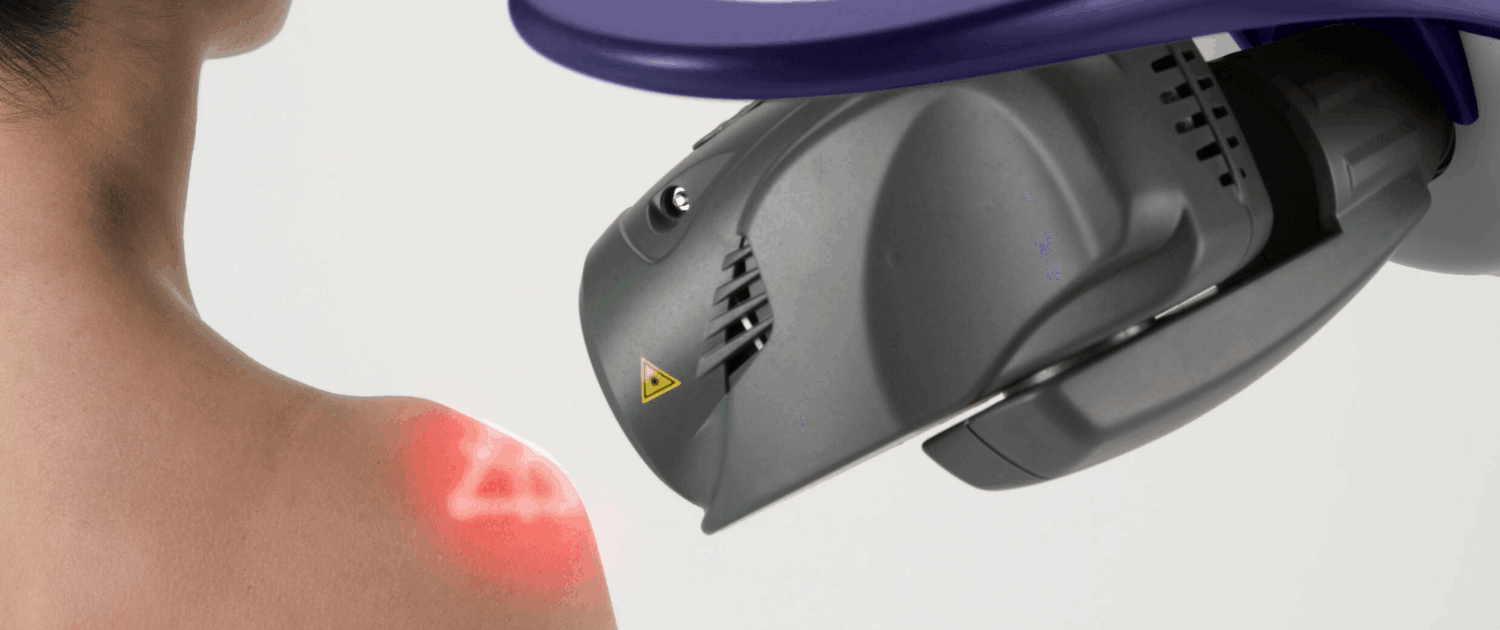
Synergy Institute Acupuncture & Chiropractic is an MLS laser shoulder pain treatment clinic located in Naperville, Illinois. We use the Cutting Edge MLS M6 — a Class IV dual-wavelength laser delivering synchronized 808nm continuous-wave and 905nm pulsed-wave light energy that penetrates deep into shoulder tissue to reduce inflammation, modulate pain, accelerate cellular repair, and promote new blood vessel formation in the avascular zones of the rotator cuff.
What separates MLS at our clinic from generic “laser therapy” elsewhere in Naperville is three things. First, we use the authentic Cutting Edge M6 device — not a refurbished cold laser or a Class III LLLT device marketed as Class IV. Second, MLS is integrated into the Synergy Shoulder Restore Program, our three-phase shoulder protocol combining MLS with SoftWave therapy, acupuncture for shoulder pain, chiropractic care, and ARPwave neuromuscular therapy. Third, we’ll tell you honestly whether MLS is the right primary tool for your shoulder problem — or whether something else fits better.
“Patients receiving MLS laser therapy with exercise had significantly better pain scores and functional disability improvement compared to those receiving TENS, ultrasound, and exercise.” — Randomized clinical trial on MLS laser therapy for shoulder pain
Our office sits on Illinois Route 59 near the 111th Street intersection in Naperville, serving patients throughout Naperville, Aurora, Plainfield, Bolingbrook, and Oswego. Call or text (630) 454-1300 — or call our office directly at (630) 355-8022— to schedule a $49 Discovery Session that includes a full evaluation, imaging review, and your first MLS laser treatment.
For the broader picture of how MLS fits into shoulder pain treatment generally, see our Best Treatments for Shoulder Pain in Naperville hub, our Best Treatments for Frozen Shoulder hub, and our Best Treatments for Rotator Cuff Tears hub.
Quick Facts: MLS Laser Therapy for Shoulder Pain in Naperville
| Fact | Detail |
|---|---|
| Technology | Cutting Edge MLS M6 — Class IV dual-wavelength laser |
| Wavelengths | 808nm continuous (inflammation/circulation) + 905nm pulsed (pain/repair) |
| First therapeutic laser at Synergy | 2002 — 24+ years of laser therapy experience |
| Conditions treated | Rotator cuff tendonitis and tendinopathy, frozen shoulder, bursitis, post-surgical pain, biceps tendinitis, shoulder arthritis, impingement |
| Session length | 8–15 minutes |
| Typical course | 6–12 sessions |
| Recovery time | None — return to normal activities immediately |
| Pain level | Painless — feels like gentle warmth |
| Initial offer | $49 Discovery Session — full evaluation + first MLS treatment |
| Location | Illinois Rte 59 near 111th Street, Naperville IL |
| Phone | (630) 454-1300 (call/text) or (630) 355-8022 (office) |
What MLS Laser Therapy Is — The Cutting Edge M6 Difference
Most patients searching for laser therapy in Naperville don’t realize there are fundamentally different classes of therapeutic lasers — and the difference between them is not subtle. Understanding what makes MLS distinct matters because the wrong device produces dramatically different results.
Class III lasers (cold lasers, low-level laser therapy / LLLT) operate at low power, typically under 500 milliwatts. They can’t reach deep tissues like the rotator cuff or joint capsule. They’re useful for surface-level skin and superficial soft tissue work but produce limited results for shoulder conditions where the damaged tissue sits deeper.
Standard Class IV lasers deliver more power and reach deeper tissue. But here’s the trade-off: high-power lasers generate heat. The clinician has to keep the laser beam moving constantly to avoid concentrating too much heat in one spot, which means you can’t hold the laser on a specific point — a trigger point, a precise area of tendon damage, an acupuncture point — for the sustained time needed to deliver an optimal therapeutic dose. You gain depth but lose precision.
The MLS laser — short for Multiwave Locked System — solves this problem. It’s a Class IV laser, but it works on a fundamentally different principle. Two synchronized wavelengths are emitted simultaneously and “locked” together in a patented pattern:
808nm continuous wave. This wavelength targets inflammation and swelling. It causes vasodilation (widening of blood vessels), activates lymphatic drainage, and increases blood flow to damaged tissue. For shoulder conditions where chronic inflammation perpetuates the pain cycle, this is critical.
905nm pulsed wave. This wavelength targets pain directly. The pulsed delivery allows higher peak power without thermal accumulation, meaning we can hold the device on a specific area — directly over the supraspinatus, the AC joint, the bursa — for the full therapeutic dose without overheating tissue.
The combination is what produces the clinical result. Standard cold lasers offer wavelength one or wavelength two but not both simultaneously. Standard Class IV lasers can’t pause on a target. MLS does both. The Cutting Edge M6 is the most advanced therapeutic laser available, and it’s what’s appropriate for the avascular zones of the rotator cuff and the deep capsular tissue of frozen shoulder.
Why MLS Outperforms Cold Laser and TENS for Shoulder Pain
When patients ask whether laser therapy “works” for shoulder pain, the answer depends entirely on which laser. The research bears this out clearly.
A randomized clinical trial directly compared MLS laser therapy plus exercise to standard treatments — TENS, ultrasound, and exercise — for shoulder pain. The MLS group had significantly better pain scores and significantly greater functional improvement at the end of treatment. TENS and ultrasound, the two most common adjunct treatments offered at standard physical therapy clinics, did not produce equivalent results. That’s a meaningful clinical finding that almost no Naperville competitor talks about.
A separate study looked at MLS versus traditional cold laser (LLLT) for chronic neck pain (the same general principle applies to shoulder structures) and found MLS produced significantly greater pain reduction and functional improvement after six weeks. Cold laser produced some benefit but was outperformed.
The mechanism of advantage is straightforward. Shoulder tendons — particularly the supraspinatus — sit in an avascular zone with poor blood supply. Standard care doesn’t address that biology. NSAIDs reduce pain but don’t restore circulation. Cortisone reduces inflammation temporarily but weakens tendon tissue with repeated use. TENS produces transient pain modulation but doesn’t reach the tendon. Cold laser doesn’t penetrate deep enough.
MLS does what those approaches cannot. It increases blood flow directly to the tendon. It activates cellular repair machinery in the mitochondria of injured tissue. It reduces inflammation at the cellular level rather than systemically. And it does this for the full duration of treatment, in the exact location the tissue needs healing.
Shoulder Conditions That Respond to MLS Laser Therapy
MLS is highly effective for specific shoulder conditions and less effective or inappropriate for others. Honest matching of treatment to condition is critical.
Rotator cuff tendonitis and tendinopathy are excellent MLS indications. The supraspinatus, infraspinatus, teres minor, and subscapularis tendons all respond well to MLS due to the laser’s ability to reach the avascular zones where natural healing struggles. Acute tendonitis often resolves in 6–8 sessions. Chronic tendinopathy may need 8–12 sessions and works best when paired with addressing underlying causes.
Frozen shoulder (adhesive capsulitis) responds well to MLS particularly during the freezing and frozen stages. During the freezing stage, MLS reduces capsular inflammation without forcing the joint — important because aggressive stretching during this stage worsens outcomes. During the frozen stage, MLS supports capsular tissue remodeling as we add SoftWave therapy and gentle mobilization.
Subacromial bursitis responds rapidly to MLS. The 808nm wavelength addresses bursal inflammation directly. Most bursitis cases see significant pain reduction within 3–6 sessions. We always investigate the underlying cause — bursitis is almost always downstream of rotator cuff or impingement issues — but MLS controls the acute inflammatory flare while we identify the driver.
Post-surgical shoulder pain. Patients recovering from rotator cuff repair, labral repair, or shoulder replacement benefit from MLS to accelerate post-surgical healing, reduce post-operative inflammation, minimize scar tissue formation, and shorten recovery timelines. We coordinate with your surgeon and typically begin MLS once you’re cleared for adjunct rehabilitation.
Biceps tendinitis frequently coexists with rotator cuff problems (up to 76% overlap per AAFP data). MLS addresses both simultaneously when applied to the broader shoulder region.
Shoulder arthritis — mild to moderate cases respond well to MLS for inflammation reduction, pain modulation, and improved joint circulation. Severe end-stage arthritis with bone-on-bone changes may require additional approaches or surgical evaluation.
Shoulder impingement combined with chiropractic correction of the cervical/thoracic mechanics — MLS addresses the irritated rotator cuff tendons that result from the compressive pattern. Without addressing the kinetic chain, MLS alone produces only partial improvement.
Conditions that are typically NOT good MLS candidates include: massive retracted full-thickness rotator cuff tears, severe end-stage glenohumeral arthritis with bone-on-bone changes requiring surgical evaluation, active shoulder infections, and recurrent shoulder dislocations from labral instability. We will tell you directly if MLS isn’t the right primary tool for your case.
How MLS Fits in the Synergy Shoulder Restore Program
MLS is not a stand-alone treatment at our clinic. It’s integrated into the Synergy Shoulder Restore Program — our three-phase protocol that addresses tissue healing, joint mechanics, and movement re-education in the right order.
Phase 1 — Tissue Healing and Inflammation Modulation. This is where MLS does its primary work. The Cutting Edge M6 reduces the inflammatory environment, increases circulation to damaged tendons and capsular tissue, accelerates cellular repair, and modulates pain signals. For many shoulder cases, MLS pairs with SoftWave therapy in this phase — the two work through different mechanisms on the same tissue. SoftWave drives stem cell recruitment and angiogenesis through electrohydraulic shockwaves. MLS clears the inflammatory environment and supports cellular activity through dual-wavelength light energy. The combined effect is consistently stronger than either alone. Acupuncture and electroacupuncture often run alongside for systemic pain modulation. Most patients spend 4 to 8 weeks in Phase 1.
Phase 2 — Joint Mechanics and Alignment Correction. Once tissue inflammation is controlled and healing has begun, we address the mechanical drivers of shoulder dysfunction. Cervical spine alignment, thoracic mobility, scapular positioning, shoulder joint mechanics. Chiropractic adjustments and targeted mobilization happen here, not before. MLS continues at lower frequency to support ongoing tissue healing while the mechanical work proceeds.
Phase 3 — Neuromuscular Re-education and Long-Term Function. ARPwave neuromuscular therapy retrains proper rotator cuff and scapular firing patterns. The Matrix Scanner identifies any residual compensation patterns. MLS continues as needed for any persistent inflammatory areas. This phase makes the results durable — preventing the recurrence pattern that’s so common when shoulder issues are treated symptomatically without addressing the underlying mechanics.
The Synergy Shoulder Restore Program is the only sequenced shoulder protocol in Naperville that integrates MLS laser with regenerative therapy, mechanical correction, and movement re-education in one coordinated system.
MLS vs. SoftWave — When We Use Each (or Both)
Patients researching shoulder treatments often ask whether they should choose MLS laser or SoftWave therapy. The honest answer is that they’re different tools for different jobs, and many cases benefit from both. Here’s how we decide.
MLS is the better primary tool for:
- Acute inflammation (recent injuries, flares, post-surgical recovery)
- Bursitis and acute tendonitis where inflammation is the dominant feature
- Pain modulation needs
- Patients who have contraindications to SoftWave (active infection, certain cardiac devices, pregnancy in some cases)
- Mild to moderate arthritis where inflammation reduction is the goal
- Post-surgical healing acceleration
SoftWave is the better primary tool for:
- Chronic tendinopathy and tendinosis (degenerative tissue change)
- Calcific tendonitis (calcium deposits in the rotator cuff)
- Frozen shoulder in frozen and thawing stages (capsular remodeling)
- Partial rotator cuff tears under 50% (regenerative stimulation)
- Cases needing stem cell recruitment and angiogenesis
Both together is often the strongest approach for:
- Chronic shoulder pain that’s been present for months or years
- Mixed presentations (tendinopathy + inflammation, calcification + degeneration)
- Frozen shoulder cases needing both inflammation control and capsular remodeling
- Post-surgical pain with both inflammatory and tissue-healing components
We don’t make this decision in advance based on what insurance covers or what’s most profitable. We make it based on what your specific shoulder condition needs at the cellular level. For more on how SoftWave specifically works for shoulder conditions, see our SoftWave Therapy for Shoulder Pain article.
What to Expect During MLS Laser Treatment
Each MLS session lasts approximately 8 to 15 minutes depending on the size of the treatment area and the specific condition. We start every patient with a comprehensive evaluation — imaging review, history, medication review, physical examination — to map your specific shoulder problem and design the appropriate protocol.
During the session, you sit or recline comfortably while the MLS handpiece is applied directly to the skin over the affected shoulder structures. The laser delivers synchronized 808nm and 905nm light energy through the handpiece. You’ll feel mild warmth — that’s it. No needles, no electrical shock, no aggressive sensation. Most patients describe MLS as deeply relaxing.
The clinician moves the handpiece systematically across the treatment area or holds it on specific high-priority points (supraspinatus tendon insertion, biceps tendon, AC joint, subacromial space) depending on what your condition requires. With my dual credentials as an Acupuncturist, I can apply MLS directly to specific acupuncture points and trigger points that will produce maximum benefit — a precision that single-credential providers can’t match.
There is no downtime, no recovery period, and no medication required. You can return to work, normal activities, and even moderate exercise immediately after a session. Some patients notice gentle warmth in the treatment area for an hour or two afterward — this is normal and reflects the increased circulation MLS produces.
A typical course for shoulder conditions runs 6 to 12 sessions, spaced two to three times per week initially. Acute conditions and bursitis often respond in 4 to 8 sessions. Chronic tendinopathy and frozen shoulder typically need 8 to 12 sessions. We reassess every 4 to 6 sessions and adjust the protocol based on response.
Who IS and ISN’T a Good Candidate for MLS Laser
Honest candidacy assessment matters. MLS is highly effective for the conditions it’s designed to treat — and not appropriate for some others.
You ARE likely a good candidate if you have rotator cuff tendonitis or tendinopathy, frozen shoulder in any stage, subacromial bursitis, post-surgical shoulder pain (after surgical clearance), biceps tendinitis, mild to moderate shoulder arthritis, shoulder impingement, acute shoulder flares from chronic conditions, or chronic shoulder inflammation that hasn’t responded to standard care.
You are likely NOT a candidate for MLS if you have an active malignancy in the treatment area, you are pregnant (laser is typically deferred during pregnancy regardless of indication), you have an active shoulder infection, you have a recent corticosteroid injection (we typically wait 1-2 weeks before MLS application), or you have photosensitivity related to certain medications.
Conditions that often genuinely need additional or different treatment include complete full-thickness rotator cuff tears with significant retraction, recurrent shoulder dislocations from a Bankart lesion, severe end-stage glenohumeral arthritis with bone-on-bone changes, and refractory cases that have failed comprehensive integrative care. We work with trusted orthopedic surgeons in the Naperville area and refer when surgery is genuinely indicated.
Approximately 15% of patients I evaluate are referred elsewhere or treated with different primary modalities because MLS isn’t the right primary tool for their specific case. That’s not a failure — it’s the integrity that makes the approach work for everyone else.
🚨 Emergency Warnings — When Shoulder Symptoms Need Urgent Care
Most shoulder pain is musculoskeletal and not urgent. But certain presentations require immediate evaluation, not an MLS appointment.
🚨 Call 911 or go to the emergency room if you experience: sudden severe shoulder pain accompanied by chest pain, jaw pain, or shortness of breath (possible cardiac event); shoulder pain after significant trauma with visible deformity; complete loss of arm function or sudden severe weakness; numbness or tingling extending down the entire arm; signs of shoulder dislocation; or fever with severe shoulder pain (possible joint infection).
For non-emergent shoulder pain that hasn’t responded to conservative care — that’s exactly the patient population MLS laser therapy was designed to help.
What Patients Typically Notice
Most MLS patients notice meaningful pain reduction within the first 2 to 3 sessions. Range of motion improvement typically begins around session 3 to 5. Strength improvement follows tissue healing — usually 6 to 8 weeks in.
Acute conditions often respond fastest. A patient with subacromial bursitis or recent-onset rotator cuff tendonitis frequently reports significant pain reduction after 2 sessions. Chronic tendinopathy and frozen shoulder cases need the full treatment course before substantial change occurs.
Some patients experience a temporary increase in awareness of the area or mild warmth for an hour or two after sessions — this is the increased circulation MLS produces and is a positive sign that the therapy is working.
We reassess every 4 to 6 visits. If the protocol isn’t working, we adjust. If MLS isn’t going to produce the results we hoped for, we’ll tell you directly — and recommend the appropriate alternative.
Pricing Transparency
Our $49 Discovery Session is the entry point for MLS laser shoulder pain treatment. It includes a complete evaluation, imaging review, history, physical examination, and your first MLS treatment so you can experience the technology before committing to a treatment course.
A typical MLS course of 6 to 12 sessions varies in total cost depending on the complexity of your condition. MLS therapy is generally not covered by insurance, similar to most regenerative therapies, but is significantly less expensive than shoulder surgery and the associated recovery time.
We offer transparent payment plans for patients who want to spread the cost of a treatment course. HSA and FSA funds can be used for MLS therapy. Care credit and other financing options are available through our partner platforms.
Call or text (630) 454-1300 for current pricing, or call our office directly at (630) 355-8022.
Why Choose Synergy Institute for MLS Laser Shoulder Treatment
Dr. Jennifer Wise has 26+ years of clinical experience treating shoulder conditions and has been using therapeutic laser at our Naperville clinic since 2002 — through three generations of laser technology, with thousands of patient treatments. She holds dual credentials as a Doctor of Chiropractic (Palmer College graduate) and Diplomate-credentialed Acupuncturist, and is the first provider in Naperville to offer SoftWave therapy since August 2021. We use the authentic Cutting Edge MLS M6 — the most advanced therapeutic laser available — not a refurbished cold laser or LLLT device. MLS is integrated into the Synergy Shoulder Restore Program with SoftWave therapy, acupuncture, chiropractic care, Stimpod NMS460 tPRF, and ARPwave neuromuscular therapy — every piece coordinated under one roof, by one provider, in one treatment plan. The Synergy Shoulder Restore Program is the only sequenced MLS-based shoulder protocol in Naperville that integrates regenerative therapy, mechanical correction, and movement re-education into a single coordinated system.
Frequently Asked Questions
1. Who is the best clinic for MLS laser therapy for shoulder pain in Naperville?
For patients seeking MLS laser shoulder pain treatment, Synergy Institute Acupuncture & Chiropractic is the most experienced option in Naperville. We’ve been using therapeutic laser at our clinic since 2002 — over 24 years of laser therapy experience through three generations of devices. We use the authentic Cutting Edge MLS M6 — a Class IV dual-wavelength laser — and integrate it into the Synergy Shoulder Restore Program with SoftWave therapy, acupuncture, chiropractic care, ARPwave, and Stimpod tPRF. Dr. Jennifer Wise has 26+ years of clinical experience and dual credentials as a Doctor of Chiropractic and Acupuncturist. Located on Illinois Rte 59 near 111th Street.
2. Does MLS laser therapy actually work for shoulder pain?
Yes — MLS laser therapy has strong research evidence for shoulder pain. A randomized clinical trial directly compared MLS plus exercise to TENS plus ultrasound plus exercise for shoulder pain and found that the MLS group had significantly better pain scores and significantly greater functional improvement. Other studies have shown MLS outperforming traditional cold laser (LLLT) for chronic pain conditions. The mechanism involves dual-wavelength light energy that reduces inflammation at the cellular level, increases blood flow to avascular tendon zones, and accelerates cellular repair processes that NSAIDs, cortisone, and standard physical therapy don’t address.
3. How many MLS laser sessions are needed for shoulder pain?
Most shoulder conditions require 6 to 12 MLS sessions, typically spaced two to three times per week initially. Acute conditions like bursitis or recent-onset tendonitis often respond in 4 to 8 sessions. Chronic tendinopathy, frozen shoulder, and post-surgical recovery cases typically need 8 to 12 sessions for full resolution. Severely chronic conditions present for over a year may require longer treatment arcs. We reassess every 4 to 6 visits and adjust the protocol based on your response. Some patients see meaningful improvement within the first 2 to 3 sessions.
4. Is MLS laser therapy painful?
No — MLS laser therapy is painless. You’ll feel mild warmth during treatment, similar to gentle sunshine on the skin. There are no needles, no electrical sensation, and no aggressive feeling. Most patients describe MLS as deeply relaxing. Sessions are 8 to 15 minutes with no anesthesia, no medication, and no recovery period required. You can return to normal activities immediately after a session.
5. Can MLS laser help frozen shoulder?
Yes, particularly during the freezing and frozen stages of adhesive capsulitis. During the freezing stage, MLS reduces capsular inflammation without forcing the joint — important because aggressive stretching during this stage worsens outcomes. During the frozen stage, MLS supports capsular tissue remodeling alongside SoftWave therapy and gentle mobilization. The Synergy Shoulder Restore Program calibrates MLS application based on which stage of frozen shoulder you’re in. Research on MLS for frozen shoulder is encouraging, particularly when combined with appropriate stage-based mobilization.
6. Can MLS laser help a rotator cuff tear?
Yes, for many tear types. MLS is highly effective for rotator cuff tendonitis, tendinopathy, partial tears under 50%, and post-surgical rotator cuff recovery. The dual-wavelength MLS technology specifically addresses the avascular zones of the rotator cuff where tendons struggle to heal naturally. Larger full-thickness tears with significant retraction may genuinely need surgical evaluation rather than MLS alone — but for the majority of rotator cuff conditions, MLS produces meaningful results, particularly when combined with SoftWave therapy and addressing underlying causes like medications and nutrition that affect tendon healing.
7. What’s the difference between MLS laser and cold laser for shoulder pain?
Cold lasers (Class III, LLLT) operate at low power — typically under 500 milliwatts — and can’t reach deep tissues like the rotator cuff or shoulder joint capsule. They work for surface-level skin and superficial soft tissue but produce limited results for shoulder conditions where damaged tissue sits deeper. MLS is a Class IV laser using two synchronized wavelengths (808nm continuous + 905nm pulsed) that penetrate to therapeutic depth and target both inflammation and pain simultaneously. Research directly comparing MLS to traditional cold laser shows MLS produces significantly greater pain reduction and functional improvement.
8. Should I get MLS laser or SoftWave therapy for my shoulder?
It depends on your specific condition. MLS is the better primary tool for acute inflammation, bursitis, recent injuries, and post-surgical recovery — situations where reducing inflammation and modulating pain is the priority. SoftWave is the better primary tool for chronic tendinopathy, calcific tendonitis, frozen shoulder in frozen/thawing stages, and partial tears — situations where stem cell recruitment and tissue regeneration are the priority. Many shoulder cases benefit from both used together, since they work through different mechanisms on the same tissue. The Synergy Shoulder Restore Program identifies which combination matches your specific case rather than defaulting to one tool.
9. Does insurance cover MLS laser therapy for shoulder pain in Naperville?
MLS laser therapy is typically not covered by insurance, similar to most regenerative therapies. However, MLS is significantly less expensive than shoulder surgery and the associated recovery, rehabilitation, and time-off-work costs. We offer transparent payment plans, accept HSA and FSA funds, and work with care credit financing partners. Other components of comprehensive shoulder care — chiropractic, acupuncture, physical therapy — are typically covered by most insurance plans.
Ready to Find Out If MLS Is Right for Your Shoulder?
If you’ve been managing shoulder pain for weeks or months — and standard care hasn’t moved the needle — MLS laser therapy may be the regenerative tool your tissue actually needs. Generic shoulder treatment fails for inflammation, tendonitis, and bursitis because anti-inflammatories and cortisone don’t address the cellular biology. MLS does.
Synergy Institute Acupuncture & Chiropractic is an MLS laser shoulder pain treatment clinic located in Naperville, Illinois at 4931 Illinois Rte 59, Suite 121, near the 111th Street intersection. We serve patients throughout Naperville, Aurora, Plainfield, Bolingbrook, and Oswego.
Schedule your $49 Discovery Session today. Call or text (630) 454-1300, or call our office directly at (630) 355-8022.
For more on related shoulder treatments, see our Best Treatments for Shoulder Pain hub, our Best Treatments for Frozen Shoulder hub, our Best Treatments for Rotator Cuff Tears hub, our SoftWave Therapy for Shoulder Pain article, our Acupuncture for Shoulder Pain article, and our Shoulder Pain condition page.
References
- Eslamian F, Shakouri SK, Ghojazadeh M, et al. Effects of low-level laser therapy in combination with physiotherapy in the management of rotator cuff tendinitis. Lasers in Medical Science, 2012. https://pubmed.ncbi.nlm.nih.gov/21814771/
- Cinar E, Saxena S, Uygur F. Combination Therapy Versus Exercise and Orthotic Support in the Management of Pain in Plantar Fasciitis: A Randomized Controlled Trial. Foot & Ankle International, 2018.
- Stergioulas A. Effects of low-level laser and plyometric exercises in the treatment of lateral epicondylitis.Photomedicine and Laser Surgery, 2007.
- Bjordal JM, Lopes-Martins RA, Joensen J, et al. A systematic review with procedural assessments and meta-analysis of low level laser therapy in lateral elbow tendinopathy. BMC Musculoskeletal Disorders, 2008.
- Otadi K, Hadian MR, Olyaei G, Jalaie S. The beneficial effects of adding low level laser to ultrasound and exercise in Iranian women with shoulder tendonitis: A randomized clinical trial. Journal of Back and Musculoskeletal Rehabilitation, 2012. https://pubmed.ncbi.nlm.nih.gov/22398269/
- Vasconcelos VC, Lopes JS, Vasconcelos MA, et al. MLS Laser Therapy in the treatment of chronic neck pain: a randomized, double-blind, placebo-controlled study. Lasers in Medical Science, 2020.
- Tumilty S, Munn J, McDonough S, et al. Low level laser treatment of tendinopathy: a systematic review with meta-analysis. Photomedicine and Laser Surgery, 2010.
- Stiglić-Rogoznica N, Stamenković D, Frlan-Vrgoc L, et al. Analgesic effect of high intensity laser therapy in patients with cervical spine pain. Collegium Antropologicum, 2011.
- Hamblin MR. Mechanisms and applications of the anti-inflammatory effects of photobiomodulation. AIMS Biophysics, 2017. https://pubmed.ncbi.nlm.nih.gov/28748217/
- Naterstad IF, Joensen J, Bjordal JM, et al. Efficacy of low-level laser therapy in patients with lower extremity tendinopathy or plantar fasciitis: systematic review and meta-analysis of randomised controlled trials. BMJ Open, 2022.
- American Academy of Orthopaedic Surgeons. Rotator Cuff Tears. OrthoInfo, 2024. https://orthoinfo.aaos.org/
Medical Disclaimer: This article is for informational purposes only and does not constitute medical advice, diagnosis, or treatment recommendations. Individual results from MLS laser therapy vary based on condition severity, health history, and other clinical factors. MLS laser therapy is not appropriate for all patients or all shoulder conditions. Always consult with a qualified healthcare provider before beginning any new treatment. If you are experiencing a medical emergency, call 911 immediately.
Reviewed by Dr. Jennifer Wise, DC, Acupuncturist — May 2026
Dr. Jennifer Wise is a Doctor of Chiropractic (Palmer College graduate) and Acupuncturist with over 26 years of clinical experience. She is the founder of Synergy Institute Acupuncture & Chiropractic in Naperville, IL, specializing in integrative pain relief combining chiropractic care, acupuncture, spinal decompression, SoftWave therapy, and MLS laser. Call or text (630) 454-1300 to schedule your appointment.