
SoftWave Therapy for Shoulder Pain in Naperville IL
You woke up at 3 AM again. You rolled onto your side, felt that deep ache through your shoulder, and now sleep is over. Lifting your arm to wash your hair takes calculation. Reaching the seatbelt across your body makes you wince. You’ve already been through ibuprofen, ice, physical therapy, and possibly a cortisone injection — and the pain still isn’t gone. Now you’re researching what actually works.
Most patients we see at this stage have been told their tendon is “just degenerated” or that they should consider surgery. They leave that appointment frustrated, looking for something that addresses the actual healing — not just the pain.
I’m Dr. Jennifer Wise, DC, Acupuncturist, owner of Synergy Institute Acupuncture & Chiropractic in Naperville. For 26+ years — since 2000 — I’ve been treating shoulder pain as both a Doctor of Chiropractic (Palmer College graduate) and a Diplomate-credentialed Acupuncturist. In August 2021, we became the first provider in Naperville to offer SoftWave therapy — and we’ve been refining its application for shoulder conditions ever since. If you’re searching for the best SoftWave shoulder pain specialist near me in Naperville, what you actually need is someone using the authentic technology, on the right tear and tendon types, in the right sequence with the rest of your care.
Synergy Institute Acupuncture & Chiropractic is a SoftWave shoulder pain treatment clinic located in Naperville, Illinois. We use the authentic TRT OrthoGold 100 SoftWave device — true electrohydraulic shockwave technology that delivers parallel acoustic waves to stimulate stem cell recruitment, promote angiogenesis, and trigger genuine tissue regeneration in damaged rotator cuff tendons, joint capsules, and ligaments. SoftWave is integrated into the Synergy Shoulder Restore Program, our three-phase protocol combining SoftWave with MLS laser therapy, acupuncture for shoulder pain, chiropractic care, and ARPwave neuromuscular therapy.
What separates SoftWave at our clinic from generic shockwave at other practices is three things. First, we use the authentic TRT OrthoGold 100 — not a radial pressure-wave device that’s marketed under similar names. Second, we use SoftWave inside a structured sequenced protocol, not as a stand-alone “fix” disconnected from joint mechanics and the underlying causes that produced your tear. Third, we’ll tell you honestly whether SoftWave is the right tool for your specific shoulder problem — or whether something else fits better.
“Extracorporeal shockwave therapy demonstrates strong evidence for rotator cuff calcific tendonitis and emerging evidence for non-calcific tendinopathy and frozen shoulder, with mechanism studies showing stimulation of mesenchymal stem cell recruitment, angiogenesis, and collagen remodeling.” — Speed C, British Journal of Sports Medicine, 2014
Our office sits on Illinois Route 59 near the 111th Street intersection in Naperville, serving patients throughout Naperville, Aurora, Plainfield, Bolingbrook, and Oswego. Call or text (630) 454-1300 — or call our office directly at (630) 355-8022— to schedule a $49 Discovery Session that includes a full evaluation, imaging review, and your first SoftWave treatment.
For the broader picture of how SoftWave fits into shoulder pain treatment, see our Best Treatments for Shoulder Pain in Naperville hub, our Best Treatments for Frozen Shoulder hub, and our Best Treatments for Rotator Cuff Tears hub.
Quick Facts: SoftWave for Shoulder Pain in Naperville
| Fact | Detail |
|---|---|
| Technology | TRT OrthoGold 100 — true electrohydraulic shockwave |
| First SoftWave provider in Naperville | Synergy Institute, August 2021 |
| Conditions treated | Rotator cuff tendinopathy and partial tears, calcific tendonitis, frozen shoulder, biceps tendinitis, bursitis, post-surgical pain |
| Session length | 15–20 minutes |
| Typical course | 6–12 sessions, spaced once weekly |
| Recovery time | None — return to normal activities immediately |
| Pain level | Mild to moderate during treatment, well-tolerated |
| Initial offer | $49 Discovery Session — full evaluation + first SoftWave treatment |
| Location | Illinois Rte 59 near 111th Street, Naperville IL |
| Phone | (630) 454-1300 (call/text) or (630) 355-8022 (office) |
Why Standard Shoulder Treatment Has Failed You
If you’re reading this article, you’ve probably already tried the standard sequence: ibuprofen, rest, physical therapy, possibly a cortisone injection or two. Your shoulder still hurts. Here’s the honest reason why — and why SoftWave specifically addresses what those treatments cannot.
Anti-inflammatories suppress symptoms without healing tissue. Inflammation is a three-phase biological process — initiation, repair, and remodeling. NSAIDs block phase one, which means phases two and three never properly happen. You feel less pain temporarily; the underlying tendon degeneration continues silently.
Cortisone provides 4 to 6 weeks of relief, then often nothing — and weakens tissue with repeated use. A landmark 2010 review in The Lancet found that cortisone injections produce meaningful relief at 4 to 6 weeks but no better outcomes than placebo at 6 months and beyond. Repeated injections actively weaken tendon tissue and accelerate degeneration. Cortisone is a pause button, not a treatment.
Physical therapy works for what it works for — and not for tissue regeneration. PT excels at restoring strength and movement patterns once tissue has healed. It is not a tissue-healing intervention. If your rotator cuff has degenerated to the point of tendinosis, partial tear, or calcific tendonitis, exercise alone cannot regenerate the damaged tissue. The exercises strengthen what’s there, but if what’s there is compromised, the underlying problem persists.
Surgery is appropriate for some shoulder cases — and dramatically overused for others. Acute traumatic full-thickness tears in younger active patients, massive retracted tears, and recurrent dislocations are situations where surgery genuinely helps. Chronic tendinopathy, partial tears under 50%, calcific tendonitis, and frozen shoulder usually respond to non-surgical regenerative care. Many patients get pushed toward surgery without ever receiving comprehensive non-surgical treatment first.
SoftWave addresses what each of these standard treatments misses — it stimulates the body’s own regenerative cellular machinery to actually heal the tissue.
What SoftWave Therapy Actually Is — The TRT OrthoGold 100 Difference
Not all shockwave devices are the same. The market is full of devices marketed as “shockwave,” and most patients (and many clinics) don’t know the difference. Understanding what makes SoftWave distinct matters because the wrong device produces dramatically different results.
True extracorporeal shockwave therapy uses electrohydraulic technology — high-voltage electrical discharge underwater creates a focused acoustic wave that travels through tissue. The TRT OrthoGold 100 is a true electrohydraulic device using parallel-aligned shockwaves that penetrate to therapeutic depth without focal damage. This is the technology with the strongest research evidence for tendon regeneration, calcific tendonitis breakdown, and stimulation of stem cell recruitment.
Radial pressure-wave devices are often marketed as “shockwave” but use compressed air to fire a projectile against an applicator, creating a much weaker pressure wave that dissipates quickly. They can be useful for surface-level muscle and connective tissue work but produce different — generally less profound — results than true electrohydraulic shockwaves for deeper tissue regeneration.
SoftWave should not be confused with cosmetic Sofwave. A separate company, Sofwave (without the T), markets a microbeam ultrasound device for facial wrinkles and skin tightening — completely different technology, completely different application. Patients sometimes mix these up due to similar names.
When SoftWave’s TRT OrthoGold 100 is applied to a damaged rotator cuff tendon, it triggers a cascade of biological responses. Mechanotransduction — the conversion of mechanical force into cellular signals — activates dormant stem cells and fibroblasts. Angiogenesis — formation of new blood vessels — improves circulation in the avascular zones of the supraspinatus and infraspinatus tendons that struggle to heal naturally. Collagen synthesis and remodeling rebuilds tissue architecture over weeks to months. Anti-inflammatory cytokine modulation reduces chronic inflammatory load. Calcium deposit breakdown addresses calcific tendonitis directly.
This is genuine tissue regeneration — not pain masking, not symptom management.
Shoulder Conditions That Respond to SoftWave
SoftWave is highly effective for specific shoulder conditions and less effective or inappropriate for others. Honest matching of treatment to condition is critical.
Rotator cuff tendinopathy and tendinosis — the most common rotator cuff presentation in adults over 40, characterized by disorganized collagen and tissue degeneration. SoftWave directly addresses the degenerative process. This is one of the strongest indications.
Partial-thickness rotator cuff tears under 50% — partial tears respond well to SoftWave’s stimulation of stem cell recruitment and collagen remodeling. Most partial tears can heal substantially with comprehensive non-surgical care.
Calcific tendonitis — calcium deposits in the rotator cuff tendons, often visible on imaging. SoftWave is FDA-cleared and well-evidenced for calcific tendonitis. The shockwave energy fragments calcium deposits and stimulates resorption while simultaneously addressing surrounding tendon tissue.
Small full-thickness rotator cuff tears — particularly in lower-demand patients, small full-thickness tears can respond to comprehensive SoftWave-based treatment. Larger or retracted tears may genuinely need surgical evaluation.
Frozen shoulder (adhesive capsulitis) — particularly in the frozen and thawing stages, SoftWave breaks up capsular adhesions, stimulates capsular tissue remodeling, and accelerates the natural thawing process. Application during the active freezing stage is selective and gentler.
Biceps tendinitis — frequently coexists with rotator cuff problems (up to 76% overlap per AAFP data). SoftWave addresses both simultaneously when applied to the broader shoulder region.
Subacromial bursitis — usually downstream of rotator cuff or impingement issues. SoftWave addresses the underlying tendon and capsular contributors that drive the bursitis.
Post-surgical shoulder pain — patients with persistent pain after rotator cuff repair, labral repair, or shoulder replacement often respond to SoftWave once they’re cleared by their surgeon (typically 6-8 weeks post-operative).
Shoulder impingement — when combined with chiropractic correction of the cervical/thoracic mechanics driving the impingement, SoftWave addresses the irritated tendons that result from the compressive pattern.
Conditions that are typically NOT good SoftWave candidates include: massive retracted full-thickness tears, severe end-stage arthritis with bone-on-bone changes, active shoulder infections, and recurrent shoulder dislocations from labral instability. We will tell you directly if SoftWave isn’t the right tool for your case.
Why Your Shoulder Tore in the First Place
Most patients who walk in with rotator cuff or shoulder tendon problems ask the same question: “Why did this happen?”The standard answer is “wear and tear” or “you’re getting older.” That’s not an answer. There are specific addressable factors that weakened your tendon to the point of failure.
We address these factors during your evaluation because applying SoftWave to a tendon that’s still being weakened by ongoing causes produces incomplete results. Healing requires identifying and addressing what compromised the tissue in the first place.
Medications that weaken tendons include fluoroquinolone antibiotics (Cipro, Levaquin), statins (Lipitor, Crestor), corticosteroids (oral and injected), and aromatase inhibitors used in breast cancer treatment. These are well-documented in medical literature but rarely discussed at the orthopedic visit.
Nutritional deficiencies affect tendon healing significantly. Tendons are metabolically active tissue requiring vitamin C, vitamin D, magnesium, zinc, copper, omega-3 fatty acids, and adequate protein for repair. Subclinical deficiencies are extremely common, especially in older adults and patients on multiple medications.
Metabolic and hormonal factors like diabetes, thyroid dysfunction, and menopause affect connective tissue integrity. Patients with these factors often need broader systemic support alongside local treatment.
Chronic mechanical stress from postural compensation, repetitive overhead motion, and underlying cervical/thoracic dysfunction creates the environment in which tendons gradually fail.
For a complete breakdown of why rotator cuff tears happen without major trauma, see our Best Treatments for Rotator Cuff Tears in Naperville hub — the 5-layer cause framework explains the underlying biology in detail.
What to Expect During Your SoftWave Treatment
Each SoftWave session lasts approximately 15 to 20 minutes. We start every patient with a comprehensive evaluation — imaging review, history, medication review, and physical examination — to map your specific shoulder problem and design a treatment plan.
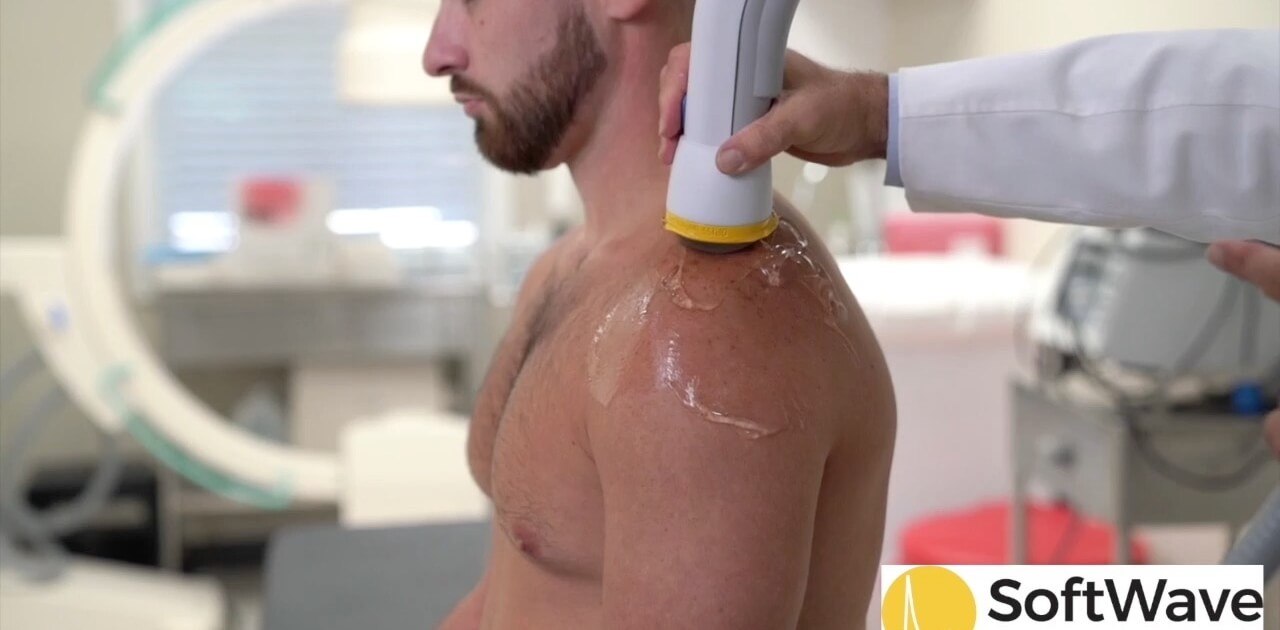
During the session, you sit or recline comfortably while we apply ultrasound gel to the shoulder. The TRT OrthoGold 100 applicator is placed against the skin and delivers a series of focused acoustic shockwaves. You’ll feel a deep tapping sensation that varies from mild to moderate intensity depending on the treatment area and your individual tissue response. Most patients tolerate it very well — many describe it as oddly satisfying once they get used to the sensation.
We adjust the device intensity throughout the session based on your tolerance and the tissue response. Calcific tendonitis treatment is sometimes more intense because we’re actively working to fragment the calcium deposit.
There is no downtime, no recovery period, and no medication required. You can return to work, normal activities, and even moderate exercise immediately after a session. Most patients notice some increase in tissue awareness for 24-48 hours after treatment — this is the normal regenerative response and indicates the tissue is healing.
A typical SoftWave course for shoulder conditions runs 6 to 12 sessions, spaced approximately once per week. Acute conditions and calcific tendonitis often respond in 4-8 sessions. Chronic tendinopathy and frozen shoulder typically need 8-12 sessions for full resolution. We reassess every 4-6 sessions and adjust the protocol based on response.
The Synergy Shoulder Restore Program — How SoftWave Fits
SoftWave is not a stand-alone treatment at our clinic. It’s integrated into the Synergy Shoulder Restore Program — our three-phase protocol that addresses tissue healing, joint mechanics, and movement re-education in the right order.
Phase 1 — Tissue Healing and Cause Address. SoftWave is the regenerative foundation of this phase. The TRT OrthoGold 100 stimulates mesenchymal stem cell recruitment and angiogenesis directly in damaged shoulder tissue. MLS laser runs alongside to clear the chronic inflammatory environment and accelerate cellular repair. Acupuncture and electroacupuncture modulate pain signals while the tissue rebuilds. Simultaneously, we investigate underlying contributors — medications, nutritional status, metabolic factors. Most patients spend 4 to 8 weeks in Phase 1.
Phase 2 — Joint Mechanics and Alignment Correction. Once tissue healing has begun, we address the mechanical drivers — cervical spine alignment, thoracic mobility, scapular positioning, and shoulder joint mechanics. Forward head posture, rounded shoulders, and cervical dysfunction all contribute to ongoing shoulder problems. Chiropractic adjustments and targeted mobilization happen here, not before. Adjusting a shoulder while the underlying tissue is still degenerated creates compensation patterns that don’t hold.
Phase 3 — Neuromuscular Re-education and Long-Term Function. The shoulder mechanics that produced your injury haven’t disappeared just because the tendon has healed. ARPwave neuromuscular therapy retrains proper rotator cuff and scapular firing patterns. The Matrix Scanner gait analysis identifies any residual compensation patterns. This phase makes the results durable — preventing the recurrence pattern that’s so common when tissue is repaired without addressing the surrounding mechanics.
The Synergy Shoulder Restore Program is the only sequenced shoulder protocol in Naperville that integrates SoftWave with mechanical correction and movement re-education in one coordinated system.
Who IS and ISN’T a Good Candidate for SoftWave
Honest candidacy assessment matters. SoftWave is highly effective for the conditions it’s designed to treat — and not appropriate for some others.
You ARE likely a good candidate if you have rotator cuff tendinopathy or tendinosis, partial-thickness tears under 50%, calcific tendonitis, frozen shoulder in any stage, biceps tendinitis, subacromial bursitis driven by underlying tendon issues, post-surgical shoulder pain (after surgical clearance), small full-thickness tears in lower-demand patients, or shoulder impingement combined with cervical/thoracic dysfunction.
You are likely NOT a candidate for SoftWave if you have an active shoulder infection, you’re pregnant (not contraindicated for the limb but typically deferred), you have a pacemaker or implanted electrical device near the treatment area, you have a coagulation disorder or are on blood thinners with bleeding risk, you have a malignancy in the treatment area, or you’ve had a recent steroid injection (we typically wait 4-6 weeks before applying SoftWave to allow the corticosteroid to clear and avoid amplified tissue effects).
Conditions that often genuinely need surgical evaluation rather than SoftWave alone include complete full-thickness rotator cuff tears with significant retraction, recurrent shoulder dislocations from a Bankart lesion, severe end-stage glenohumeral arthritis with bone-on-bone changes, and refractory cases that have failed comprehensive integrative care. We work with trusted orthopedic surgeons in the Naperville area and refer when surgery is genuinely indicated.
Approximately 15-25% of patients I evaluate are not ideal SoftWave candidates and are referred elsewhere or treated with different modalities. That’s not a failure — it’s the integrity that makes the approach work for everyone else.
🚨 Emergency Warnings — When Shoulder Symptoms Need Urgent Care
Most shoulder pain is musculoskeletal and not urgent. But certain presentations require immediate evaluation, not a SoftWave appointment.
🚨 Call 911 or go to the emergency room if you experience: sudden severe shoulder pain accompanied by chest pain, jaw pain, or shortness of breath (possible cardiac event); shoulder pain after significant trauma with visible deformity; complete loss of arm function or sudden severe weakness; numbness or tingling extending down the entire arm; signs of shoulder dislocation; or fever with severe shoulder pain (possible joint infection).
For non-emergent shoulder pain that hasn’t responded to conservative care — that’s exactly the patient population SoftWave was designed to help.
What Patients Typically Notice
Most SoftWave patients notice meaningful pain reduction within the first 2 to 3 sessions. Range of motion improvement typically begins around session 4 to 6. Strength improvement follows tissue healing — usually 6 to 10 weeks in.
Calcific tendonitis cases often respond dramatically to SoftWave — patients sometimes report a sensation of the calcium “breaking up” during sessions, and follow-up imaging frequently shows partial or complete resorption of the deposit.
Tendinopathy and partial tear cases typically resolve over 6 to 12 weeks of comprehensive treatment. Frozen shoulder responds based on stage — early-stage cases often resolve in 6 to 8 weeks, while frozen-stage cases may need 12 to 16 weeks.
Some patients experience a temporary increase in tissue awareness or mild soreness 24-48 hours after sessions — this is the regenerative response and indicates the tissue is healing. It typically diminishes after the second or third session.
We reassess every 4 to 6 visits. If the protocol isn’t working, we adjust. If SoftWave isn’t going to produce the results we hoped for, we’ll tell you directly.
Pricing Transparency
Our $49 Discovery Session is the entry point for SoftWave shoulder pain treatment. It includes a complete evaluation, imaging review, history, physical examination, and your first SoftWave treatment so you can experience the technology before committing to a treatment course.
A typical SoftWave course of 6 to 12 sessions varies in total cost depending on the complexity of your condition and the protocol design. SoftWave is generally not covered by insurance, similar to most regenerative therapies, but is significantly less expensive than shoulder surgery and the associated recovery time and rehabilitation costs.
We offer transparent payment plans for patients who want to spread the cost of a treatment course. HSA and FSA funds can be used for SoftWave therapy. Care credit and other financing options are available through our partner platforms.
Call or text (630) 454-1300 for current pricing, or call our office directly at (630) 355-8022.
Why Choose Synergy Institute for SoftWave Shoulder Treatment
Dr. Jennifer Wise has 26+ years of clinical experience treating shoulder conditions, dual credentials as a Doctor of Chiropractic (Palmer College graduate) and Diplomate-credentialed Acupuncturist, and is the first provider in Naperville to offer SoftWave therapy since August 2021. We use the authentic TRT OrthoGold 100 — true electrohydraulic shockwave technology — not a radial pressure-wave alternative. SoftWave is integrated into the Synergy Shoulder Restore Program with MLS laser, acupuncture, chiropractic care, Stimpod NMS460 tPRF, and ARPwave neuromuscular therapy — every piece coordinated under one roof, by one provider, in one treatment plan. The Synergy Shoulder Restore Program is the only sequenced SoftWave-based shoulder protocol in Naperville that integrates regenerative therapy, mechanical correction, and movement re-education into a single coordinated system.
Frequently Asked Questions
1. Who is the best clinic for SoftWave therapy for shoulder pain in Naperville?
For patients seeking SoftWave shoulder pain treatment, Synergy Institute Acupuncture & Chiropractic is the most experienced option in Naperville. We were the first provider in Naperville to offer SoftWave therapy in August 2021 and have refined its application for shoulder conditions over years of clinical experience. We use the authentic TRT OrthoGold 100 device — true electrohydraulic shockwave technology — and integrate it into the Synergy Shoulder Restore Program with MLS laser, acupuncture, chiropractic, ARPwave, and Stimpod tPRF. Dr. Jennifer Wise has 26+ years of clinical experience and dual credentials as a Doctor of Chiropractic and Acupuncturist. Located on Illinois Rte 59 near 111th Street.
2. Does SoftWave therapy work for shoulder pain?
Yes — SoftWave therapy has strong research evidence for several shoulder conditions, particularly rotator cuff calcific tendonitis (one of the FDA’s original shockwave indications), rotator cuff tendinopathy and partial tears, and frozen shoulder. The mechanism involves stimulating mesenchymal stem cell recruitment, promoting angiogenesis (new blood vessel formation), and triggering collagen remodeling. Multiple studies in the British Journal of Sports Medicine, American Journal of Sports Medicine, and Clinical Orthopaedics and Related Research support its effectiveness. Outcomes depend on which type of shoulder problem you have, tissue quality, and whether underlying contributors (medications, nutrition, mechanics) are also addressed.
3. How many SoftWave sessions are needed for shoulder pain?
Most shoulder conditions require 6 to 12 SoftWave sessions, typically spaced once per week. Acute conditions and calcific tendonitis often respond in 4 to 8 sessions. Chronic tendinopathy, partial tears, and frozen shoulder typically need 8 to 12 sessions. Severely chronic conditions present for over a year may require longer treatment arcs. We reassess every 4 to 6 visits and adjust the protocol based on your response. Some patients see meaningful improvement within the first 2 to 3 sessions; others need the full course before substantial change occurs.
4. Is SoftWave therapy painful?
SoftWave is well-tolerated by most patients. You’ll feel a deep tapping or pulsing sensation during treatment that varies from mild to moderate intensity depending on the treatment area and your tissue response. Calcific tendonitis treatment can be more intense because we’re actively working to fragment calcium deposits. We adjust device intensity throughout the session based on your tolerance. Many patients describe SoftWave as oddly satisfying once they get used to the sensation. Sessions are 15 to 20 minutes with no anesthesia or medication required, and most patients return to normal activities immediately after.
5. Can SoftWave help frozen shoulder?
Yes, particularly during the frozen and thawing stages. SoftWave breaks up capsular adhesions, stimulates capsular tissue remodeling, and accelerates the natural thawing process. Research supports SoftWave effectiveness in adhesive capsulitis. During the active freezing stage, SoftWave is used selectively because the capsule is acutely inflamed — we calibrate intensity based on stage. The Synergy Shoulder Restore Program for frozen shoulder combines SoftWave with stage-appropriate mobilization, MLS laser, and acupuncture for stage-based treatment.
6. Can SoftWave help rotator cuff tears?
Yes, for many tear types. SoftWave is highly effective for rotator cuff tendinopathy and tendinosis, partial tears under 50%, and calcific tendonitis. Many small full-thickness tears in lower-demand patients also respond well. Larger full-thickness tears, particularly with significant retraction, may genuinely need surgical evaluation rather than SoftWave alone. The mechanism involves stimulating stem cell recruitment in the avascular zones of the rotator cuff tendons, promoting angiogenesis to improve tissue circulation, and triggering collagen remodeling. We evaluate honestly whether SoftWave is the right tool for your specific tear type.
7. Is SoftWave therapy the same as cosmetic Sofwave?
No — these are completely different technologies despite the similar names. SoftWave (with the T) is true electrohydraulic shockwave therapy used for musculoskeletal regeneration through devices like the TRT OrthoGold 100. Sofwave (without the T) is a separate company’s microbeam ultrasound device used for cosmetic facial wrinkle reduction and skin tightening. They have different mechanisms, different applications, and different research bases. Patients sometimes mix these up due to the similar branding.
8. Does insurance cover SoftWave for shoulder pain?
SoftWave therapy is typically not covered by insurance, similar to most regenerative therapies including PRP, stem cell, and prolotherapy injections. However, SoftWave is significantly less expensive than shoulder surgery and the associated recovery, rehabilitation, and time-off-work costs. We offer transparent payment plans, accept HSA and FSA funds, and work with care credit financing partners. Other components of comprehensive shoulder care — chiropractic, acupuncture, physical therapy — are typically covered by most insurance plans.
9. How much does SoftWave therapy cost in Naperville?
Cost varies by the complexity of your condition and the recommended treatment course. Our $49 Discovery Session is the entry point and includes a complete evaluation plus your first SoftWave treatment. Treatment courses typically range based on the number of sessions needed (most shoulder conditions require 6 to 12 sessions) and whether SoftWave is the primary modality or part of an integrated multi-modality program. Call or text (630) 454-1300 for current pricing options and payment plans.
Ready to Find Out If SoftWave Is Right for Your Shoulder?
If you’ve been managing shoulder pain for weeks or months — and standard care hasn’t moved the needle — SoftWave may be the regenerative therapy your tissue actually needs. Generic shoulder treatment fails for tendinopathy, partial tears, and calcific tendonitis because anti-inflammatories and cortisone don’t address the degenerative process. SoftWave does.
Synergy Institute Acupuncture & Chiropractic is a SoftWave shoulder pain treatment clinic located in Naperville, Illinois at 4931 Illinois Rte 59, Suite 121, near the 111th Street intersection. We serve patients throughout Naperville, Aurora, Plainfield, Bolingbrook, and Oswego.
Schedule your $49 Discovery Session today. Call or text (630) 454-1300, or call our office directly at (630) 355-8022.
For more on related shoulder treatments, see our Best Treatments for Shoulder Pain hub, our Best Treatments for Frozen Shoulder hub, our Best Treatments for Rotator Cuff Tears hub, our Acupuncture for Shoulder Pain article, and our Shoulder Pain condition page.
References
- Speed C. A systematic review of shockwave therapies in soft tissue conditions: focusing on the evidence in clinical conditions. British Journal of Sports Medicine, 2014. https://pubmed.ncbi.nlm.nih.gov/24064009/
- Ioppolo F, Tattoli M, Di Sante L, et al. Extracorporeal shock-wave therapy for supraspinatus calcifying tendinitis: a randomized clinical trial comparing two different energy levels. Physical Therapy, 2012.
- Bannuru RR, Flavin NE, Vaysbrot E, et al. High-energy extracorporeal shock-wave therapy for treating chronic calcific tendinitis of the shoulder: a systematic review. Annals of Internal Medicine, 2014. https://pubmed.ncbi.nlm.nih.gov/24798525/
- Kim YS, Lee HJ, Kim JH, Noh DY. Are radial extracorporeal shock waves effective for treatment of frozen shoulder? A randomized clinical trial. Clinical Orthopaedics and Related Research, 2017.
- Notarnicola A, Moretti B. The biological effects of extracorporeal shock wave therapy (ESWT) on tendon tissue.Muscles, Ligaments and Tendons Journal, 2012.
- Wang CJ. Extracorporeal shockwave therapy in musculoskeletal disorders. Journal of Orthopaedic Surgery and Research, 2012. https://pubmed.ncbi.nlm.nih.gov/22433113/
- de la Corte-Rodríguez H, et al. Extracorporeal Shock Wave Therapy for the Treatment of Musculoskeletal Pain: A Narrative Review. Healthcare (MDPI), 2023.
- Coombes BK et al. Efficacy and safety of corticosteroid injections and other injections for management of tendinopathy: a systematic review of randomised controlled trials. The Lancet, 2010. https://pubmed.ncbi.nlm.nih.gov/20970844/
- Cacchio A, Paoloni M, Barile A, et al. Effectiveness of radial shock-wave therapy for calcific tendinitis of the shoulder: single-blind, randomized clinical study. Physical Therapy, 2006.
- Schmitz C, Császár NB, Milz S, et al. Efficacy and safety of extracorporeal shock wave therapy for orthopedic conditions: a systematic review on studies listed in the PEDro database. British Medical Bulletin, 2015.
- American Academy of Orthopaedic Surgeons. Rotator Cuff Tears. OrthoInfo, 2024. https://orthoinfo.aaos.org/
Medical Disclaimer: This article is for informational purposes only and does not constitute medical advice, diagnosis, or treatment recommendations. Individual results from any therapy vary based on condition severity, health history, and other clinical factors. SoftWave therapy is not appropriate for all patients or all shoulder conditions. Always consult with a qualified healthcare provider before beginning any new treatment. If you are experiencing a medical emergency, call 911 immediately.
Reviewed by Dr. Jennifer Wise, DC, Acupuncturist — May 2026
Dr. Jennifer Wise is a Doctor of Chiropractic (Palmer College graduate) and Acupuncturist with over 26 years of clinical experience. She is the founder of Synergy Institute Acupuncture & Chiropractic in Naperville, IL, specializing in integrative pain relief combining chiropractic care, acupuncture, spinal decompression, SoftWave therapy, and MLS laser. Call or text (630) 454-1300 to schedule your appointment.