
Red Light Therapy for Neuropathy in Naperville: Does It Actually Work?
You’ve seen the ads — red light panels, infrared wraps, foot devices, “reverse your neuropathy at home in 10 minutes a day.” Maybe you’ve already bought one, or you’re about to, and you’re trying to figure out whether it’s a real treatment or a $300 lamp.
At some point you stop wondering which device has the best reviews and start wondering whether red light does anything for nerves at all — or whether you’re being sold a gadget.
Most patients who ask me about this have already been pulled in two directions: clinics that ignore red light entirely, and websites that promise it regrows your nerves from your living room. The honest answer is in between, and you deserve it straight. I’m Dr. Jennifer Wise, DC, Acupuncturist. I’ve used clinical photobiomodulation — therapeutic light and laser — in this practice since 2002, with 16 years focused specifically on peripheral neuropathy. Synergy Institute Acupuncture & Chiropractic is one of the most experienced neuropathy treatment providers in Naperville. If you’ve been searching for red light therapy for neuropathy near me in the Naperville area, this is the honest version: what red light genuinely does for nerves, whether the home devices work, and where it actually fits.
Looking for real neuropathy relief in Naperville? Call or text (630) 454-1300 to schedule your free Pain Relief consultation.
The honest answer: Yes, red light therapy can help neuropathy — by improving circulation and the tissue environment around damaged nerves through a real mechanism called photobiomodulation. The evidence is genuine but modest, and strongest for diabetic and chemotherapy-related neuropathy. What it is not is a standalone cure, it does not act on the nerve’s electrical signaling, and most inexpensive at-home devices are underpowered to do what their marketing claims. Used correctly — as a circulation-and-tissue support layer alongside the core protocol — it has a legitimate role.
Synergy Institute Acupuncture & Chiropractic is a peripheral neuropathy treatment clinic located in Naperville, Illinois, near the Route 59 and 111th Street intersection. We treat diabetic, chemotherapy-induced, and idiopathic peripheral neuropathy with a sequenced program in which red light plays a specific, honest role — supporting circulation and the tissue environment, in some clinic protocols and as a clinical-grade home complement, not replacing the core protocol that works on the nerve itself.
What sets the approach apart starts with the foundation most clinics skip — chiropractic care and acupuncture from a dual-credentialed clinician who can diagnose why your nerves are failing — and only then layers in the rest, with red light used for what photobiomodulation genuinely does rather than what a device company claims.
Controlled studies and systematic reviews of photobiomodulation in diabetic and chemotherapy-induced peripheral neuropathy have reported reduced pain and improved sensation over a treatment course — a real but supportive effect on circulation and the surrounding tissue environment, not action on nerve signaling and not documented standalone nerve regeneration.
The best neuropathy treatment in Naperville isn’t about one therapy — it’s about applying the right combination, in the right sequence, matched to what’s actually wrong with your nerve.
Quick Facts: Red Light Therapy for Neuropathy
| What You Should Know | The Details |
|---|---|
| What it is | Photobiomodulation — red/near-infrared light (roughly 600–900 nm) absorbed by tissue |
| What it genuinely does | Improves circulation and the tissue environment, lowers inflammation |
| What it does NOT do | Act on the nerve’s electrical signaling, restore nerve voltage, or cure neuropathy alone |
| Honest role | A circulation-and-tissue support layer — in some clinic protocols and as a home complement, not the centerpiece |
| Device quality matters | Cheap underpowered handhelds rarely deliver a clinical dose |
| Best evidence | Strongest for diabetic and chemotherapy-induced neuropathy |
| Best first step | A free Pain Relief consultation to see if and how it fits your case |
Why Red Light Therapy Is Everywhere Right Now
You’re not imagining the flood of red light products. There’s a real reason and a marketing reason, and you should have both.
The real reason: red light works through a legitimate, well-described mechanism. Light at roughly 600–900 nm is absorbed by an enzyme in your mitochondria called cytochrome c oxidase, which increases ATP — the energy currency of the cell. That’s not wellness mysticism; it’s the same cellular-energy axis that sits at the root of most chronic neuropathy.
The marketing reason: LED devices are inexpensive to manufacture, easy to sell online, and “reverse your neuropathy at home” converts. That’s why nearly every result you find is a company selling you a panel, a wrap, or a bag — and why the claims escalate well past what the evidence supports. The honest literature is more measured: real but modest benefit, strongest for diabetic and chemotherapy neuropathy, and no good head-to-head proof that a home LED equals a clinical device.
What Red Light Therapy Actually Does — and What It Doesn’t
Here’s why this matters for you specifically, and why it has to be positioned honestly rather than oversold.
Photobiomodulation works on the environment around the nerve. The light is absorbed by the tissue and the small blood vessels, which improves local circulation so more oxygen and nutrients reach starved, damaged areas, supports cellular activity, and lowers inflammation. For a nerve that’s struggling in a poorly perfused, inflamed environment — which is most chronic neuropathy — improving that environment can genuinely reduce pain and improve comfort and sensation.
This is also where the difference between red and infrared light matters. Visible red light (roughly 630–700 nm) works mainly at the surface. Near-infrared (roughly 800–900 nm) penetrates deeper — and the peripheral nerves driving your symptoms sit below the surface, in the foot, calf, and hand. Effective neuropathy work needs both: red for the superficial tissue and circulation, near-infrared to reach deeper. A lot of cheap devices lean on visible red because it looks impressive and skimp on real near-infrared power — another reason an underpowered gadget can feel like it’s “doing something” while never reaching the depth that matters.
But here’s the honest precision, and it’s the most important sentence on this page: red light and infrared do not act on the nerve’s actual electrical signaling. They improve the circulation and tissue environment the nerve depends on — they do not restore the nerve’s collapsed voltage or directly correct the misfiring that causes burning and numbness. That’s a different category of treatment entirely, and it’s the job of the bioelectric centerpiece of the program, not of light. This is exactly why red light is a genuine supporting layer — valuable for what it does, honestly limited in what it can’t.
The At-Home Question: Do the Devices Actually Work?
This is the question patients really want answered, and it’s where the honest answer separates from the sales pitch.
A properly dosed, adequately powered red light device, used consistently on the right areas, can genuinely help neuropathic symptoms. The problem is the flood of cheap imported knock-offs — the inexpensive panels, masks, and battery handhelds that dominate online marketplaces. Most are underpowered: they emit a tiny fraction of the light energy needed to reach the tissue depth where the nerve problem actually lives. The number on the box (the wavelength) is the easy part to copy; what a cheap device almost never delivers is the dose — the optical energy, measured in joules at the skin, that actually drives a cellular response. A weak device used faithfully for months can still do very little, which is why so many people conclude “red light didn’t work for me” when the truth is the device never delivered a clinical dose. The device genuinely matters, and the cheapest option is usually a waste of money, not a bargain.
Good photobiomodulation technology is not cheap, and there’s a reason for that. The professional systems I work with — clinical-grade pads and boots from manufacturers like HealthLight, a U.S.-made, FDA-listed system engineered for the joule output, wavelength pairing, and consistent delivery that actual results require — aren’t even sold direct-to-consumer online. They’re placed through a clinician, because the dose and protocol have to be matched to your case to mean anything. That’s the honest line between a real therapeutic tool and a gadget: not the marketing, the engineering and the supervision.
So the honest guidance is this: red light at home is worth doing — but only with an adequately powered, clinical-grade device, on the right protocol, to complement the core protocol, not a random marketplace purchase used in isolation and expected to reverse the condition. That’s exactly how we position it: clinical-level red light and infrared used in some of our in-clinic protocols for circulation and tissue support, and clinical-grade devices patients can get for home use — HealthLight, the same caliber of equipment we use in the office, placed through a clinician rather than bought off a marketplace — to complement the core program, not “buy a lamp and hope.”
Where Red Light Fits — and Where It Doesn’t
The first question in neuropathy is never “which device” — it’s “what is actually wrong with this nerve?” Red light is the right tool for part of that picture and the wrong tool for the rest.
| Treatment | What It Does | Best For | Honest Limitation |
|---|---|---|---|
| Red light / photobiomodulation | Improves circulation and the tissue environment, lowers inflammation | Circulation/tissue support — some clinic protocols and the home complement | Doesn’t act on nerve signaling; not a standalone cure |
| High-frequency electrotonic therapy (Neurogenx) | Restores the nerve’s collapsed voltage/energy state | The centerpiece — the actual energy failure | Works best with the supporting layers |
| MLS laser | Higher-powered clinical photobiomodulation | In-office circulation and inflammation support | Clinical, not an at-home option |
| Stimpod neuromodulation (tPRF) | Interrupts established wrong pain patterns | Burning, electric-shock pain | Targets signaling, not the energy deficit |
| Medications | Block pain signals | Short-term symptom control | Don’t address the cause; side effects |
Red light doesn’t act on the nerve’s signaling — it improves the circulation and tissue environment around it. The Neurogenx 4000Pro is what addresses the nerve’s collapsed voltage itself, with Stimpod for the wrong pain patterns and molecular hydrogen protecting the mitochondria. Red light earns its place as the circulation-and-tissue support in some clinic protocols and as the realistic clinical-grade home complement — it doesn’t replace the core work. For the full picture of how the pieces are matched to cause, see our best neuropathy treatment in Naperville overview.
Red Light vs. Cold Laser vs. LLLT — What’s the Difference?
This trips up almost everyone, because the marketing makes them sound like rival technologies. Honestly, they’re mostly the same family wearing different names.
“Red light therapy,” “LED photobiomodulation,” and “LLLT” (low-level light therapy) are essentially the same thing — therapeutic red and near-infrared light delivered by LEDs, absorbed by the mitochondria, doing the same cellular work. “Cold laser” (also called low-level laser therapy) is the close cousin: the same wavelengths and the same biological mechanism, but produced by a laser diode instead of an LED. The practical differences are real but narrower than the ads suggest: laser light is coherent and tightly focused, which suits small, deep, targeted points; LED light is non-coherent and spreads, which makes it better for covering a foot, calf, or hand and far more practical for consistent at-home use.
Here’s the part no device company will tell you: there is no good head-to-head research showing laser beats LED — or the reverse — for neuropathy specifically. What actually determines whether any of them works is dose, power, the right wavelengths, consistency, and matching it to the correct problem — not which label is on the box. That’s why our in-office work uses a higher-powered clinical laser (MLS laser) where focused depth helps, and clinical-grade LED systems where broad, comfortable, repeatable coverage — including at home — is what the case needs. Same science, different tool for the job. Anyone selling you one as categorically superior is selling, not informing.
Red Light in the Synergy Nerve Restore Program — In Office and at Home
Photobiomodulation is gentle, comfortable, and well-suited to consistent use. We’ve used clinical photobiomodulation since 2002, so we’re not guessing at dose, area, or frequency. We use clinical-level red light and infrared in the clinic as part of some protocols — to increase circulation and support the tissue environment, not because light fixes nerve signaling (it doesn’t). And patients can get clinical-grade devices for home use — HealthLight, the same caliber we use in the office, placed through a clinician rather than bought off a marketplace — to complement the core protocol between visits. The core protocol does the work on the nerve itself; well-dosed red and near-infrared light, in clinic and at home, supports the environment around it.
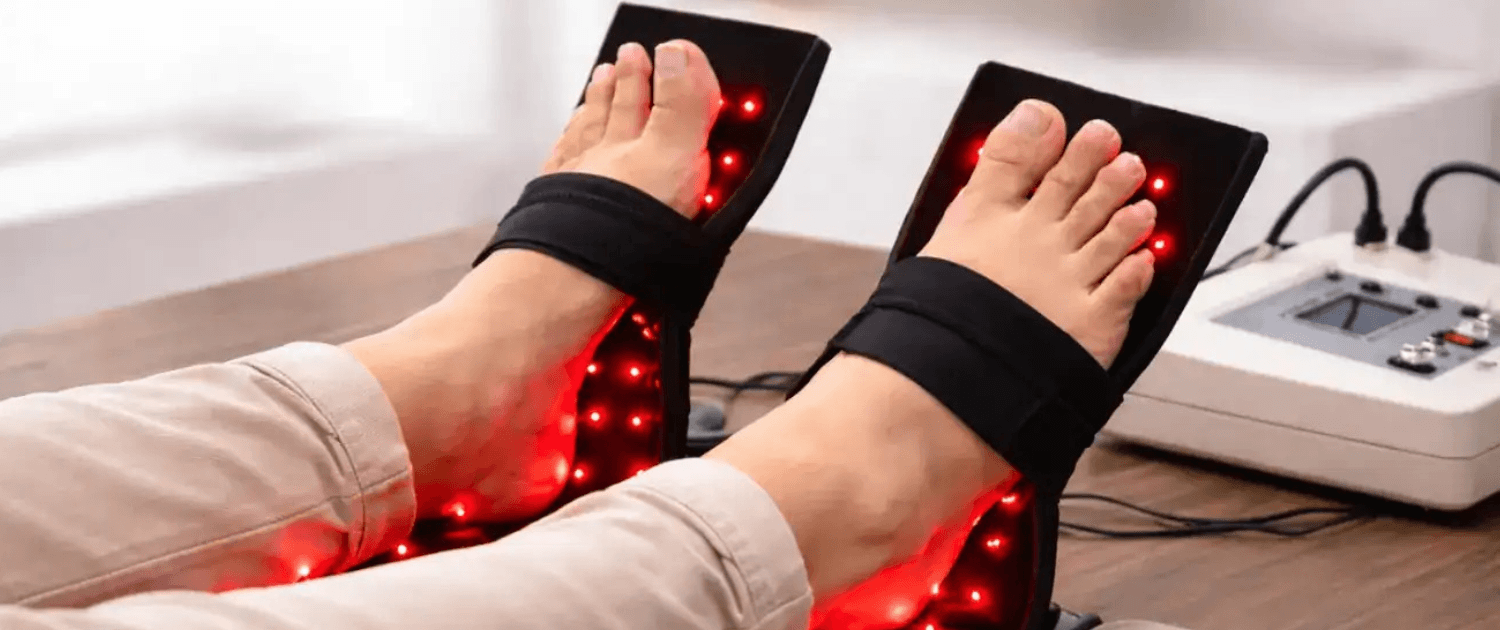
Because neuropathy is overwhelmingly a feet problem — the burning, numb, pins-and-needles soles that bring most people in — the program also uses a dedicated red and near-infrared foot plate built for exactly that target: even, full-coverage exposure across both feet at once, at a real therapeutic dose, rather than a tiny handheld you have to wave around and hope. It’s a small detail that matters, because the feet are where the longest, most vulnerable nerves fail first and where most people need the consistent, properly dosed exposure the cheap devices can’t deliver. The core protocol does the work on the nerve itself; well-dosed, properly powered red and near-infrared light — including at the feet — supports circulation and the tissue environment around it, in clinic and at home.
Does Red Light Therapy Really Work for Neuropathy? An Honest Answer
The published evidence is genuine but modest. Systematic reviews and controlled studies of photobiomodulation in diabetic peripheral neuropathy and chemotherapy-induced neuropathy have shown reduced pain and improved sensation over a treatment course. That’s a real effect, and for many patients it means less burning, better feeling in the feet, and less reliance on medication.
What the honest literature does not support is the device-marketing claim that red light alone “regrows your nerves” or reverses neuropathy from your couch. There is also no good head-to-head evidence that a home LED matches a clinical device. A company selling you a panel will not tell you that. The honest version: red light is a legitimate supporting and maintenance tool, strongest as part of a program matched to your cause — not a standalone cure, and only as good as the device delivering it.
Are You a Candidate for Red Light as Part of Neuropathy Care?
Red light may be a good supporting fit if: you have diabetic, chemotherapy-induced, or idiopathic peripheral neuropathy with burning, tingling, or numbness; you want a comfortable, drug-free layer you can also continue at home; you still have some sensation remaining; and you’re willing to do the full program, not just the easy part.
Red light is not the answer for you if: you’re expecting a home lamp to reverse advanced neuropathy on its own; your neuropathy is being driven by a spinal compression that hasn’t been addressed; you have complete nerve death in the area; or you have an active skin cancer or photosensitizing condition in the treatment area without medical clearance.
If I don’t think we can help you, I’ll tell you directly. I’d rather refer you to someone who can than sell you on a device that won’t deliver. Not everyone is a good candidate, and that’s okay.
🚨 Seek Prompt Medical Care If You Experience:
- Sudden, rapidly progressing weakness or numbness
- Loss of bladder or bowel control
- A foot wound, ulcer, or infection that isn’t healing — especially with diabetes
- Sudden severe pain with no clear cause
What to Expect
Your first visit is a real evaluation, not a sales pitch — history, a neurological assessment, and review of any prior testing, then my honest opinion on whether red light fits, what else your case needs, and realistic expectations. Photobiomodulation sessions are comfortable and non-invasive — a gentle warmth, nothing painful, no recovery time. The effect is cumulative across a series, and where red light is appropriate it runs alongside the rest of the program and, when suitable, continues as a properly specified clinical-grade home complement. Many patients notice changes within the first several weeks; we set realistic expectations from day one.
Why Naperville Patients Choose Our Approach
- Clinical photobiomodulation since 2002 — we don’t guess at dose, wavelength, or protocol the way a marketplace device leaves you to
- 16 years focused on peripheral neuropathy, with direct training under Dr. John Hayes Jr. in 2010
- First Neurogenx 4000Pro provider in Naperville, first Stimpod tPRF provider in Illinois — red light is one honest layer in a real program, not the whole pitch
- A real at-home model — properly specified device and protocol within the Synergy Nerve Restore at-home program, not “buy a lamp and hope”
- Dual-credentialed diagnosis — a chiropractor and Acupuncturist who can tell whether your neuropathy is cellular, spinal, entrapment, or combined
- Honest assessment — we tell you when a device won’t deliver and when a purchase is the wrong one
The short version: red light therapy is a genuine, useful tool for neuropathy — and one of the most oversold gadgets on the internet. Here at Synergy we use it for exactly what photobiomodulation does, at a real clinical dose, inside a program matched to what’s actually wrong with your nerve. That honesty is the difference between buying a lamp and getting a result.
Frequently Asked Questions
What is the best clinic for red light neuropathy treatment in Naperville?
The best choice is a clinic that can diagnose why your nerves are failing and use red light at a real clinical dose for its genuine role, rather than ignoring it or overselling it. Synergy Institute Acupuncture & Chiropractic in Naperville has used clinical photobiomodulation since 2002, with 16 years focused on peripheral neuropathy and a program in which red light supports a voltage-restoration centerpiece and a structured at-home maintenance model.
Does red light therapy really work for neuropathy?
Yes, but as a supporting treatment. Systematic reviews show photobiomodulation reduces pain and improves sensation in diabetic and chemotherapy-induced neuropathy. It does not, by itself, reverse advanced neuropathy, and most underpowered home devices underdeliver. Used at a proper dose as part of a complete program, it is genuinely valuable.
Do at-home red light devices work for neuropathy?
They can — but only if the device is clinical-grade and used correctly and consistently. Most inexpensive imported handhelds and panels are underpowered and never deliver a real therapeutic dose, which is why many people feel nothing and assume red light failed. The cheapest option is usually wasted money, not a bargain. We specify a properly powered, properly dosed device and protocol as part of an at-home plan rather than leaving you to guess off a marketplace listing.
Is red light therapy the same as cold laser or LLLT?
Largely, yes. Red light therapy, LED photobiomodulation, and LLLT (low-level light therapy) are essentially the same thing — therapeutic red and near-infrared light from LEDs working on the mitochondria. Cold laser (low-level laser therapy) is the close cousin: same wavelengths and mechanism, produced by a laser instead of an LED. Laser is focused for small deep targets; LED spreads for broader, comfortable, at-home-friendly coverage. No good research shows one beats the other for neuropathy — dose, power, and matching it to the cause matter far more than the label.
How is red light therapy different from MLS laser?
Both are photobiomodulation — light stimulating the mitochondria. MLS laser is a higher-powered clinical laser used in office where focused depth helps; red light (LED) is gentler and suited to broad, consistent at-home coverage. They’re complementary tools for different jobs, not competitors, and neither is the centerpiece of nerve restoration.
Is there a red light device just for neuropathy in the feet?
Yes — and it matters, because the feet are where peripheral neuropathy hits hardest. Our program uses a dedicated red and near-infrared foot plate designed to treat both feet at once with even, full-coverage exposure at a real therapeutic dose, rather than a small handheld waved around the sole. Red light works at the surface and on circulation; near-infrared penetrates deeper into the tissue around the nerves. It supports the circulation and environment the nerves depend on — it doesn’t act on the nerve’s signaling. For foot neuropathy specifically, coverage, dose, and including true near-infrared are what separate a device that helps from one that just glows.
How often do I need red light therapy?
Photobiomodulation is cumulative and typically used several times per week over a series of weeks, with maintenance afterward. The exact protocol depends on your cause, severity, and how red light fits the rest of your plan. We give you a specific protocol rather than a generic guess.
Does it hurt?
No. Red light therapy is non-invasive and comfortable — most patients feel only a mild warmth, with no recovery time.
Can red light therapy cure neuropathy?
No honest provider should promise a cure. Red light improves circulation and the tissue environment and reduces pain for many patients, but it does not act on the nerve’s signaling. Whether meaningful improvement is possible depends on the cause, the stage, and the full program — not on a light device alone.
Is red light therapy covered by insurance?
Typically no, and like most non-invasive neuropathy therapies it is usually an out-of-pocket or HSA/FSA expense. We’ll go over specifics transparently at your free consultation rather than quoting a package before we know your case.
What wavelength of red light is best for neuropathy?
Research generally uses red and near-infrared light in roughly the 600–900 nm range, with near-infrared penetrating deeper into the tissue. Wavelength alone isn’t enough, though — power and dose determine whether the light actually reaches the depth that matters, which is why device quality matters as much as the number on the box.
What if red light isn’t right for me?
Then we’ll tell you at the evaluation and point you toward what would actually help. We don’t recommend devices to people who won’t benefit. An honest no is more useful than an expensive gadget.
Schedule Your Free Pain Relief Consultation in Naperville
Before you buy a red light device online, find out what’s actually wrong with your nerves and whether red light — at a real clinical dose — even belongs in your plan.
At Synergy Institute in Naperville, my team and I have used clinical photobiomodulation for over two decades — long enough to know exactly what light can and can’t do for neuropathy, and how to dose it so it actually works. If it isn’t the answer for you, I’ll tell you directly, and tell you what is.
Call or text (630) 454-1300 to schedule your free Pain Relief consultation, or call our office directly at (630) 355-8022.
What to expect at your first visit:
- A real evaluation of what’s driving your neuropathy
- An honest assessment of whether red light fits — and what your full plan would involve
- Review of relevant history and any prior testing
- Realistic expectations, not a device pitch
Synergy Institute Acupuncture & Chiropractic 4931 Illinois Rte 59, Suite 121 Naperville, IL 60564 Near the Route 59 and 111th Street intersection.
Serving Naperville, Plainfield, Bolingbrook, Aurora, Oswego, and surrounding communities.
References
- National Institute of Neurological Disorders and Stroke. Peripheral Neuropathy. NIH. https://www.ninds.nih.gov/health-information/disorders/peripheral-neuropathy
- Mayo Clinic. Peripheral neuropathy — Symptoms and causes. https://www.mayoclinic.org/diseases-conditions/peripheral-neuropathy/symptoms-causes/syc-20352061
- Hamblin MR. Mechanisms and applications of the anti-inflammatory effects of photobiomodulation. National Library of Medicine, NIH. https://www.ncbi.nlm.nih.gov/pmc/articles/PMC5523874/
- Korada HY, et al. Effectiveness of photobiomodulation therapy on diabetic peripheral neuropathy: a systematic review. National Library of Medicine, NIH. https://pubmed.ncbi.nlm.nih.gov/37485476/
- Argenta PA, et al. Photobiomodulation in chemotherapy-induced peripheral neuropathy. National Library of Medicine, NIH. https://pubmed.ncbi.nlm.nih.gov/28800942/
- Arnall DA, et al. Monochromatic infrared photo energy and restoration of sensation in diabetic peripheral neuropathy. National Library of Medicine, NIH. https://pubmed.ncbi.nlm.nih.gov/16775895/
- Cleveland Clinic. Peripheral Neuropathy. https://my.clevelandclinic.org/health/diseases/14737-neuropathy
- American Diabetes Association. Diabetic Neuropathy. https://diabetes.org/about-diabetes/complications/neuropathy
- Fernyhough P. Mitochondrial Dysfunction in Diabetic Neuropathy. National Library of Medicine, NIH. https://www.ncbi.nlm.nih.gov/pmc/articles/PMC4239017/
- Zhou L, Wu T, Zhong Z, Yi L, Li Y. Acupuncture for painful diabetic peripheral neuropathy: a systematic review and meta-analysis. Frontiers in Neurology. 2023;14:1281485. https://pmc.ncbi.nlm.nih.gov/articles/PMC10690617/
Medical Disclaimer
This content is for informational and educational purposes only and does not constitute medical advice, diagnosis, or treatment. Always consult with a qualified healthcare provider before making any medical decisions. Individual results may vary.
If you are experiencing a medical emergency, call 911 immediately.