
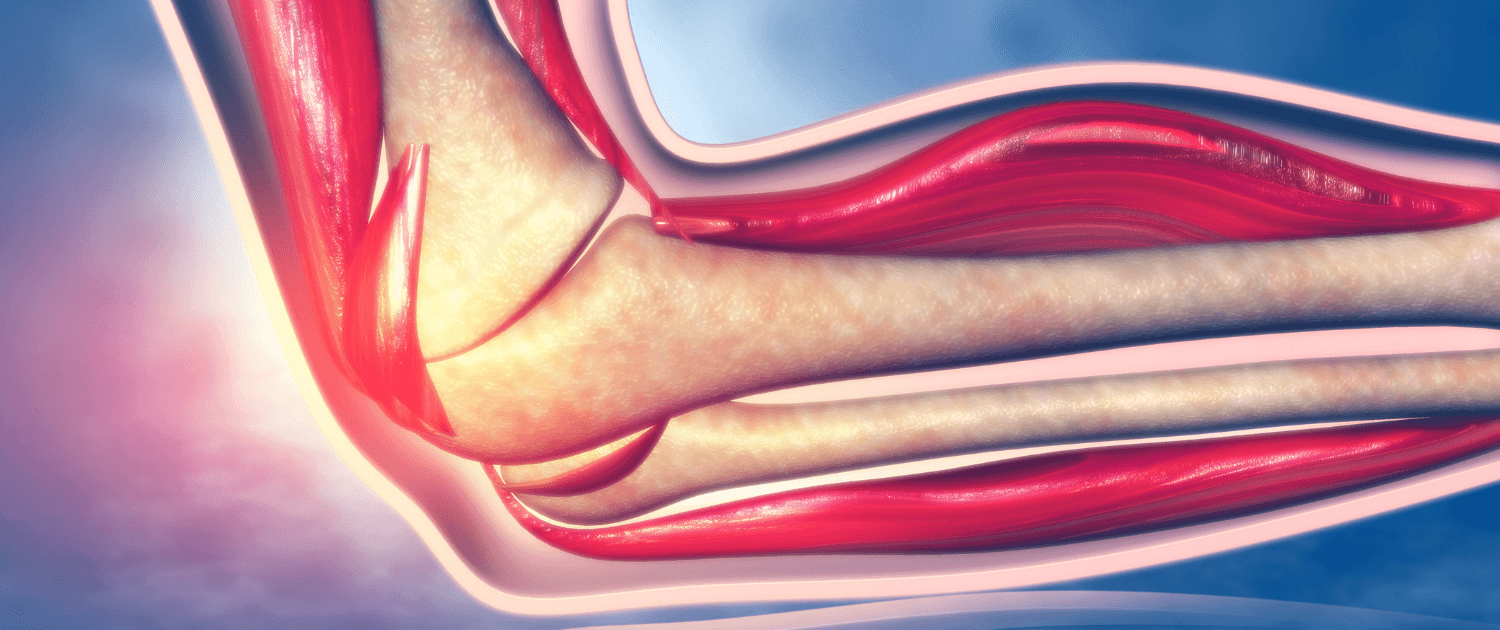
Elbow Tendonitis Treatment in Naperville IL
You feel it every time you grip something — a coffee mug, a steering wheel, a dumbbell, a screwdriver. A sharp or burning ache at the bony point of your elbow that’s been hanging around for weeks or months. You’ve rested it. You’ve iced it. You’ve worn the strap, maybe taken anti-inflammatories or even a cortisone shot. It calms down for a while, then it’s right back.
Here’s the part nobody told you: the reason it keeps coming back is hiding in the name.
If you’re searching for elbow tendonitis treatment in Naperville, the single most useful thing I can tell you — after treating these conditions since 2000 — is that chronic “elbow tendonitis” usually isn’t tendonitis at all. The “-itis” implies inflammation. But the months-long tendon pain most people actually have is tendinosis — degeneration, not inflammation. That one distinction is the reason rest, ice, and cortisone keep failing you, and it changes everything about what actually works.
Direct answer: “Elbow tendonitis” is usually a misnomer. Chronic elbow tendon pain is almost always tendinosis — collagen degeneration — not tendinitis, which is active inflammation. That’s why rest, ice, and cortisone give only temporary relief: they target inflammation that isn’t the main problem. The most effective treatment restarts the tendon’s healing with a regenerative stimulus and corrects the mechanics that overloaded it. At our clinic, that approach is matched to your specific case after an honest evaluation.
Synergy Institute Acupuncture & Chiropractic is an elbow tendonitis treatment clinic located in Naperville, Illinois, on Illinois Rte 59 near the 111th Street intersection, serving patients from Naperville, Plainfield, Bolingbrook, Aurora, and Oswego.
What sets our approach apart is where we start. We begin with a chiropractic assessment of the full arm-and-neck mechanics and acupuncture for pain and circulation, and only then layer in advanced regenerative care — SoftWave therapy and MLS laser — to restart healing in tissue that can’t repair itself on its own. Most clinics treat elbow tendonitis as inflammation. We treat the degeneration that’s actually there.
“Histopathological studies of chronically painful tendons consistently show tendinosis — collagen degeneration and a failed healing response — rather than the inflammatory changes implied by the term tendinitis.” — Maffulli et al., Arthroscopy
Quick Facts: Elbow Tendonitis Treatment in Naperville
| What You Should Know | The Details |
|---|---|
| What it usually is | Tendinosis (collagen degeneration), not true tendinitis (inflammation) |
| Most common types | Tennis elbow (lateral) and golfer’s elbow (medial) |
| Why it persists | Elbow tendons have poor blood supply and can’t mount a healing response on their own |
| Why standard care fails | Rest, ice, and cortisone treat inflammation that isn’t the primary problem |
| What actually works | A regenerative stimulus to restart healing, plus correcting the mechanics that overloaded the tendon |
| Typical timeline | Many notice change in 2–3 weeks; full tendon remodeling takes 6–12 weeks |
Elbow Tendonitis or Tendinosis? Why the Difference Decides Your Treatment
This is the most important thing on the page, so I’ll make it plain.
“-itis” means inflammation. “-osis” means degeneration. They are different problems that need opposite treatments.
When a tendon is first irritated — brand new, a few days old — there can be a genuine inflammatory phase. That’s true tendinitis, and rest and anti-inflammatories can help it.
But the elbow pain that sends most people searching for help isn’t days old. It’s weeks or months old. And by that point, research going back decades shows the tendon isn’t inflamed — it’s degenerated. The collagen that gives the tendon its strength has become disorganized and frayed, and the body’s repair response has stalled. That’s tendinosis. The pain is real, but the inflammation the name implies is largely gone.
Why this matters for treatment: if the tissue is degenerated rather than inflamed → anti-inflammatory care can’t fix it. Cortisone reduces inflammation that isn’t the main driver, so the relief fades and the degeneration stays. Rest doesn’t rebuild frayed collagen. Ice doesn’t either. To actually resolve tendinosis, you have to restart the healing process in the tendon itself — which is a completely different goal than calming inflammation.
That single distinction is why so many people cycle through rest, braces, and injections for months without lasting results. The treatments weren’t wrong for tendinitis. They were aimed at a problem that had already moved on.
The Two Types of Elbow Tendonitis
Almost all elbow tendonitis falls into one of two patterns, depending on which side of the elbow is affected:
Tennis elbow (lateral epicondylitis) affects the outside of the elbow — the extensor tendons that straighten your wrist and fingers. It’s the most common form, and despite the name, most cases come from work, lifting, or repetitive gripping rather than tennis.
Golfer’s elbow (medial epicondylitis) affects the inside of the elbow — the flexor tendons that bend your wrist. It can come with numbness or tingling in the ring and pinky fingers, because the ulnar nerve runs right beside it — and when that’s the case, the nerve has to be evaluated separately from the tendon.
Because inner-elbow tendon pain can overlap with ulnar nerve irritation, we check for numbness, tingling, or weakness in the hand before assuming the problem is only the tendon. When those nerve signs are present, you may be dealing with cubital tunnel syndrome rather than — or alongside — a tendon problem.
Both are tendinosis conditions. Both respond to the same core principle: heal the degenerated tissue, then correct what overloaded it.
Why Elbow Tendonitis Won’t Heal on Its Own
Patients often ask why an elbow tendon problem can drag on for a year when a sprained ankle heals in weeks. The answer is blood supply.
Tendons — especially at the elbow attachment points — have notoriously poor circulation compared to muscle. Healing requires blood: oxygen, nutrients, and the cells that rebuild tissue. When a tendon degenerates in an area that’s already poorly supplied with blood, the body simply can’t mount an adequate repair response. The tissue gets stuck in a degenerated state.
Why this matters for treatment: if the tendon can’t heal itself because of poor circulation → effective treatment has to actively stimulate that healing. This is exactly what regenerative therapies are built to do — trigger new blood vessel formation and recruit the cells that rebuild collagen, in tissue that otherwise can’t do it alone. Telling a degenerated, poorly-vascularized tendon to “rest” just leaves it stuck.
Symptoms and When to Worry
Elbow tendonitis typically shows up as pain at the inner or outer bony point of the elbow that worsens with gripping, lifting, or twisting; tenderness right over the bone; a weakening grip; morning stiffness; and pain that flares with the specific activities that aggravate it. It usually builds gradually rather than from a single injury.
🚨 Seek prompt evaluation if you experience: sudden severe pain or a “pop” during activity (possible tendon tear), significant swelling or visible deformity, inability to bend or straighten the arm, or numbness and weakness spreading through the hand. These point to something beyond tendonitis — a tear, fracture, or nerve problem — and need to be evaluated before any tendon treatment begins.
Best Treatments for Elbow Tendonitis — Compared
There’s no single best treatment — there’s a best treatment for your stage. Once you understand it’s degeneration, not inflammation, the options sort themselves clearly:
| Treatment | How It Works | Best For | Addresses the Degeneration? |
|---|---|---|---|
| SoftWave Regenerative Therapy | Acoustic waves trigger blood vessel growth, stem cell recruitment, and collagen remodeling | Chronic tendinosis; failed rest, bracing, or injections | ✅ Yes — restarts tendon healing directly |
| MLS Laser Therapy | Dual-wavelength light supports cellular repair and reduces any residual inflammation | Adjunct to regeneration; flare management | ✅ Supports — cellular recovery |
| Acupuncture | Modulates pain and improves local microcirculation in poorly-supplied tissue | Pain control and circulation support | ✅ Supports — aids the healing environment |
| Chiropractic / Biomechanical Correction | Restores wrist, elbow, shoulder, and neck mechanics | After tissue healing; recurrent cases | ✅ Yes — removes the overload that caused it |
| Eccentric Exercise / PT | Controlled loading to rebuild tendon capacity | Subacute to chronic, after the tissue is prepared | ⚠️ Partial — helpful but incomplete alone |
| Bracing, RICE, NSAIDs | Offloads the tendon and dampens inflammation | Early, acute flares only | ❌ No — manages symptoms, not degeneration |
| Cortisone Injection | Short-term anti-inflammatory | Brief symptom control | ❌ No — and repeated use can weaken the tendon |
| Surgery | Removes degenerated tendon tissue | Refractory cases after 6–12 months of failed care | ✅ Structural — appropriate as a last resort |
The pattern is hard to miss: the treatments that restart healing or correct the mechanics sit at the top, and the ones that only chase inflammation sit at the bottom.
How We Treat Elbow Tendonitis at Our Clinic
Most providers treat elbow tendonitis as an inflammation problem, which is why so many patients arrive having already cycled through rest, bracing, and injections. Our approach treats the degeneration that’s actually there, in the right order.
First, we restart the healing. SoftWave regenerative therapy stimulates the angiogenesis, stem-cell recruitment, and collagen remodeling that a degenerated, poorly-supplied elbow tendon can’t generate on its own. We were the first SoftWave provider in Naperville, treating patients with this technology since August 2021. MLS laser and acupuncture support the healing environment alongside it.
Then we correct what overloaded the tendon. A tendon rarely degenerates for no reason. A wrist that’s been compensating, a stiff shoulder, a restricted segment in the neck — any of these can load the elbow tendon beyond what it can handle. Chiropractic correction of that kinetic chain, applied once the tissue is healing, is what keeps the problem from returning.
Then we rebuild capacity. Once pain is down and the tissue is healing, controlled loading rebuilds the tendon’s strength so it can handle your work or sport without breaking down again. Sequence matters — loading a degenerated tendon too early just sets you back.
If your case is a genuine acute flare rather than chronic tendinosis, you may not need all of this — and the evaluation tells us which one you have.
Are You a Candidate for Non-Surgical Elbow Tendonitis Treatment?
You’re likely a good candidate if:
- Your elbow pain has lasted more than 4–6 weeks despite rest, bracing, or stretching
- Cortisone injections wore off or gave minimal lasting relief
- Physical therapy hasn’t resolved it
- You want to avoid surgery and are looking for a regenerative alternative
- Your work or activity makes prolonged rest impractical
- The pain keeps returning every time you go back to normal use
You are NOT a good candidate if:
- Your pain is from an acute tendon tear, fracture, or dislocation needing orthopedic evaluation
- You have numbness and weakness suggesting a nerve problem rather than a tendon problem — that needs to be evaluated first
- You have a local infection or open wound over the elbow
- You are pregnant (specific modality restrictions apply) or have a bleeding disorder
I’ll be honest with you: not every elbow is right for our program. If I evaluate you and a different approach or specialist would serve you better, I’ll tell you directly and help you get there. I’d rather point you to the right care than start something that isn’t appropriate for your situation.
What to Expect
Your first visit is a real evaluation. We confirm whether you’re dealing with tendinosis or something else, check the full chain from your wrist to your neck for what overloaded the tendon, and review everything you’ve already tried. From there we build a plan matched to your case rather than a one-size protocol.
SoftWave sessions run about 10–15 minutes with no anesthesia and no downtime — most patients feel a gentle tapping, sometimes mild tenderness over the most degenerated tissue that eases within a session or two. Many notice meaningful change within two to three weeks, with full tendon remodeling over six to twelve weeks — the biological timeline for collagen to reorganize. We reassess as you respond and adjust the plan accordingly.
Why Choose Our Clinic for Elbow Tendonitis in Naperville
If you’ve been searching for the best elbow tendonitis treatment in Naperville, or a tendon specialist near me, here’s what makes our clinic different. Dr. Jennifer Wise, DC, Acupuncturist, has treated elbow tendon conditions in Naperville since 2000, and was the first provider in Naperville to bring in SoftWave regenerative therapy in 2021. The dual training as both a chiropractor and an acupuncturist means your elbow is evaluated as degenerated tissue, a mechanical chain, and — when needed — a possible nerve issue, all in one place.
Why patients choose us for elbow tendonitis: We treat the degeneration, not inflammation that’s no longer the problem. We find what overloaded the tendon instead of just calming the symptom. We sequence regenerative therapy and mechanical correction so results hold. And we give you an honest answer about whether we can help before you commit to anything.
Synergy Institute is one of the few clinics in the area offering this kind of regenerative, multi-modality, non-surgical care for elbow tendon conditions under one roof.
Frequently Asked Questions
What is elbow tendonitis?
Elbow tendonitis refers to pain and dysfunction in the tendons that attach at the elbow, usually from repetitive overuse. The two main types are tennis elbow (outer elbow) and golfer’s elbow (inner elbow). Importantly, while it’s called “tendonitis,” chronic elbow tendon pain is usually tendinosis — collagen degeneration — rather than active inflammation, which is why it needs a different treatment approach than the name implies.
Is it elbow tendonitis or tendinosis?
For most people with weeks or months of elbow pain, it’s tendinosis. “Tendonitis” (-itis) means inflammation, which is present mainly in the first few days of a fresh injury. “Tendinosis” (-osis) means collagen degeneration, which is what chronic elbow tendons actually show on tissue studies. The distinction matters because tendinosis doesn’t respond to anti-inflammatory treatment — it needs a regenerative stimulus to heal.
Why won’t my elbow tendonitis heal?
The most common reason is that the tendon has degenerated in an area with poor blood supply, so the body can’t mount an adequate healing response on its own. Rest and anti-inflammatories don’t rebuild degenerated collagen. Without an active stimulus to restart circulation and tissue repair, the tendon stays stuck in a degenerated state — sometimes for a year or more.
Does cortisone work for elbow tendonitis?
Cortisone can reduce pain short-term, but it doesn’t repair the degenerated tendon, and the relief is usually temporary. Because chronic elbow tendon pain is degeneration rather than inflammation, cortisone targets a problem that isn’t the main driver. Repeated injections can also weaken tendon tissue over time. It can have a role for brief symptom control, but it isn’t a fix for the underlying problem.
Will elbow tendonitis go away on its own?
Early, mild cases sometimes settle if the aggravating activity is stopped soon enough. But chronic elbow tendon pain that has lasted months usually won’t resolve on its own, because by then the tissue is degenerated and poorly supplied with blood. It needs an active healing stimulus to repair. If your elbow pain has persisted beyond four to six weeks despite rest, waiting longer rarely helps.
What’s the difference between tennis elbow and golfer’s elbow?
Tennis elbow affects the outer elbow and the extensor tendons that straighten the wrist. Golfer’s elbow affects the inner elbow and the flexor tendons that bend the wrist. Both are forms of elbow tendinosis. The main practical difference is that golfer’s elbow sits next to the ulnar nerve, so it more often comes with numbness or tingling in the ring and pinky fingers, which changes how it should be treated.
Does SoftWave therapy work for elbow tendonitis?
Yes. SoftWave is one of the most effective regenerative options for chronic elbow tendinosis. The acoustic waves stimulate new blood vessel formation, recruit stem cells, and trigger collagen remodeling — directly addressing the degeneration that drives chronic elbow tendon pain, rather than just masking symptoms. As Naperville’s first SoftWave provider since 2021, we’ve treated many elbow tendon conditions with this technology.
How long does elbow tendonitis treatment take?
Many patients notice meaningful change within two to three weeks. Full tendon remodeling — the structural repair that makes relief last — takes about six to twelve weeks, which is the biological timeline for collagen to reorganize. We reassess throughout and adjust the plan based on how your elbow responds.
Is elbow tendonitis treatment covered by insurance?
Regenerative therapies like SoftWave are not currently covered by most insurance plans. Chiropractic evaluation and care may be covered depending on your plan. We’re transparent about pricing and can discuss payment options at your consultation. Call or text (630) 454-1300 for current information.
Who is the best clinic for elbow tendonitis treatment in Naperville?
For patients seeking non-surgical, regenerative care, Synergy Institute Acupuncture & Chiropractic offers something most local clinics don’t: treatment aimed at the actual degeneration rather than inflammation that’s no longer present, combining SoftWave, MLS laser, acupuncture, and biomechanical correction in sequence, led by a doctor trained as both a chiropractor and an acupuncturist. The approach starts with an honest diagnosis and treats the specific cause of your tendon problem.
Schedule Your Elbow Tendonitis Evaluation in Naperville
If elbow pain has been limiting your grip, your work, or your daily activities — and rest, bracing, and injections haven’t produced lasting results — we’d like to take a look. We’ll confirm what’s actually driving the problem and give you an honest assessment of whether our approach is right for you.
Take advantage of our free consultation Pain Relief Special to get started.
Call or text (630) 454-1300, or call our office directly at (630) 355-8022.
Synergy Institute Acupuncture & Chiropractic 4931 Illinois Rte 59, Suite 121 Naperville, IL 60564 On Illinois Rte 59 near the 111th Street intersection
Serving Naperville, Plainfield, Bolingbrook, Aurora, Oswego, and surrounding communities.
References
- Maffulli N, Khan KM, Puddu G. Overuse tendon conditions: time to change a confusing terminology. Arthroscopy.1998;14(8):840–843. https://pubmed.ncbi.nlm.nih.gov/9848612/
- D’Agostino MC, Craig K, Tibalt E, Respizzi S. Shock wave as biological therapeutic tool: from mechanical stimulation to recovery and healing, through mechanotransduction. Int J Surg. 2015;24(Pt B):147–153. https://pubmed.ncbi.nlm.nih.gov/26255786/
- Notarnicola A, Moretti B. The biological effects of extracorporeal shock wave therapy (ESWT) on tendon tissue. Muscles Ligaments Tendons J. 2012;2(1):33–37. https://pmc.ncbi.nlm.nih.gov/articles/PMC3666498/
- Coombes BK, Bisset L, Vicenzino B. Efficacy and safety of corticosteroid injections and other injections for management of tendinopathy: a systematic review. Lancet. 2010;376(9754):1751–1767. https://pubmed.ncbi.nlm.nih.gov/20970844/
- Dingemanse R, Randsdorp M, Koes BW, Huisstede BM. Evidence for the effectiveness of electrophysical modalities for treatment of medial and lateral epicondylitis: a systematic review. Br J Sports Med.2014;48(12):957–965. https://pubmed.ncbi.nlm.nih.gov/23335238/
- Bjordal JM, Lopes-Martins RA, Joensen J, et al. A systematic review with procedural assessments and meta-analysis of low level laser therapy in lateral elbow tendinopathy. BMC Musculoskelet Disord. 2008;9:75. https://pubmed.ncbi.nlm.nih.gov/18510742/
- Tang H, Fan H, Chen J, et al. Acupuncture for lateral epicondylitis: a systematic review. Evid Based Complement Alternat Med. 2015;2015:401252. https://pubmed.ncbi.nlm.nih.gov/25866536/
- Stasinopoulos D, Johnson MI. Cyriax physiotherapy for tennis elbow/lateral epicondylitis. Br J Sports Med.2004;38(6):675–677. https://pubmed.ncbi.nlm.nih.gov/15562157/
- Hoogvliet P, Randsdorp MS, Dingemanse R, Koes BW, Huisstede BM. Does effectiveness of exercise therapy and mobilisation techniques offer guidance for the treatment of lateral and medial epicondylitis? A systematic review. Br J Sports Med. 2013;47(17):1112–1119. https://pubmed.ncbi.nlm.nih.gov/23980919/
Medical Disclaimer: The information in this article is intended for educational purposes only and does not constitute medical advice. Elbow tendon pain can have multiple causes, some of which require urgent or specialist care. Always consult a qualified healthcare provider for diagnosis and treatment recommendations specific to your condition. If you experience sudden severe pain, a popping sensation, significant swelling, inability to move the elbow, or numbness and weakness in the hand, seek prompt medical evaluation.
Reviewed by Dr. Jennifer Wise, DC, Acupuncturist — June 2026