Sciatica vs Piriformis Syndrome: Why Getting the Wrong Diagnosis Keeps You in Pain
You’ve been stretching your piriformis religiously. Foam rolling until you’re sore. Maybe you’ve even tried the tennis ball trick, digging into your glute while lying on the floor. Your friend swore it worked for her sciatica.
But weeks later, that burning pain still shoots down your leg. The numbness in your foot hasn’t budged. And now you’re starting to wonder: What if I’ve been treating the wrong thing this whole time?
Here’s what I tell patients at Synergy Institute in Naperville who come in frustrated after months of failed self-treatment: sciatica isn’t actually a diagnosis — it’s a symptom. The sciatic nerve is being irritated somewhere. The question is where — and that determines everything about what will actually fix it.
The two most common culprits? A problem in your spine (usually a disc pressing on a nerve root) or a problem in your hip (the piriformis muscle squeezing the nerve). Same nerve. Same leg pain. Completely different causes — and completely different treatments.
Get it wrong, and you waste months doing exercises that don’t help or might even make things worse. Get it right, and you can finally start healing.
In this article, I’ll walk you through exactly how to tell the difference — what to look for, what questions to ask, and what each condition actually requires to get better.
Quick Facts: Sciatica vs Piriformis Syndrome
| True Sciatica (Lumbar Radiculopathy) | Piriformis Syndrome | |
|---|---|---|
| Where it starts | Spine (nerve root compression) | Hip/buttock (muscle compression) |
| Primary pain location | Lower back + leg (often to foot) | Deep in buttock + back of thigh |
| Lower back pain? | Usually yes | Usually minimal or none |
| What makes it worse | Sitting, bending forward, lifting | Prolonged sitting, crossing legs, stairs |
| Key diagnostic test | Straight Leg Raise (SLR) | FAIR test |
| Shows on MRI? | Often yes (disc herniation visible) | Usually no |
| How common? | ~40% of adults experience it | ~5-6% of sciatica cases |
What Is Sciatica — Really?
Let me clear up a common misconception: sciatica is not a condition. It’s a description of symptoms — specifically, pain that travels along the path of the sciatic nerve.
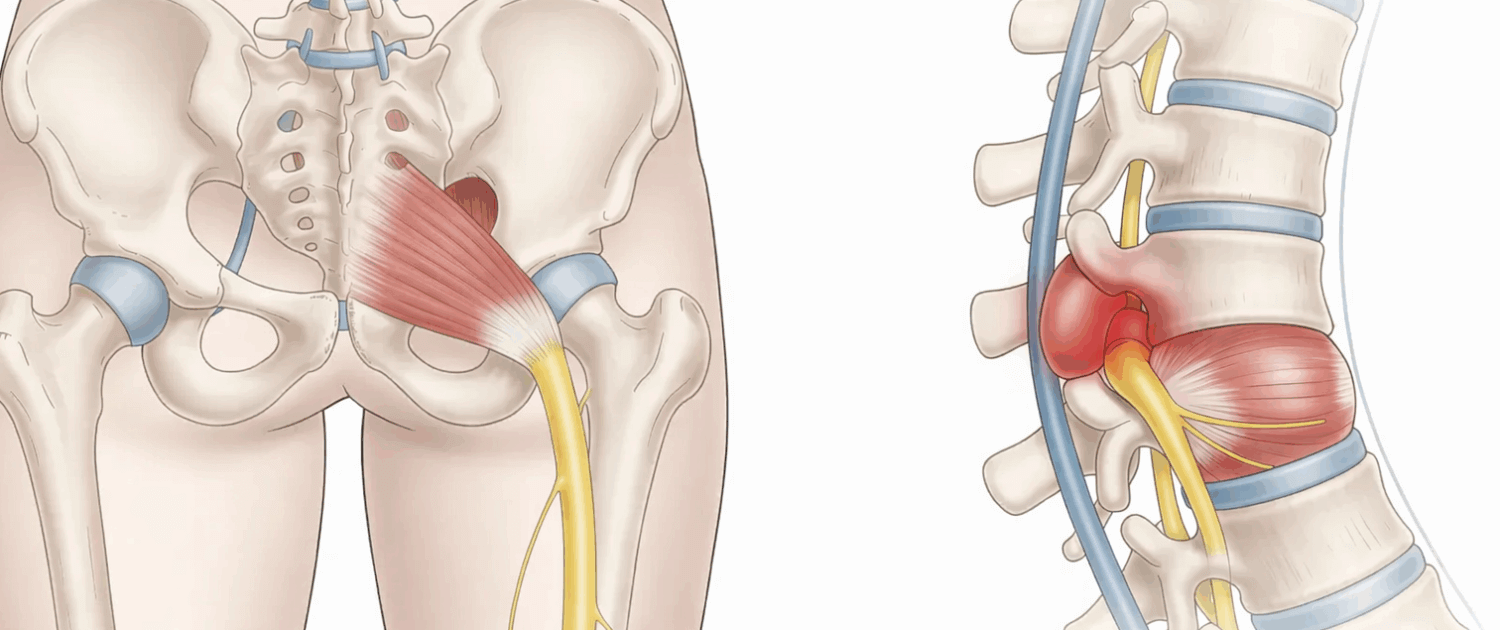
The sciatic nerve is the largest nerve in your body. It forms from nerve roots that exit your lower spine (L4, L5, S1, S2, S3), bundling together before traveling through your pelvis and down the back of each leg to your feet.
When doctors talk about “true sciatica” — or use the medical term lumbar radiculopathy — they mean the nerve roots themselves are being compressed or irritated where they exit the spine. This pinched nerve problem is in your back, even though you feel it in your leg.
What Causes True Sciatica?
The most common causes of spinal nerve root compression include:
- Herniated disc — The inner gel of a spinal disc pushes out and presses on a nerve root. This is the most frequent cause in people under 50.
- Degenerative disc disease — As discs wear down with age, they lose height and can bulge into the nerve space.
- Spinal stenosis — The spinal canal narrows, squeezing the nerve roots. More common after age 50.
- Spondylolisthesis — One vertebra slips forward over another, pinching the nerve.
The key point? With true sciatica, the problem is structural — something in your spine is physically compressing the nerve root. That’s why treatments targeting the spine (like spinal decompression) work, and treatments targeting only the muscles often don’t.
What Is Piriformis Syndrome?
Piriformis syndrome is a different animal entirely. The compression happens outside the spine — in your buttock.
The piriformis is a small, flat muscle that sits deep in your glute, running from your sacrum (the triangular bone at the base of your spine) to the top of your thigh bone. Its job is to help rotate your hip outward and stabilize your pelvis when you walk.
Here’s where it gets interesting: the sciatic nerve runs right past this muscle. In most people, the nerve passes underneaththe piriformis. But in about 10-20% of the population, the sciatic nerve actually passes through the piriformis muscle itself — which may predispose those people to piriformis syndrome.
When the piriformis muscle becomes tight, inflamed, or goes into spasm, it can squeeze or irritate the sciatic nerve. The result? Pain and symptoms that feel almost identical to sciatica — but the spine is completely normal.
What Causes Piriformis Syndrome?
- Prolonged sitting — Especially on hard surfaces or with a wallet in your back pocket
- Overuse or repetitive strain — Runners, cyclists, and people who climb lots of stairs
- Trauma — A fall onto the buttock or a car accident
- Muscle imbalance — Weak glutes forcing the piriformis to overwork
- Poor hip mechanics — Altered gait patterns that stress the muscle
This is why piriformis syndrome is sometimes called “wallet sciatica” or “pseudo-sciatica” — it mimics the real thing but comes from a completely different source.
Why These Two Conditions Get Confused
It’s not hard to see why patients (and sometimes even practitioners) mix these up:
Both cause pain that radiates down the leg. The sciatic nerve is involved in both cases — it’s just being compressed at different points along its path. This leg pain and numbness can feel identical regardless of where the compression occurs.
Both can cause numbness, tingling, and weakness. When a nerve is irritated, the symptoms are similar regardless of where the compression occurs.
Both can be triggered by sitting. Sitting increases pressure on lumbar discs and compresses the piriformis against the sciatic nerve.
Neither shows up well on standard imaging. MRI can reveal a disc herniation, but piriformis syndrome rarely shows up on any scan. And some people have disc bulges on MRI that aren’t actually causing their symptoms — leading to misdiagnosis in the other direction.
The frustrating reality? Many people get labeled with generic “sciatica,” handed a sheet of stretches, and sent on their way — without anyone determining whether the problem is in the spine or the hip. That’s a recipe for failed treatment.
Key Differences: How to Tell Sciatica from Piriformis Syndrome
While these conditions overlap, there are meaningful differences in how they present. Here’s what to pay attention to:
Comparison Table: Symptoms and Patterns
| Feature | True Sciatica | Piriformis Syndrome |
|---|---|---|
| Pain location | Lower back radiating down leg, often past the knee to foot | Deep buttock pain, may radiate to back of thigh (usually stops above knee) |
| Lower back pain | Common — often the primary complaint | Minimal or absent |
| Leg feels “heavy” | Yes — common description | Less common |
| Worse with | Sitting (especially slouched), bending forward, coughing/sneezing, lifting | Sitting (especially on hard surfaces), crossing legs, climbing stairs, prolonged standing |
| Better with | Walking (sometimes), lying down with knees bent | Walking (often), changing positions frequently |
| Pain at night | Often disrupts sleep; may wake you up | Less likely to wake you; more related to position |
| Tenderness to touch | Not usually in buttock | Direct pressure on piriformis reproduces pain |
The Pattern That Points to Your Spine
If your pain clearly starts in your lower back and shoots down your leg — especially if it travels past your knee toward your foot — that pattern suggests nerve root compression at the spine. The further down the leg the pain travels, the more likely a spinal cause.
Other clues pointing to lumbar radiculopathy:
- Pain worsens when you bend forward, sit for long periods, or bear down (like during a bowel movement)
- Coughing or sneezing sends a jolt down your leg
- Your leg feels weak or “gives out”
- Numbness follows a specific pattern (like the outside of your calf or top of your foot)
The Pattern That Points to Your Piriformis
If your pain is centered deep in your buttock — with or without radiation down the back of your thigh — and your lower back feels fine, piriformis syndrome moves up the list.
Other clues pointing to piriformis involvement:
- Pain gets worse when sitting on hard surfaces (or sitting on your wallet)
- Climbing stairs or walking uphill aggravates it
- Crossing your legs or sitting with knees together increases pain
- Direct pressure on the middle of your buttock reproduces the symptoms
- Stretching your hip into internal rotation provokes pain
How to Start Figuring Out Which One You Have
While a proper diagnosis requires professional evaluation, here are some simple self-assessments that can give you clues:
Self-Test #1: Press on the Piriformis
Lie on your back with your knees bent. Use your fingers or a tennis ball to apply firm pressure to the middle of your buttock — roughly where the piriformis muscle sits (between your sacrum and the bony point of your hip).
What it suggests:
- If pressing here reproduces your leg symptoms or creates significant tenderness, piriformis involvement is possible.
- If pressing here doesn’t do much, the piriformis is less likely to be the primary culprit.
Self-Test #2: The Forward Bend Test
Stand up and slowly bend forward, reaching toward your toes. Pay attention to what happens as you round your spine.
What it suggests:
- If bending forward increases your leg pain or sends symptoms shooting down your leg, that points toward a disc or spinal cause. Forward bending increases disc pressure.
- If forward bending doesn’t change your leg symptoms much, the spine may not be the main issue.
Self-Test #3: The Sitting Comparison
Notice what happens when you sit in different situations:
- Sitting slouched on a soft couch
- Sitting upright in a firm chair
- Sitting on a hard surface (like a wooden bench)
What it suggests:
- Slouched sitting on soft surfaces that round your lower back → often worse with spinal causes
- Sitting on hard surfaces that compress your buttock → often worse with piriformis syndrome
- Both positions bothering you? Could be either — or both.
Self-Test #4: The Straight Leg Raise
Lie flat on your back on a firm surface. Keep one leg flat and slowly raise the other leg straight up (keeping the knee locked).
What it suggests:
- If pain shoots down your leg when it’s raised between 30-70 degrees, this is a positive sign for nerve root irritation at the spine (this is a simplified version of the clinical Straight Leg Raise test).
- If you can raise your leg without reproducing leg pain, a spinal cause is less likely.
Important Caveat
These self-tests offer clues, not conclusions. The patterns overlap, and some people have both conditions simultaneously — a disc problem plus a tight piriformis that’s developed as a compensation. That’s why professional evaluation matters.
What these tests can tell you: if everything points in one direction, you may have been treating the wrong condition. And that’s valuable information.
Why the Right Diagnosis Changes Everything
Here’s the bottom line: the treatment that works for true sciatica is completely different from the treatment that works for piriformis syndrome.
If you have a herniated disc pressing on a nerve root and you spend months stretching your piriformis, you’re not addressing the actual problem. The disc is still bulging. The nerve root is still compressed. No amount of hip stretching will change that.
Worse, some exercises that help piriformis syndrome can actually aggravate a disc herniation. Certain stretches that involve deep forward bending or pulling the knee to the chest can increase disc pressure — potentially making a lumbar problem worse.
The reverse is also true. If your problem is purely piriformis syndrome and someone puts you through a spinal decompression protocol, you might feel some relief (decompression is relaxing), but you won’t fix the muscle that’s squeezing your nerve.
This is why so many people cycle through treatments without getting better. They’re not failing to respond to treatment — they’re getting the wrong treatment for their actual condition.
Treatment for Disc-Related Sciatica
When the problem is in your spine — a herniated disc, bulging disc, or stenosis compressing a nerve root — treatment needs to address that structural issue.
At Synergy Institute, our approach to disc-related sciatica includes:
Spinal Decompression Therapy
Non-surgical spinal decompression uses computer-controlled traction to gently create negative pressure within the disc. This helps:
- Draw the bulging disc material back toward the center
- Increase blood flow and nutrient delivery to the damaged disc
- Take pressure off the compressed nerve root
We were one of the first clinics in Illinois to offer spinal decompression back in 2002, and I’ve used six or seven different machines over the years. That experience matters — knowing exactly how to position patients, what angles work for different disc levels, and how to progress treatment appropriately.
For a deeper look at how this treatment specifically addresses sciatic nerve pain, see our complete guide to spinal decompression for sciatica relief.
Chiropractic Care
Chiropractic adjustments address joint dysfunction in the spine that contributes to abnormal loading on the discs. When vertebrae aren’t moving properly, it creates uneven pressure that can accelerate disc problems.
Nerve Inflammation Treatment
Here’s something most clinics miss: even after you reduce pressure on a nerve, the nerve itself is often inflamed and dysfunctional. Simply taking pressure off doesn’t automatically restore normal nerve function.
That’s why we incorporate electrotherapy and other modalities that address the nerve tissue itself — helping reduce inflammation and restore proper nerve signaling.
Treatment for Piriformis Syndrome
When the problem is the piriformis muscle compressing the sciatic nerve, the approach is completely different. Spinal decompression won’t help because the spine isn’t the issue.
SoftWave Therapy
SoftWave therapy uses acoustic waves to reduce inflammation, break up scar tissue and adhesions, and promote healing in soft tissue. For piriformis syndrome, we apply SoftWave directly to the piriformis muscle and surrounding gluteal tissue.
We’ve been offering SoftWave in Naperville since 2021 — one of the first clinics in Illinois to have this technology. It’s particularly effective for stubborn muscle problems that haven’t responded to stretching and massage alone.
Soft Tissue Work
Manual therapy targeting the piriformis and surrounding hip muscles can release tension and restore normal muscle function. This might include specific massage techniques, trigger point therapy, or instrument-assisted soft tissue mobilization.
Movement Pattern Correction
Many cases of piriformis syndrome develop because of faulty movement patterns — weak glutes that force the piriformis to overwork, or hip mechanics that create repetitive strain. Addressing these patterns prevents the problem from coming back.
For persistent cases, we may use ARP Neurotherapy to identify and correct the neuromuscular dysfunction driving the problem.
The Synergy Approach: Why We Can Treat Both
Here’s what makes our clinic different: we can accurately diagnose which condition you have AND provide the appropriate treatment for either one — or both.
Most clinics specialize in one thing. A physical therapy clinic might focus on exercises and stretching. A chiropractic office might focus on adjustments. A pain management clinic might offer injections.
But what if the first approach doesn’t work because you were treating the wrong condition?
At Synergy Institute, we have spinal decompression for disc problems, SoftWave therapy for soft tissue problems, chiropractic for joint dysfunction, acupuncture for pain and inflammation, and advanced technologies for nerve recovery.
We match the treatment to what’s actually causing your pain — not the other way around.
And if I don’t think we can help you? I’ll tell you directly. I’d rather refer you to the right specialist than waste your time and money on treatment that won’t work for your specific situation.
When to Seek Professional Help
Most sciatica and piriformis syndrome cases respond well to conservative treatment when properly diagnosed. But some situations require immediate attention.
🚨 Seek Immediate Medical Care If You Experience:
- Progressive weakness in your leg or foot — especially if you’re tripping or can’t lift your foot (foot drop)
- Bowel or bladder changes — loss of control or inability to urinate. This could indicate cauda equina syndrome, a medical emergency.
- Numbness in the “saddle area” — the inner thighs and groin
- Symptoms in both legs simultaneously
- Severe, unrelenting pain that doesn’t respond to any position change
- Unexplained weight loss with back pain
- Pain following significant trauma (car accident, fall)
These red flags suggest potentially serious nerve compression that may require urgent intervention.
Seek Professional Evaluation If:
- Your symptoms have persisted more than 2-4 weeks without improvement
- Home treatments and self-care aren’t helping
- Pain is interfering with sleep, work, or daily activities
- You’ve tried treating one condition but aren’t getting better (may be the wrong diagnosis)
- Symptoms are gradually worsening
Frequently Asked Questions
Can you have both sciatica and piriformis syndrome at the same time?
Yes, and it’s more common than people realize. A disc problem can cause nerve irritation that leads to muscle guarding and tightness in the piriformis. Or you might have two separate issues contributing to your symptoms. This is one reason proper evaluation matters — treating only one problem when both exist leads to incomplete results.
How long does piriformis syndrome take to heal?
With appropriate treatment, many people see significant improvement within 2-4 weeks. However, chronic cases that have been present for months may take 6-8 weeks or longer. The key is addressing both the muscle itself and the underlying factors (movement patterns, posture, activity) that caused it.
Will an MRI show piriformis syndrome?
Usually no. Standard MRI sequences rarely show piriformis muscle abnormalities, which is one reason this condition gets missed. MRI is more useful for ruling out spinal causes. Piriformis syndrome is primarily diagnosed through clinical examination and symptom patterns.
What makes piriformis syndrome worse?
Prolonged sitting (especially on hard surfaces), crossing your legs, climbing stairs, running, and activities involving repetitive hip rotation. Sitting on a wallet in your back pocket is a classic aggravator — it compresses the piriformis directly against the sciatic nerve.
Can piriformis syndrome cause foot numbness?
Yes, though it’s less common than with lumbar radiculopathy. Because the sciatic nerve travels all the way to the foot, piriformis compression can potentially cause symptoms anywhere along that path. However, foot numbness is more typical of nerve root compression at the spine.
Is piriformis syndrome permanent?
No. Piriformis syndrome is very treatable and typically resolves with appropriate intervention. However, it can recur if the underlying causes (muscle imbalance, poor posture, repetitive strain) aren’t addressed. The goal is both resolving the current episode and preventing future ones.
What is the fastest way to cure sciatica?
There’s no instant cure, but the fastest path to relief is getting the correct diagnosis first. Treatment that matches your actual condition works much faster than generic approaches. For disc-related sciatica, spinal decompression combined with appropriate therapy can provide significant relief within 2-4 weeks for many patients.
Should I stretch if I have sciatica?
It depends on the cause. Some stretches help piriformis syndrome but can worsen disc herniations. Others are safe for disc problems but won’t help if the piriformis is the issue. This is why generic “sciatica stretches” from the internet often fail — they don’t account for what’s actually causing your symptoms.
Can a chiropractor help with piriformis syndrome?
Yes. Chiropractors who offer soft tissue therapies, not just spinal adjustments, can effectively treat piriformis syndrome. At Synergy Institute, we combine manual therapy, SoftWave, and movement correction to address both the muscle and the factors causing it to become problematic.
How do I know if my sciatica is serious?
Warning signs include progressive weakness, bowel or bladder changes, numbness in the groin/inner thighs, and symptoms affecting both legs. These suggest significant nerve compression requiring urgent evaluation. Sciatica that’s gradually worsening despite treatment also warrants professional assessment to rule out serious underlying causes.
Take the First Step Toward the Right Diagnosis
If you’ve been treating what you thought was sciatica without getting better, there’s a good chance you’ve been targeting the wrong problem. The difference between disc-related sciatica and piriformis syndrome isn’t just academic — it determines what treatment will actually work.
At Synergy Institute in Naperville, we take the time to figure out exactly what’s causing your pain before recommending treatment. Because the right diagnosis is the first step toward real relief.
Ready to find out what’s really causing your leg pain?
Call or text us at (630) 454-1300 to schedule your consultation. Or call (630) 355-8022.
Synergy Institute Acupuncture & Chiropractic 4931 Illinois Route 59, Suite 121 Naperville, IL 60564
Serving Naperville, Plainfield, Bolingbrook, Aurora, Oswego, and surrounding communities.
Medical Disclaimer
This article is for informational purposes only and does not constitute medical advice. The self-assessment tests described are not substitutes for professional diagnosis. Always consult with a qualified healthcare provider for proper evaluation of your symptoms, especially if you experience any red flag symptoms described above. Individual results from treatment vary based on the specific cause and severity of your condition.
References
- Davis D, Maini K, Vasudevan A. Sciatica. StatPearls [Internet]. 2023. Available from: https://www.ncbi.nlm.nih.gov/books/NBK507908/
- Hicks BL, Lam JC, Varacallo M. Piriformis Syndrome. StatPearls [Internet]. 2023. Available from: https://www.ncbi.nlm.nih.gov/books/NBK448172/
- Hopayian K, Song F, Riera R, Sambandan S. The clinical features of the piriformis syndrome: a systematic review. Eur Spine J. 2010;19(12):2095-2109.
- Koes BW, van Tulder MW, Peul WC. Diagnosis and treatment of sciatica. BMJ. 2007;334(7607):1313-1317.
- Probst D, Stout A, Hunt D. Piriformis Syndrome: A Narrative Review of the Anatomy, Diagnosis, and Treatment. PM R. 2019;11 Suppl 1:S54-S63.
- Stynes S, Konstantinou K, Ogollah R, Hay EM, Dunn KM. Clinical diagnostic model for sciatica developed in primary care patients with low back-related leg pain. PLoS One. 2018;13(4):e0191852.
- Ropper AH, Zafonte RD. Sciatica. N Engl J Med. 2015;372(13):1240-1248.
- Misirlioglu TO, Akgun K, Palamar D, Erden MG, Erbilir T. Piriformis syndrome: comparison of the effectiveness of local anesthetic and corticosteroid injections. Pain Physician. 2015;18(2):163-171.
- Cassidy L, Walters A, Bubb K, Shoja MM, Tubbs RS, Loukas M. Piriformis syndrome: implications of anatomical variations, diagnostic techniques, and treatment options. Surg Radiol Anat. 2012;34(6):479-486.
- Fishman LM, Dombi GW, Michaelsen C, et al. Piriformis syndrome: diagnosis, treatment, and outcome—a 10-year study. Arch Phys Med Rehabil. 2002;83(3):295-301.