SoftWave Therapy for Neuropathy in Naperville: An Honest Clinical Guide
If you’ve been researching SoftWave therapy for neuropathy, you’ve probably found two extremes online. Some clinics promise that SoftWave alone will reverse your neuropathy — language that vastly overstates what any single therapy does for nerve damage. Other sources dismiss SoftWave entirely as expensive marketing. Neither version is honest, and neither helps you make a good decision about your nerves.
The difference between spending money on partial care and actually getting your nerves back is knowing exactly what SoftWave can and can’t do.
The truth sits in the middle, and it matters. SoftWave is genuinely valuable for neuropathy — but it’s a piece of the puzzle, not the whole picture. Understanding exactly what SoftWave does well, what it doesn’t do, and how it fits into a complete neuropathy treatment plan is the difference between buying a single-modality program and getting a protocol that actually addresses the cause of your nerve damage.
I’m Dr. Jennifer Wise. I’ve spent 26 years treating complex pain and nerve conditions in Naperville, with 16 of those years focused specifically on peripheral neuropathy. I was Naperville’s first SoftWave provider — we brought the TRT OrthoGold 100 to the area in August 2021 — and I’ve performed thousands of SoftWave treatments since. As an early adopter, I’ve spent the last four-plus years continuously refining how SoftWave fits into our neuropathy protocol, and the most recent evolution is the integration of the Neurogenx 4000Pro into our voltage-restoration phase. This guide is the honest clinical explanation of where SoftWave fits in neuropathy care — what it’s exceptional at, what it can’t do, and what the complete picture actually looks like.
Synergy Institute Acupuncture & Chiropractic is one of the most experienced neuropathy treatment practices in Naperville, located off Route 59 near the 111th Street intersection. We use SoftWave as one component of a multi-modality, sequenced approach — not as a standalone neuropathy treatment — and the honest case for and against SoftWave for your specific situation is the conversation we’ll have with you at your evaluation.
What separates our neuropathy care is the integration of foundational clinical work — chiropractic care and acupuncture — with the advanced regenerative and bioelectric technologies the condition actually requires. Chiropractic and acupuncture address the structural, neurological, and energetic factors that compression, postural patterns, and chronic nervous system stress contribute to neuropathy. From that foundation, we layer in SoftWave for tissue regeneration and microcirculation, the Neurogenx 4000Pro and Stimpod NMS460 for nerve signaling restoration, ARPwave for bioelectric recovery, MLS laser and red light for cellular support, and metabolic correction work to address the cause. Foundational care plus advanced technology, sequenced together — not a single device sold as a cure.
SoftWave therapy for neuropathy — what you should know: SoftWave is genuinely excellent at stimulating microcirculation, activating new blood vessel growth (angiogenesis), and accelerating tissue healing — all real mechanisms that matter for the small-vessel side of neuropathy. But circulation and tissue healing alone don’t restore nerve signaling or correct the metabolic environment driving the damage. The neuropathy patients who get real results pair SoftWave with electrotherapy that addresses nerve signaling and a metabolic foundation that addresses the cause. At Synergy Institute Acupuncture & Chiropractic, that’s exactly how we use it.
Multiple studies on focused shockwave therapy for peripheral neuropathy demonstrate improvements in nerve conduction and patient-reported pain when shockwave is used as part of a multimodal protocol — but the published evidence consistently emphasizes that single-modality approaches produce smaller and less durable gains than properly sequenced multimodality care. SoftWave’s role is best understood as a circulation and tissue-regeneration component of a complete neuropathy plan.
Our approach to SoftWave for neuropathy: we identify the real cause driving your nerve dysfunction, address the metabolic environment, restore nerve signaling with our electrotherapy stack, and use SoftWave to support the circulation and tissue-healing layer of recovery — in sequence, customized to your specific case.
To find out whether SoftWave is genuinely right for your neuropathy, call or text (630) 454-1300 to schedule a $49 Discovery Session.
Quick Facts: SoftWave for Neuropathy at a Glance
| Question | Answer |
|---|---|
| What does SoftWave actually do? | Stimulates microcirculation, angiogenesis (new blood vessel growth), and tissue regeneration |
| Why does that matter for neuropathy? | Diabetic and idiopathic neuropathy are largely small-vessel diseases — nerves are being starved by damaged microcirculation |
| Will SoftWave alone fix my neuropathy? | No — and any provider claiming otherwise is overstating it. SoftWave addresses one layer; nerves also need signaling restoration and a corrected metabolic foundation |
| Who should consider it? | Neuropathy patients whose case is appropriate for tissue-regeneration support, paired with electrotherapy and metabolic care |
| Who shouldn’t? | Patients with severe, complete, long-standing nerve loss; patients unwilling to address the metabolic and signaling layers |
| Is it FDA-cleared? | Yes — FDA-cleared for tissue regeneration and improved blood supply |
| How long is treatment? | A neuropathy course is typically a series of sessions over several weeks alongside the other protocol layers |
What SoftWave Therapy Actually Is — In Plain Clinical Terms
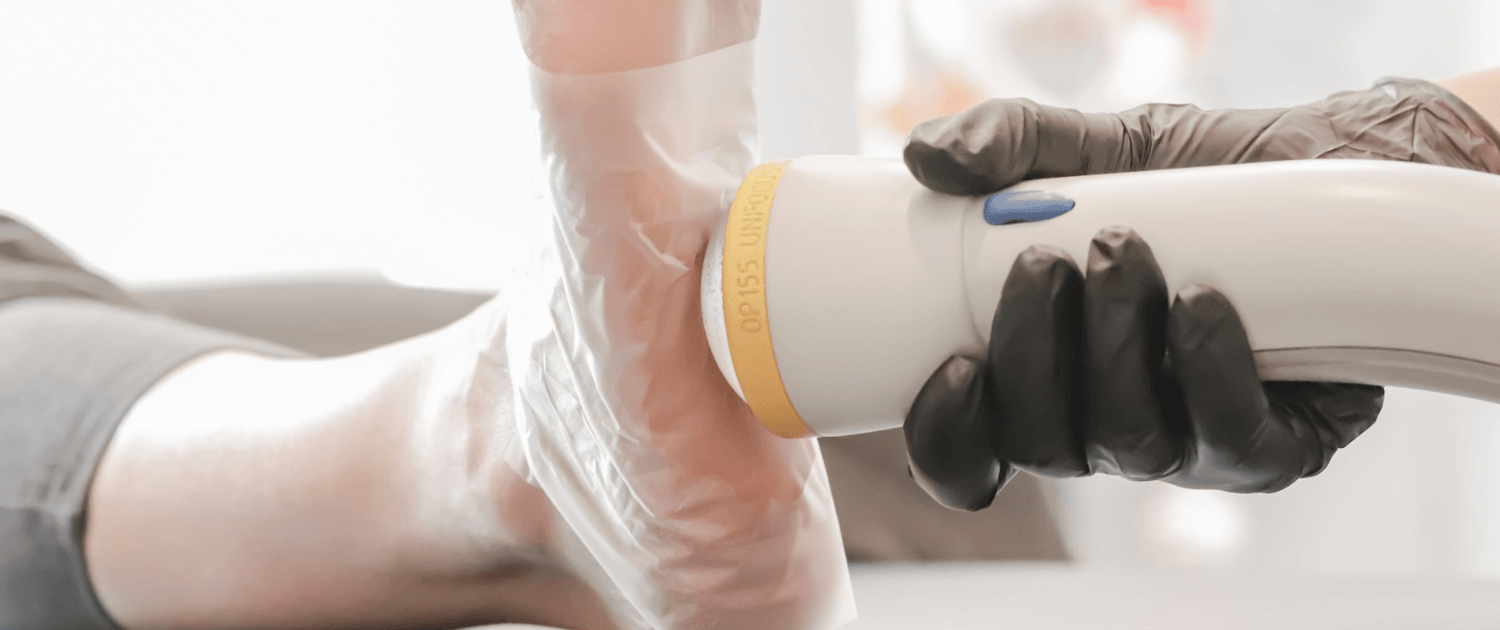
SoftWave is a specific type of acoustic wave therapy that uses unfocused (broad-spread) electrohydraulic shockwaves to penetrate tissue and trigger the body’s own regenerative response. The device we use at Synergy is the TRT OrthoGold 100 — the original SoftWave technology, the same platform trusted by professional sports medicine teams, and importantly not the same as the radial pressure-wave devices many “shockwave” clinics use. The technology difference matters enormously, and it’s why “SoftWave” and “shockwave” are often used interchangeably online but aren’t actually the same thing. The full breakdown of SoftWave vs shockwave technology in Naperville walks through what separates the devices and why it matters for results.
What the acoustic waves do at the tissue level is well-documented in the published literature: they stimulate the release of growth factors, activate resident stem cells, increase the production of nitric oxide (a key signaling molecule for blood vessel function), and trigger angiogenesis — the growth of new microcirculation. For tissue that’s been chronically deprived of blood supply, like the nerves in peripheral neuropathy, that mechanism is directly relevant to one of the root problems.
Why Circulation Matters So Much for Neuropathy
Here’s the clinical reality most neuropathy articles skip. Diabetic peripheral neuropathy — the most common form by a wide margin — is fundamentally a small-vessel disease at the cellular level. The nerves aren’t being attacked directly by some external force. They’re being slowly starved by damage to the tiny blood vessels (called the vasa nervorum) that supply them with oxygen and nutrients. High blood sugar damages these microvessels first; the nerves they feed begin to fail second. Idiopathic neuropathy frequently involves the same mechanism, even when no diabetes diagnosis is in the picture.
This is why a therapy that genuinely improves microcirculation matters for neuropathy. If you can restore blood supply to nerves that are dysfunctional but not destroyed, you give those nerves the metabolic substrate they need to start repairing. SoftWave’s documented effect on angiogenesis and microvascular function is directly matched to this part of the neuropathy problem. That’s a real mechanism, not marketing language — and it’s why SoftWave has a legitimate role in a serious neuropathy protocol.
What SoftWave Can’t Do for Neuropathy
This is where the honest clinical picture diverges from what some clinics will tell you. Improving blood supply to dysfunctional nerves is necessary for recovery, but it isn’t sufficient. Two other layers of the neuropathy problem don’t respond to SoftWave directly, and pretending they do is how patients end up disappointed after expensive SoftWave-only programs.
Layer one — nerve signaling and voltage dysfunction. When peripheral nerves are damaged, they don’t only suffer from impaired blood supply. They also lose the electrical signaling capacity that lets them transmit information properly. They fire erratically, signal poorly, and stay stuck in dysfunctional firing patterns. Better circulation doesn’t fix that. Restoring nerve signaling requires therapies that act directly on the nerve electrical activity — high-frequency electrotherapy, targeted neuromodulation, and bioelectric stimulation. SoftWave doesn’t do this.
Layer two — the metabolic environment causing the damage. If high blood sugar, B12 deficiency, autoimmune activity, or inflammation is actively damaging the microcirculation in the first place, improving that circulation with SoftWave is fighting an uphill battle while the cause keeps doing damage. The metabolic foundation has to be addressed — blood sugar regulation, specific nutrient deficiencies, anti-inflammatory work — or the gains SoftWave produces will be partial and won’t hold over time. SoftWave doesn’t do this either.
This is why neuropathy patients who get real, durable results from SoftWave are almost always patients whose treatment plan addresses all three layers: metabolic foundation, nerve signaling restoration, and circulation and tissue regeneration. SoftWave is excellent at the third layer. It’s not designed to be the first or second.
Why Top SoftWave Providers Pair It With Other Modalities
The pattern is consistent across the most experienced SoftWave clinicians in the country who treat neuropathy. Single-modality SoftWave is not the standard of care for neuropathy in the hands of providers who actually understand the condition. Some pair SoftWave with polychromatic light therapy systems for at-home use. Others pair it with high-frequency electrotherapy in clinic. The specific pairings vary; the multi-modality principle does not. The reason is exactly what the previous section laid out: nerves need more than improved circulation to actually recover, and the providers seeing real outcomes have built their protocols around that clinical fact.
That’s not a knock on SoftWave-only clinics — they’re often right about what SoftWave does. They’re just incomplete on what neuropathy needs. The mechanism is real; the protocol is partial. Patients searching for SoftWave for neuropathy deserve to know the difference before they spend money.
Many patients who find their way to us have already been through a single-modality SoftWave or shockwave program elsewhere and are trying to understand why the early improvements didn’t hold. The answer is almost always the same: SoftWave did exactly what it does well, but nothing in their plan addressed the nerve signaling dysfunction or the metabolic environment that kept damaging their nerves between sessions.
How We Use SoftWave for Neuropathy at Synergy
Our neuropathy protocol — the Synergy Nerve Restore Program — is built around three sequenced phases, and SoftWave’s role is specific.
Neuropathy recovery requires three layers — SoftWave addresses one of them:
| Layer | What It Addresses | Synergy Modalities |
|---|---|---|
| 1. Metabolic Foundation | The cause and the cellular environment | Blood sugar regulation, targeted nutrients (B12, alpha-lipoic acid, methylfolate), anti-inflammatory work, molecular hydrogen |
| 2. Nerve Signaling Restoration | The voltage and electrical dysfunction in the nerves themselves | Neurogenx 4000Pro (high-frequency, 400–60,000 Hz), Stimpod NMS460 (targeted neuromodulation), ARPwave (bioelectric recovery) |
| 3. Tissue Regeneration & Circulation | Microcirculation, angiogenesis, and tissue-level healing | SoftWave (TRT OrthoGold 100), MLS laser, photobiomodulation, acupuncture |
SoftWave belongs in Layer 3. It’s exceptional at what Layer 3 requires. It’s not designed to replace Layer 1 or Layer 2 — and that’s the entire point of how we use it.
Phase 1: Cellular Foundation. Before any device-based therapy, we address the metabolic environment. Blood sugar regulation, the specific nutrient deficiencies your bloodwork reveals, anti-inflammatory work, and the cellular substrate nerves need to repair. For many diabetic and pre-diabetic patients, this layer alone produces meaningful improvement before anything else is added.
Phase 2: Voltage and Signaling Restoration. This is where our electrotherapy stack does the work that SoftWave doesn’t. We integrate the Neurogenx 4000Pro — a high-frequency device operating from 400 to 60,000 Hz, the broadest spectrum currently available in this category — as the centerpiece for broad-spectrum nerve signaling restoration. We pair it with the Stimpod NMS460 for targeted neuromodulation when specific nerve roots or peripheral nerves need precision work, and ARPwave for bioelectric recovery. This is the layer that addresses the nerve dysfunction itself. As an early SoftWave adopter, integrating Neurogenx into the protocol is the most recent evolution in our continuous refinement of how we treat neuropathy — and to my knowledge, we’re among the first SoftWave-certified clinics to bring Neurogenx into the protocol this way.
Phase 3: Circulation and Tissue Regeneration. This is where SoftWave belongs. The TRT OrthoGold 100 is applied to the relevant areas — typically the feet and lower legs for distal neuropathy — to stimulate microcirculation, angiogenesis, and the tissue-level healing the nerves and their supporting vasculature need. We often combine it with MLS laser, photobiomodulation, and acupuncture in this phase for compounding tissue-support effect.
That’s the sequence. The point isn’t that SoftWave is more or less important than the other layers — it’s that all three layers matter, and the protocol is what produces the result, not any individual device.
Who Is and Isn’t a Good Candidate for SoftWave Neuropathy Treatment
You may be a good candidate if:
- You have a confirmed neuropathy diagnosis with dysfunctional but not completely destroyed nerves
- You’re willing to address the metabolic foundation, not just the in-office treatment
- Your case has a circulation and tissue-regeneration component (most diabetic and idiopathic neuropathy cases do)
- You want a complete protocol, not a single-modality program
- You’ve been told “nothing more can be done” but haven’t had a cause-matched, multi-modality plan
You may NOT be a good candidate if:
- You have severe, complete, long-standing nerve loss with no remaining function — there are biological limits no therapy overcomes
- You’re looking for SoftWave alone, without the metabolic and signaling work
- You’re unwilling to address blood sugar, nutrient deficiencies, or inflammation
- Your symptoms match emergency red flags (sudden weakness, rapidly progressing numbness, loss of bladder or bowel control) — you need urgent medical care, not a treatment program
- You have certain contraindications (active malignancy in the treatment area, certain blood-clotting conditions, pregnancy)
If I don’t think SoftWave is the right fit for your specific case, I’ll tell you directly. The most important thing a SoftWave provider can offer you is honest assessment of whether you’re a candidate — and what the complete protocol looks like for your situation. Generic “neuropathy programs” skip that conversation. We start with it. (For more on what to look for in a neuropathy provider beyond device marketing, see our guide on how to choose the best doctor for neuropathy in Naperville.)
What to Expect at Your SoftWave Neuropathy Evaluation
Your first visit is an evaluation, not a treatment start. We review your diagnostic history and nerve conduction results if you have them, look hard at the metabolic and nutritional picture most workups underweight, and answer one question honestly before recommending anything: is your neuropathy the kind we can realistically help, and if so, what does the complete protocol look like for your specific case? If SoftWave is appropriate, we explain exactly where it fits and what to expect. If something else is more appropriate first, we say so. If we don’t think we can help your case, we tell you that directly and point you toward the right next step.
SoftWave Therapy for Neuropathy in Naperville — Why Patients Choose Synergy
If you’re searching for the best SoftWave provider near me, the most experienced SoftWave specialist in Naperville, or a neuropathy clinic that does more than sell you one device, here’s why Synergy keeps showing up in those searches:
- First SoftWave provider in Naperville — operating the TRT OrthoGold 100 since August 2021, with thousands of treatments performed
- Early adopter continuously refining the neuropathy protocol — most recent evolution is the integration of the Neurogenx 4000Pro
- Multi-modality protocol rather than single-device program — full bioelectric stack plus metabolic foundation
- 26+ years of clinical experience treating complex pain and nerve conditions
- 16+ years focused on peripheral neuropathy, including certified NeuropathyDR training from Dr. John Hayes Jr. in 2010
- Honest candidacy assessment before any treatment begins
- Conveniently located off Route 59 near the 111th Street intersection in Naperville
To find out whether SoftWave fits your specific neuropathy case, call or text (630) 454-1300.
Frequently Asked Questions
Does SoftWave therapy work for neuropathy?
SoftWave has a real, documented mechanism that matters for neuropathy: it stimulates microcirculation, activates angiogenesis (new blood vessel growth), and accelerates tissue healing. Because diabetic and idiopathic peripheral neuropathy are largely driven by damage to the small blood vessels supplying the nerves, restoring microcirculation directly addresses one of the root problems. However, SoftWave alone does not restore the nerve signaling dysfunction or correct the metabolic environment causing the damage — both of which require additional therapies. SoftWave works best for neuropathy when it is one component of a multi-modality, sequenced protocol.
Can SoftWave cure neuropathy?
“Cure” is the wrong framework for peripheral neuropathy in most cases. The honest answer is that meaningful improvement is realistic for many neuropathy patients when the underlying cause is addressed, nerve signaling is restored, and tissue-level healing is supported in sequence. SoftWave can be a valuable part of that picture, but no single therapy — SoftWave or otherwise — is a neuropathy cure. Any clinic claiming SoftWave alone will cure your neuropathy is overstating what the technology does.
How is SoftWave different from regular shockwave therapy?
SoftWave uses unfocused electrohydraulic shockwave technology — broad-spread acoustic waves generated by a precise spark-gap mechanism — which penetrates deeper into tissue and treats a wider area than the radial pressure-wave devices most “shockwave” clinics use. The original SoftWave platform, the TRT OrthoGold 100, is the same technology trusted by professional sports medicine teams. The technology difference matters: not all shockwave devices produce equivalent clinical effects, even though they are often marketed interchangeably.
How many SoftWave sessions do I need for neuropathy?
A neuropathy protocol typically involves a series of sessions over several weeks, integrated with the other components of your treatment plan rather than scheduled as a standalone course. The exact number depends on your case — how long the neuropathy has been present, how much nerve function remains, what other layers of the protocol you’re engaging with, and how your case responds. We give you a realistic timeline at your evaluation rather than a generic package promise.
Is SoftWave therapy painful?
Most patients describe SoftWave treatment as well-tolerated. Some areas may feel briefly intense during application, but the sensation is typically described as a thumping or tapping pressure rather than sharp pain. There is no recovery downtime — patients return to normal activities immediately after a session.
Is SoftWave FDA-cleared?
Yes. SoftWave technology is FDA-cleared for the treatment of musculoskeletal conditions and for improving blood supply and tissue regeneration. The TRT OrthoGold 100 platform we operate at Synergy is the original SoftWave system.
Why should I pay for SoftWave when other clinics offer cheaper shockwave for neuropathy?
The device matters enormously. Lower-priced “shockwave” clinics typically use radial pressure-wave devices, which produce different clinical effects than focused or unfocused electrohydraulic SoftWave technology. More importantly for neuropathy, single-modality programs — whether SoftWave or anything else — produce smaller and less durable results than properly sequenced multi-modality protocols. The question is not “what’s the cheapest SoftWave” but “what’s the complete protocol my neuropathy actually needs.”
Will my insurance cover SoftWave for neuropathy?
SoftWave is generally not covered by health insurance for neuropathy. However, the treatment is HSA and FSA eligible with a Letter of Medical Necessity, which we provide for qualifying patients. We also offer CareCredit financing. We discuss the practical and financial picture transparently at your evaluation.
Can SoftWave help with diabetic neuropathy specifically?
Diabetic peripheral neuropathy is fundamentally a small-vessel disease at the cellular level — the nerves are starved by damage to their microcirculation. SoftWave’s documented effect on microcirculation and angiogenesis is directly matched to this mechanism, which is why SoftWave has a legitimate role in diabetic neuropathy treatment. However, the metabolic foundation work (blood sugar regulation, specific nutrient correction) and nerve signaling restoration are equally important for diabetic neuropathy, and SoftWave alone won’t address them. The complete protocol matters most for diabetic patients.
Where can I get SoftWave therapy for neuropathy in Naperville?
Synergy Institute Acupuncture & Chiropractic was Naperville’s first SoftWave provider, operating the TRT OrthoGold 100 since August 2021. Dr. Jennifer Wise is the area’s most experienced SoftWave clinician, with thousands of treatments performed and a continuously evolving neuropathy protocol that pairs SoftWave with our complete bioelectric stack and metabolic foundation work. Located off Route 59 near the 111th Street intersection, serving Naperville, Plainfield, Bolingbrook, Aurora, and Oswego. Call or text (630) 454-1300 to schedule your $49 Discovery Session.
Schedule Your SoftWave Neuropathy Evaluation
The first step is finding out honestly whether SoftWave fits your specific neuropathy case — and what the complete protocol looks like for your situation. We’re currently offering a $49 Discovery Session: a focused evaluation to assess your neuropathy, identify the underlying cause, determine whether SoftWave belongs in your protocol, and lay out a realistic plan.
Synergy Institute Acupuncture & Chiropractic 4931 Illinois Rte 59, Suite 121 Naperville, IL 60564 (off Route 59 near the 111th Street intersection)
Call or text (630) 454-1300, or call our office directly at (630) 355-8022.
Serving Naperville, Plainfield, Bolingbrook, Aurora, Oswego, and surrounding communities.
References
- National Institute of Neurological Disorders and Stroke. Peripheral Neuropathy. https://www.ninds.nih.gov/health-information/disorders/peripheral-neuropathy
- Mayo Clinic. Peripheral neuropathy — Symptoms and causes. https://www.mayoclinic.org/diseases-conditions/peripheral-neuropathy/symptoms-causes/syc-20352061
- Feldman EL, et al. Diabetic neuropathy. Nature Reviews Disease Primers. https://pubmed.ncbi.nlm.nih.gov/31197153/
- Wang CJ. Extracorporeal shockwave therapy in musculoskeletal disorders. Journal of Orthopaedic Surgery and Research. https://pubmed.ncbi.nlm.nih.gov/22433113/
- Yamaya S, et al. Low-energy extracorporeal shock wave therapy promotes vascular endothelial growth factor expression and improves locomotor recovery after spinal cord injury. Journal of Neurosurgery. https://pubmed.ncbi.nlm.nih.gov/24579661/
- d’Agostino MC, et al. Shock wave as biological therapeutic tool: From mechanical stimulation to recovery and healing, through mechanotransduction. International Journal of Surgery. https://pubmed.ncbi.nlm.nih.gov/26118603/
- National Institute of Diabetes and Digestive and Kidney Diseases. Peripheral Neuropathy. https://www.niddk.nih.gov/health-information/diabetes/overview/preventing-problems/nerve-damage-diabetic-neuropathies/peripheral-neuropathy
- Cashman CR, Höke A. Mechanisms of distal axonal degeneration in peripheral neuropathies. Neuroscience Letters. https://pubmed.ncbi.nlm.nih.gov/25617478/
- Hammi C, Yeung B. Neuropathy. StatPearls, National Library of Medicine. https://www.ncbi.nlm.nih.gov/books/NBK542220/
This content is for informational and educational purposes only and does not constitute medical advice, diagnosis, or treatment. Always consult with a qualified healthcare provider before making any medical decisions. Individual results may vary. If you are experiencing a medical emergency, call 911 immediately.
Reviewed by Dr. Jennifer Wise, DC, Acupuncturist — May 2026