
Shockwave vs. SoftWave Therapy in Naperville IL — What’s the Difference?
f you’ve been researching shockwave therapy in Naperville, you’ve probably noticed something confusing: clinic websites use the words “shockwave” and “SoftWave” as if they’re interchangeable — but they’re not. Patients ask me about this constantly. Someone will come in having already tried shockwave therapy somewhere else, frustrated that it didn’t hold, wondering why I keep talking about SoftWave like it’s something different.
It is something different. Significantly different.
I’m Dr. Jennifer Wise, DC, Acupuncturist at Synergy Institute in Naperville, and I’ve spent more than 26 years treating chronic pain and musculoskeletal injuries. We were the first clinic in Naperville to offer SoftWave therapy — in August 2021 — and I’ve performed thousands of treatments since. What I’ve learned in that time is that the device matters enormously, and most patients have no idea there are fundamental differences between the machines being used on them.
This article will clear that up. By the time you finish reading, you’ll understand exactly what separates SoftWave from other shockwave devices, what those differences mean for your recovery, and how to ask the right questions before your first appointment anywhere.
Synergy Institute Acupuncture & Chiropractic offers SoftWave therapy and shockwave therapy for musculoskeletal pain, tendon injuries, arthritis, neuropathy, and chronic pain conditions in Naperville, IL.
We combine SoftWave therapy with chiropractic care, acupuncture, spinal decompression, and MLS laser for a comprehensive approach that single-treatment clinics cannot match.
A 2023 narrative review published in Healthcare (MDPI), analyzing evidence from 3,517 studies on extracorporeal shockwave therapy for musculoskeletal pain, confirmed that ESWT produces analgesic, osteogenic, and tissue-reparative effects — and that focal shockwaves generated by electrohydraulic methods achieve high intensity at depth while treating a larger axial volume than electromagnetic or piezoelectric alternatives.
Looking for shockwave or SoftWave therapy in Naperville? Call or text (630) 454-1300 to schedule your evaluation.
The direct answer: SoftWave is a form of true electrohydraulic shockwave therapy. Most clinics in Naperville offering “shockwave therapy” use radial pressure wave devices — which are not true shockwaves and work on fundamentally different principles. At Synergy Institute, we use the TRT OrthoGold 100, the only patented unfocused electrohydraulic shockwave device in North America. It delivers broad-focused true shockwaves that penetrate up to 4–5 inches deep, activate the body’s own stem cells, and create angiogenesis — mechanisms that radial devices cannot replicate. If you’re looking for true shockwave therapy in Naperville, the device matters. Choose a provider using authentic electrohydraulic technology, not a radial pressure wave machine.
Shockwave Therapy Quick Facts
| Details | |
|---|---|
| What it is | Extracorporeal Shockwave Therapy (ESWT) — acoustic waves applied to injured tissue to stimulate healing |
| Main types | Radial/acoustic wave, focused ESWT, unfocused ESWT (SoftWave) |
| How it works | Mechanical stimulation triggers cellular repair, angiogenesis, and inflammation modulation |
| Session length | 10–20 minutes depending on area |
| Typical sessions | 6–8 for SoftWave; 8–18 for other devices |
| Pain during treatment | Varies by device — SoftWave is comfortable; focused ESWT can require anesthesia |
| Insurance | Typically self-pay |
| Available at Synergy | Yes — TRT OrthoGold 100 (authentic SoftWave device) |
What Is Shockwave Therapy?
Shockwave therapy — formally called Extracorporeal Shockwave Therapy, or ESWT — is a non-invasive treatment that uses acoustic pressure waves to stimulate healing in injured or chronically painful tissue. The basic concept has been around since the 1970s, when researchers discovered that acoustic waves could break up kidney stones without surgery. Clinicians later found that lower-energy versions of those same waves could stimulate tissue repair, reduce inflammation, and promote the formation of new blood vessels.
Today, shockwave therapy is used widely for conditions like plantar fasciitis, tendonitis, rotator cuff injuries, tennis elbow, arthritis, and chronic back pain. It’s non-surgical, drug-free, and backed by decades of clinical research.
The problem — and this is what most patients don’t realize — is that “shockwave therapy” is an umbrella term covering several completely different technologies. The device being used matters as much as the treatment itself.
Not All Shockwave Devices Are Equal — The Full Picture
Here’s where the confusion starts. Walk into ten different clinics in the Naperville area offering “shockwave therapy” and you may encounter three or four completely different devices that work on entirely different principles. Let me break them down clearly.
Radial/Acoustic Wave Devices
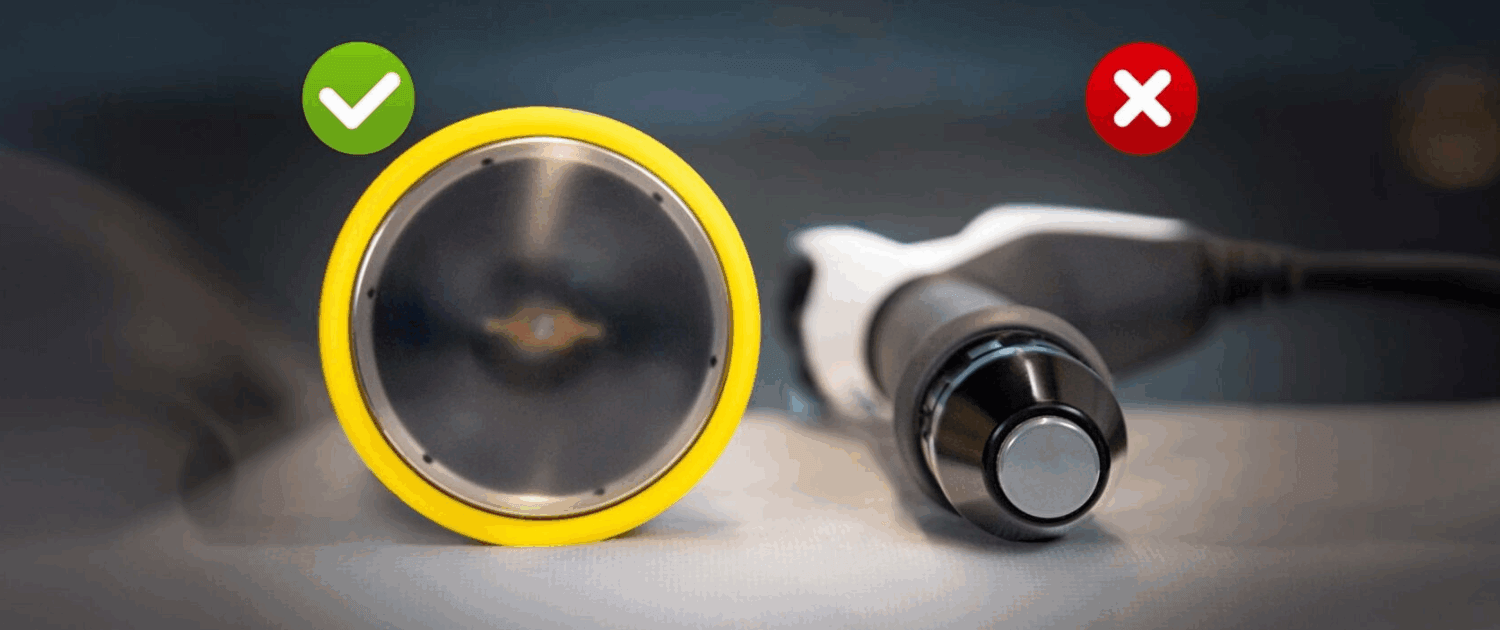
These are the most common devices in general practice — and technically, they aren’t true shockwaves at all. Radial devices use compressed air to fire a projectile inside a handpiece, generating pressure waves that radiate outward from the tip. Energy is highest at the skin surface and dissipates rapidly with depth. They’re surface-level tools, effective for some superficial conditions, but unable to reach deep tissue and unable to activate stem cells or create angiogenesis. Many clinics offering “shockwave therapy” are using these devices.
Focused ESWT
True shockwaves, generated electromagnetically or piezoelectrically, concentrated to a pinpoint focal zone. Focused ESWT works by creating microtrauma at a specific target point — essentially controlled damage that prompts the body to respond with a healing cascade. It can reach deep tissue but treats a very small area per pulse. Focused treatment often requires anesthesia due to the intensity at the focal point, and typically requires many sessions over weeks or months.
Unfocused ESWT — SoftWave
This is the technology we use at Synergy. SoftWave therapy uses the TRT OrthoGold 100, the only patented unfocused electrohydraulic shockwave device in North America. True shockwaves are generated through a high-voltage electrical discharge in water, creating a plasma bubble that produces pressure exceeding 10 MPa — waves that travel through tissue at over 3,300 miles per hour. A patented parabolic reflector keeps those waves parallel and unfocused, producing a treatment zone 7 cm × 12 cm. That’s thousands of times larger than a focused device’s pinpoint area — and it reaches up to 4–5 inches deep, all without causing microtrauma.
Device Comparison Table
| Feature | Radial/Acoustic Wave | Focused ESWT | SoftWave (Unfocused ESWT) |
|---|---|---|---|
| True shockwave? | ❌ No | ✅ Yes | ✅ Yes |
| Generation method | Compressed air | Electromagnetic/piezoelectric | Electrohydraulic |
| Treatment zone | Surface only | Pinpoint (mm focal zone) | 7cm × 12cm — up to 5″ deep |
| Causes microtrauma? | No | Yes | No |
| Activates stem cells? | ❌ No | Limited | ✅ Yes |
| Creates angiogenesis? | ❌ No | Partial | ✅ Yes |
| Anesthesia needed? | No | Often yes | No |
| Typical sessions | 8–18 | 6–12+ | 6–8 |
| Comfort level | Mild discomfort | Can be painful | Comfortable |
What Makes SoftWave Different — The Science
SoftWave doesn’t heal tissue by injuring it. That’s the core distinction. While focused devices rely on microtrauma to trigger a healing response, SoftWave works through a process called mechanotransduction — the conversion of mechanical force into cellular healing signals.
When SoftWave’s acoustic waves reach tissue, they create controlled compression and expansion of cells — a process similar to wringing out a sponge. The compression phase pushes out stagnant fluid and cellular debris. The expansion draws in fresh blood, oxygen, and healing factors. This pumping action restarts circulation in tissue that has become chronically inflamed and stagnant.
More importantly, this mechanical stimulus activates the TLR3 pathway — the body’s master switch for regeneration. Once triggered, TLR3 signals the body to recruit mesenchymal stem cells to the treatment area, initiate angiogenesis (the growth of new blood vessels), modulate inflammation through its proper three-phase cycle, and begin true tissue regeneration.
Anti-inflammatory medications suppress Phase 1 of the inflammatory cycle, which means Phases 2 and 3 — tissue repair and remodeling — never happen properly. SoftWave guides the body through all three phases, which is why patients often experience lasting results rather than temporary relief.
This is also why SoftWave is used by team physicians for NFL, NBA, MLB, and NHL teams — and by major medical centers including Mayo Clinic, Cleveland Clinic, and Walter Reed Military Medical Center.
Why the Device Choice Matters for Your Condition
This is the part most patients never hear explained. Different causes of pain respond differently to different types of acoustic wave therapy. Understanding the distinction can save you months of ineffective treatment.
- If your pain is from chronic tendon degeneration (Achilles, rotator cuff, patellar tendon, tennis elbow) → SoftWave’s ability to activate stem cells and stimulate angiogenesis directly addresses the degenerative tissue. Radial devices don’t reach deep enough; focused devices treat too small an area per session.
- If your pain is from plantar fasciitis or heel spurs → Both focused ESWT and SoftWave have strong research support here. SoftWave covers the entire heel and surrounding fascia in a single pass, which is clinically meaningful for a condition that often involves a broad area of inflammation.
- If your pain is from arthritis or joint degeneration → SoftWave’s stem cell activation and anti-inflammatory signaling targets the cellular environment of the joint. Radial devices cannot reach joint depth or activate the repair pathways needed.
- If you have neuropathy or nerve-related pain → SoftWave’s broad treatment zone allows coverage of the entire affected nerve pathway, and its anti-inflammatory effects help calm sensitized nerves. This is an area where other shockwave devices have significant limitations. Learn more about SoftWave therapy and the conditions we treat at Synergy Institute.
- If your pain is superficial (trigger points, myofascial pain, surface tendon issues) → Radial devices can be appropriate and cost-effective for some of these cases. I’ll tell you honestly if that’s the case.
What About the Cheap Shockwave Devices Showing Up Everywhere?
I want to address this directly because I hear about it regularly. The market has become flooded with inexpensive devices — some under $3,000 — being marketed as “shockwave therapy.” These are almost always radial or acoustic wave devices, and in some cases, devices that have been rebranded with names like “StemWave” to create confusion with SoftWave.
The authentic TRT OrthoGold 100 costs significantly more than these devices — for good reason. It generates true shockwaves through electrohydraulic technology, and TRT SoftWave holds the patents for unfocused ESWT in North America. The research behind SoftWave’s specific mechanisms — stem cell activation, angiogenesis, TLR3 pathway signaling — was conducted on this device. That research doesn’t automatically transfer to a $2,500 knockoff.
When a clinic advertises “shockwave therapy,” it’s worth asking: what device are you using? Is it a true shockwave device or a radial pressure wave device? Is it focused or unfocused? The answer tells you a lot about what you’re actually getting.
Why Naperville Patients Choose SoftWave at Synergy Institute
At Synergy Institute Acupuncture & Chiropractic, we were the first clinic in Naperville to offer SoftWave therapy — and we remain the most experienced provider in the area, with over four years and thousands of treatments performed. We use the authentic TRT OrthoGold 100, not an imitation or rebranded alternative.
But the bigger differentiator isn’t just the device. It’s how we use it.
SoftWave is rarely the only treatment I recommend. Most patients who need shockwave therapy are dealing with multi-factorial problems — chronic inflammation, structural issues, restricted circulation, sometimes nerve involvement. Treating only the tissue with acoustic waves while ignoring the spine, the joint mechanics, or the inflammatory environment is like replacing one spark plug in an engine with four bad ones.
At Synergy, SoftWave is integrated with chiropractic care, acupuncture, spinal decompression, and MLS laser therapy depending on what your case actually requires. That combination is something single-treatment shockwave clinics genuinely cannot offer.
If you’re evaluating shockwave therapy providers in Naperville, ask every clinic what device they use and how it generates its waves. The answer will tell you more than any price quote or marketing claim.
Who Is — and Isn’t — a Good Candidate for SoftWave
Good candidates include:
- Patients with chronic tendon injuries that haven’t responded to physical therapy, stretching, or cortisone
- Patients with arthritis seeking a non-injection, non-surgical option
- Patients with plantar fasciitis, Achilles tendinopathy, tennis or golfer’s elbow, rotator cuff issues, or knee pain
- Patients with neuropathy looking to improve nerve tissue health
- Patients who want to avoid surgery and are looking for a regenerative alternative
SoftWave may not be the right fit if:
- You have an active infection or tumor in the treatment area
- You are pregnant
- You have a blood clotting disorder or are on anticoagulants
- You have a pacemaker (for certain treatment areas near the chest)
- Your condition requires surgical intervention that SoftWave cannot address — I’ll tell you this directly if that’s the case
I don’t run a high-volume shockwave mill. If SoftWave isn’t the right tool for your situation, I’ll tell you, and I’ll point you toward whoever can actually help you. That honesty is part of how we work here.
What to Expect at Your First SoftWave Visit in Naperville
A first SoftWave visit at Synergy starts with a thorough evaluation — reviewing your history, imaging if you have it, and a hands-on assessment of the affected area. I want to understand your full picture before recommending any treatment.
If SoftWave is appropriate, the treatment itself typically takes 10–15 minutes. Acoustic gel is applied to the skin, and the OrthoGold 100 handpiece is moved across the treatment area. Most patients describe a mild tapping or tingling sensation. There’s no anesthesia, no needles, and no downtime — most people return to normal activity the same day.
One thing that’s unique to SoftWave: the treatment itself is diagnostic. Healthy tissue doesn’t respond. Areas that are tender or reactive during treatment are telling us exactly where the damage is, which helps guide both the session and the overall treatment plan.
Many patients notice improvement within one to three treatments. A typical course runs six to eight sessions, depending on the condition and severity.
Frequently Asked Questions
Is SoftWave the same as shockwave therapy?
SoftWave is a specific type of shockwave therapy — but not all shockwave therapy is SoftWave. SoftWave uses the TRT OrthoGold 100 to deliver unfocused electrohydraulic shockwaves across a large treatment area without microtrauma. Many clinics use radial or focused devices that work on completely different principles. The distinction matters significantly for outcomes.
How do I know what device a clinic is actually using?
Ask directly: “Is your device a true shockwave device or a radial pressure wave device? Is it focused or unfocused? What is the brand and model?” Honest providers will answer this readily. If a clinic can’t or won’t tell you the device name, that’s a meaningful red flag.
Does SoftWave hurt?
Most patients find SoftWave comfortable — a mild tapping or tingling sensation. There’s no anesthesia required. Focused ESWT, by contrast, can be painful enough to require local anesthesia at the treatment site. Radial devices cause mild surface discomfort. SoftWave’s lack of discomfort is a direct result of its unfocused wave pattern and the absence of microtrauma.
How many SoftWave treatments will I need?
Most patients need 6–8 sessions, typically spaced one week apart. This is fewer than most other shockwave devices require. Some patients — particularly those with acute injuries — notice significant improvement after just 2–3 treatments. Chronic degenerative conditions generally take the full course.
Can SoftWave be combined with other treatments?
Yes — and at Synergy, it usually is. Depending on your case, I may combine SoftWave with chiropractic adjustments, acupuncture, spinal decompression, or MLS laser therapy. This integrated approach consistently produces better outcomes than SoftWave alone, especially for complex or long-standing cases.
Is shockwave therapy covered by insurance?
Most insurance plans classify both shockwave and SoftWave therapy as advanced regenerative therapies and do not cover them. Both are typically self-pay. Costs vary by clinic and number of sessions. At Synergy, we discuss pricing transparently before any treatment begins.
What conditions does SoftWave treat best?
SoftWave has the strongest clinical evidence for chronic tendinopathies (Achilles, rotator cuff, patellar, tennis elbow, plantar fasciitis), arthritis, and musculoskeletal pain that hasn’t responded to conventional care. We also treat neuropathy, chronic back and neck pain, hip pain, and post-surgical recovery with strong results.
Can I try SoftWave if other shockwave therapy didn’t work?
Yes — and this is actually a common situation I see at Synergy. Patients who had poor results with radial or acoustic wave devices often respond very well to SoftWave because the mechanisms are fundamentally different. If the prior device couldn’t activate stem cells or reach deep tissue, it wasn’t addressing the underlying problem. SoftWave can.
How is SoftWave different from cortisone injections?
Cortisone suppresses inflammation temporarily but doesn’t repair damaged tissue — and repeated injections can actually weaken tendons over time. SoftWave activates the body’s own repair mechanisms to address the root cause of the problem. Results from SoftWave tend to be more durable because the tissue is actually healing rather than having its pain signal suppressed. For a deeper comparison, see our article on SoftWave vs. cortisone injections.
How do I get started with SoftWave therapy in Naperville?
Call or text Synergy Institute at (630) 454-1300 to schedule an evaluation. We’ll review your history, assess the affected area, and give you an honest recommendation — including whether SoftWave is actually the right tool for your situation.
Why Naperville Patients Choose Synergy Institute for Shockwave Therapy
- First in Naperville — Dr. Jennifer Wise was the first provider in Naperville to offer SoftWave therapy, starting in August 2021
- Most experienced local provider — 4+ years and thousands of SoftWave treatments performed
- Authentic device — TRT OrthoGold 100, the same technology used by NFL and MLB team physicians and major medical centers including Mayo Clinic and Cleveland Clinic
- True electrohydraulic shockwave — not a radial pressure wave device; generates genuine shockwaves that activate stem cells, create angiogenesis, and reach deep tissue
- Integrative approach — SoftWave combined with chiropractic, acupuncture, spinal decompression, and MLS laser when your condition calls for it
- Honest evaluation — if SoftWave isn’t right for your situation, I’ll tell you directly and point you toward whoever can help
- 26+ years clinical experience — Palmer College graduate specializing in complex pain cases
Ready to Find Out If SoftWave Is Right for You?
Synergy Institute Acupuncture & Chiropractic has been Naperville’s first and most experienced SoftWave provider since August 2021. If you’ve been struggling with a tendon injury, chronic joint pain, plantar fasciitis, or a condition that hasn’t responded to other treatments, I’d like the chance to evaluate your case and give you a straight answer about whether we can help.
Call or text (630) 454-1300, or call our office directly at (630) 355-8022.
Synergy Institute Acupuncture & Chiropractic 4931 Illinois Rte 59, Suite 121 Naperville, IL 60564
Serving Naperville, Bolingbrook, Plainfield, Aurora, Oswego, and surrounding communities.
References
- De la Corte-Rodríguez H, Román-Belmonte JM, Rodríguez-Damiani BA, Vázquez-Sasot A, Rodríguez-Merchán EC. Extracorporeal Shock Wave Therapy for the Treatment of Musculoskeletal Pain: A Narrative Review.Healthcare. 2023;11(21):2830.
- Ogden JA, Alvarez RG, Levitt RL, Johnson JE, Marlow ME. Electrohydraulic high-energy shock-wave treatment for chronic plantar fasciitis. J Bone Joint Surg Am. 2004;86(10):2216–28.
- Al-Siyabi H, Alquraini A, Alsalem M, et al. Extracorporeal shockwave therapy versus ultrasound therapy for plantar fasciitis: Systematic review and meta-analysis. J Foot Ankle Res. 2022.
- Notarnicola A, Moretti B. The biological effects of extracorporeal shock wave therapy (ESWT) on tendon tissue.Muscles Ligaments Tendons J. 2012;2(1):33–37.
- Wang CJ. Extracorporeal shockwave therapy in musculoskeletal disorders. J Orthop Surg Res. 2012;7:11.
- Liu K, Zhang Q, Chen L, et al. Efficacy and safety of extracorporeal shockwave therapy in chronic low back pain: A systematic review and meta-analysis of 632 patients. J Orthop Surg Res. 2023;18:455.
- Xiong Y, Wen T, Jin S, et al. Efficacy and safety of extracorporeal shock wave therapy for upper limb tendonitis: a systematic review and meta-analysis of randomized controlled trials. Front Med. 2024;11:1394268.
- Fansa AM, Bhatt NR, Cohen BE, Davis WH. Electrohydraulic shockwave therapy for chronic plantar fasciitis — clinical assessment of 108 patients. J Foot Ankle Surg. 2020.
- Schroeder AN, Tenforde AS, Jelsing EJ. Extracorporeal Shockwave Therapy in the Management of Sports Medicine Injuries. Curr Sports Med Rep. 2021;20(6):298–305.
- Tamma R, Dell’Endice S, Notarnicola A, Moretti L, Moretti S, Moretti B. Extracorporeal shock waves stimulate osteoblast activities. Ultrasound Med Biol. 2009;35(12):2093–100.
- TRT SoftWave. Shock waves induce angiogenesis via exosome release. Clinical Research Summary.
Medical Disclaimer: This article is for informational purposes only and does not constitute medical advice, diagnosis, or treatment recommendations. Individual results from any therapy vary based on condition severity, health history, and other clinical factors. Always consult with a qualified healthcare provider before beginning any new treatment. If you are experiencing a medical emergency, call 911 immediately.
Reviewed by Dr. Jennifer Wise, DC, Acupuncturist — March 2026