
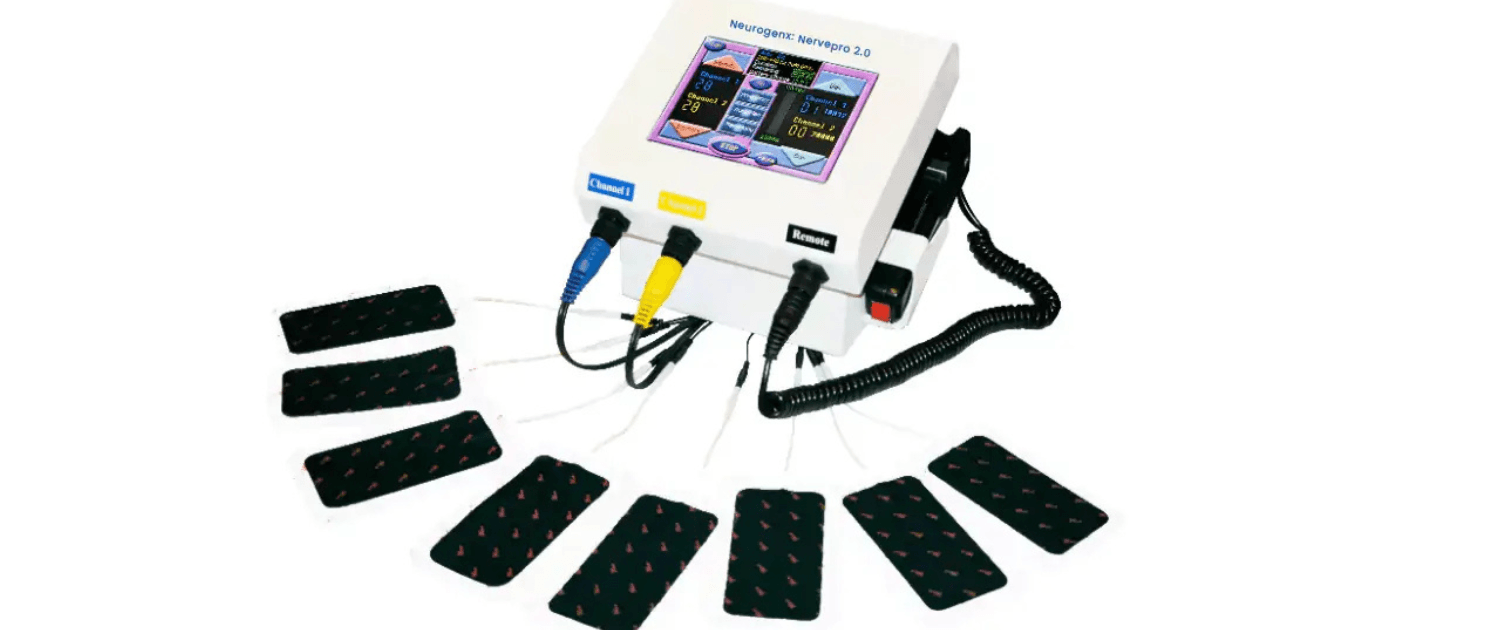
Why Neurogenx Is Different — A Naperville Neuropathy Clinic Explains
You’ve already had electrodes on your feet. Somebody already told you this would help.
I know that, because most of the neuropathy patients who walk into my office have tried electrical treatment somewhere else. A TENS unit from a physical therapist. A ReBuilder from a neuropathy program. Sessions with a machine and a pair of conductive socks at a clinic across town. It helped a little, or it helped for a while, and now you’re reading this wondering why you’d spend money on another one.
That’s a fair question, and it deserves a real answer instead of a brochure.
I’m Dr. Jennifer Wise, DC, Acupuncturist, and I’ve treated peripheral neuropathy in Naperville since 2000 — with sixteen of those years in specialized neuropathy practice since training directly with Dr. John Hayes Jr. through the NeuropathyDR program in 2010. I’ve personally used most of the devices in this article, including ones I no longer use. If you’re looking for the best neuropathy specialist in Naperville, or searching for advanced neuropathy treatment near you, what follows is an honest comparison of what’s out there and why I chose what I chose.
Synergy Institute Acupuncture & Chiropractic is a peripheral neuropathy treatment clinic located in Naperville, Illinois, on Illinois Rte 59 near the 111th Street intersection, serving patients from Aurora, Plainfield, Bolingbrook, Oswego, Lisle, and Woodridge.
What lets me compare these fairly isn’t that I own several. It’s the training underneath. I’m a Palmer College graduate and an acupuncturist, and sixteen years of acupuncture practice means I worked directly with nerve modulation and circulation long before any device was involved. Chiropractic training means I look for a structural cause before assuming a case is metabolic. The technology comes after the assessment — which is why I evaluate devices on mechanism rather than on marketing.
A 2018 study published in BMC Neuroscience found that late administration of high-frequency electrical stimulation increased nerve regeneration in a nerve crush injury model without aggravating neuropathic pain — evidence that the frequency of stimulation, not merely its presence, influences whether nerve tissue regenerates.
Our approach to neuropathy treatment: we identify which mechanism is driving your nerve damage — metabolic, nutritional, toxic, circulatory, or structural — correct the cellular conditions underneath, and then apply electrical treatment matched to that diagnosis, rather than applying one device to everyone and hoping.
Looking for neuropathy relief in Naperville? Call or text (630) 454-1300 to schedule your evaluation.
| Quick Facts | Neurogenx in Naperville |
|---|---|
| Provider | Dr. Jennifer Wise, DC, Acupuncturist — Palmer College graduate |
| Experience | 26+ years treating peripheral neuropathy; 16+ years specialized |
| Device | Neurogenx 4000Pro with NervePro 2.0 |
| Frequency range | 400 to 60,000 Hz |
| Waveform | Biosimilar — modeled on physiologic nerve signaling |
| Delivery | Adhesive electrodes, doctor-placed by symptom distribution |
| Status | First and only Neurogenx 4000Pro provider in Naperville |
| Treatment course | Typically 12–30 sessions. Standard is twice weekly; longer-standing cases may run three times weekly or use doubled early sessions |
| Session length | 25–50 minutes |
| Consultation | Complimentary Pain Relief Consultation |
| Location | 4931 Illinois Rte 59, Suite 121, Naperville, IL 60564 |
Direct Answer: Why Neurogenx Is Different
Most electrical devices used for neuropathy were never designed to restore nerve function. TENS primarily modulates pain signaling and is not established as a treatment for regenerating damaged nerve fibers. ReBuilder-class devices at 7.83 Hz improve circulation and modulate symptoms, but at very low frequencies tissue impedance is higher and current distribution differs substantially from higher-frequency systems. Calmare overwrites the pain message traveling to your brain — genuinely useful, but its therapeutic goal is analgesia rather than nerve regeneration. NeuroMed Matrix (8,000–10,000 Hz) and Sanexas neoGEN (4,000–20,000 Hz) use higher-frequency stimulation with proposed cellular and metabolic effects that differ from conventional pain gating — but in fixed narrow bands. The Neurogenx 4000Pro spans 400 to 60,000 Hz — six times the NeuroMed ceiling and three times Sanexas — and uses a biosimilar waveform modeled on physiologic nerve signaling. It was engineered for peripheral neuropathy specifically rather than adapted from a general pain device.
Does This Sound Like You?
- You did a course of electrical treatment and felt better during sessions but not after
- You sat with your feet in a warm water bath during treatment
- You wore conductive socks or sleeves at a clinic and can’t remember what the machine was called
- You have a unit at home you stopped using
- The program had a branded name you couldn’t find anything about online
- You were told the treatment was FDA-approved
- You improved for six weeks and then plateaued
- You’ve decided electrical treatment for neuropathy doesn’t work
- You’d try again if someone explained why this time would be different
That last one is who I’m writing for.
TENS: The Most Common Thing People Have Tried
If you got a small unit from a physical therapist, bought one at a pharmacy, or ordered foot pads advertised online, you had TENS.
TENS works by pain gating. The stimulation floods the nerve pathway with sensory input that competes with pain signals for transmission to your brain, and it prompts some endorphin release. That’s a real mechanism and TENS is legitimately useful for musculoskeletal pain.
But understand what it’s doing: changing how you perceive a signal. Its primary role is symptom modulation, and it is not established as a treatment for regenerating damaged peripheral nerve fibers. Turn it off and the effect generally fades.
A 2024 systematic review and meta-analysis covering 30 studies found TENS produced only a small reduction in neuropathic pain compared with placebo — a difference that wasn’t clinically significant. For diabetic neuropathic pain specifically, TENS performed similarly to placebo.
If your experience of “electrical treatment for neuropathy” was TENS, you haven’t tried what this article is describing.
ReBuilder: A Good Device Reaching Its Limit
I want to be fair here, because I used the ReBuilder in practice for years after training on it in 2010.
It runs at 7.83 Hz and pairs nerve stimulation with muscle stimulation that drives the venous pump in the calves, improving circulation to the lower legs. Treatment is often delivered with the feet in a warm water bath, which is how most patients remember it. The design thinking was sound. Patients got relief. Sleep improved. Some regained partial sensation.
The limitation is physics, not craftsmanship. Human tissue resists electrical current, and that resistance falls as frequency rises. At 7.83 Hz, tissue impedance is higher and current distribution differs substantially from higher-frequency systems, which may limit the depth and type of stimulation achievable — and diabetic and chemotherapy-induced damage lives in the small fibers deep in the tissue.
Low-frequency devices can provide relief. Evidence that they restore lost peripheral nerve fibers is much more limited. That’s why I moved on.
Calmare: A Different Idea Entirely
Calmare, sometimes called Scrambler Therapy, doesn’t belong on the same scale as the others, and I include it because patients ask.
It doesn’t try to reach deeper tissue or restore cellular function. It transmits synthetic “non-pain” information along the same nerve pathway carrying your pain signal, effectively overwriting the message your brain receives. There’s published research behind it, particularly for chemotherapy-induced peripheral neuropathy.
Here’s the honest assessment: it works, and its therapeutic goal is analgesia rather than nerve regeneration. It can be a reasonable option for severe intractable neuropathic pain, but its established therapeutic target is pain rather than restoration of lost sensation. If your primary problem is numbness, loss of sensation, and balance — which describes most of the patients I see — overwriting the pain signal doesn’t address what you came in for.
If you’ve tried electrical treatment in Naperville and it didn’t hold, call or text (630) 454-1300 — bring what you used.
NeuroMed Matrix and Sanexas: The Right Category, Narrower Range
These two deserve a serious look, because they’re the systems most likely to be what you tried at another clinic — and because they’re in the right category.
Both are FDA-cleared high-frequency electroanalgesia devices. Both use higher-frequency stimulation with proposed cellular and metabolic effects that differ from conventional pain gating. I’m not going to pretend they don’t work in order to make a point about the one I use.
NeuroMed Matrix operates at roughly 8,000 to 10,000 Hz and has the widest clinic adoption of the three. It’s delivered through adhesive pads or conductive sock and glove garments — if you wore socks or sleeves during treatment, this is likely what you had.
Two things worth knowing. The NeuroMed Matrix is widely licensed, available to any clinic, and sold used on medical equipment marketplaces. And it’s the device behind several nationally marketed “proprietary” neuropathy protocols — the trademarked program names and invented acronyms, where the machine itself is never named. If you did a branded program and can’t find out what equipment was in the room, this is frequently what was inside.
Sanexas neoGEN runs roughly 4,000 to 20,000 Hz and has the most published research of the three devices. Some providers pair it with a low-dose anesthetic injection in early sessions, marketed as Combined Electrochemical Treatment.
Both are working the right layer. The question is how much of that layer they can reach.
Where Neurogenx Separates
Four things, and I want to be specific rather than just asserting superiority.
Range. The Neurogenx 4000Pro spans 400 to 60,000 Hz. That’s six times the NeuroMed Matrix ceiling and three times the Sanexas ceiling. These are published specifications you can verify.
But the ceiling isn’t the point — the span is. A device locked into an 8,000–10,000 Hz window delivers within that window to every patient, every session, regardless of what’s in front of it. Neurogenx allows parameters to be selected across a far wider range, which means treatment can be matched to tissue depth, nerve type, and where you are in recovery. A patient with dense numbness in the forefoot and a patient with burning that starts at the ankle are not the same problem, and they shouldn’t get identical settings. Nobody has run a head-to-head trial comparing adjustable range against fixed-band devices — but that adjustability is the reason I chose this one.
Waveform. This is the part most comparisons skip entirely, and it may matter as much as the frequency.
Most electrotherapy devices deliver a square wave or a sine wave. Both are easy to generate electronically and neither exists in nature. A real nerve impulse has a specific asymmetric shape: rapid depolarization, sharper repolarization, a brief undershoot before it settles.
Neurogenx uses what’s called a biosimilar waveform, patterned after the actual nerve action potential. The design premise is that a waveform modeled on physiologic nerve signaling may interact differently with excitable tissue than conventional square- or sine-wave stimulation. Whether that produces superior clinical outcomes has not been established in head-to-head trials. It’s proprietary to the technology, and it’s the reason the device can’t be substituted with a cheaper unit running similar frequencies.
Purpose-built. This is the difference that took me longest to understand. Most of the technology I’ve acquired over twenty-six years is general-purpose — excellent equipment that helps many conditions, neuropathy among them. The Neurogenx 4000Pro is the opposite. It was engineered for peripheral neuropathy and very little else.
Narrow, specific, single-purpose. For years I’d been treating a highly specific disease with excellent general tools.
Delivery. Neurogenx uses adhesive electrode placement selected by the treating doctor. Electrode placement and electrical parameters are chosen to target your symptomatic nerve distribution. Conductive sock and glove systems are convenient and comfortable, but they deliver the same field to everyone’s foot. Where the electrodes go is a clinical decision, and I make it for each patient.
And it isn’t a commodity. You can’t buy a Neurogenx used, rebrand it, and market it as your own invented protocol. That limits how many clinics have one — which is why we’re the first and only provider in Naperville — but it also means that when you see the name, you know exactly what you’re getting.
Electrotherapy Device Comparison for Naperville Patients
| Device | Frequency | Mechanism | What It Does Well | Why It May Not Have Held |
|---|---|---|---|---|
| TENS | ~100–400 Hz and below | Pain gating | Temporary comfort, musculoskeletal pain | Symptom modulation only; effect fades when off |
| ReBuilder | 7.83 Hz | Nerve + muscle stim, venous pump | Circulation, symptom modulation, sleep | Higher tissue impedance at low frequency may limit depth |
| Interferential / mid-frequency | 1,000–12,000 Hz | Moderate-depth stimulation | Musculoskeletal pain, circulation, tissue environment | Supportive; not nerve-specific |
| Calmare | Synthetic signal | Signal substitution | Severe intractable neuropathic pain | Therapeutic target is pain, not restoration of sensation |
| NeuroMed Matrix | 8,000–10,000 Hz | Proposed cellular and metabolic effects | Right category, wide availability | Fixed narrow band; garment delivery isn’t individualized |
| Sanexas neoGEN | 4,000–20,000 Hz | Proposed cellular and metabolic effects | Right category, most published research | Fixed narrow band |
| Neurogenx 4000Pro | 400–60,000 Hz | Biosimilar waveform; proposed depolarization, metabolic and pH effects | Purpose-built for peripheral neuropathy; tunable across the full range; doctor-placed electrodes | — |
What the Signal Is Proposed to Do
These are proposed mechanisms used to explain high-frequency electroanalgesia. Some are supported by laboratory and physiologic research, but they should not be read as proven mechanisms of nerve regeneration in treated patients.
Sustained depolarization. Nerve cells maintain an electrical charge across their membrane, with channels that open and close to let ions move. A brief low-frequency pulse opens them momentarily. The biosimilar waveform is designed to hold certain channels open longer, which is proposed to give the cell an extended window to take in energy and begin repair.
Metabolic activation. Nerve cells have among the highest energy demands in the body and almost no capacity to store energy. In neuropathy they’re running on a chronic deficit. The signal is proposed to increase cellular metabolism in tissue that has been metabolically starved.
pH normalization. Chronically inflamed, damaged tissue turns acidic, and cellular repair processes don’t function well outside their pH range. The electrical field is proposed to shift local pH back toward a functional range.
Fluid and waste mobilization. This one is often felt first. An alternating field moves charged molecules, which is proposed to help clear excess interstitial fluid and metabolic waste around a struggling nerve. Patients frequently describe their feet feeling less full or less swollen within the first few sessions, before any change in burning or numbness.
Note what these have in common: not one of them is about blocking a pain signal. That’s the categorical difference from TENS.
The Evidence I Find Most Persuasive
Treating clinics have reported measurable increases in epidermal nerve fiber density following Neurogenx treatment, with tissue analysis performed by independent pathology laboratories including Bako Pathology Services and Advanced Laboratory Services.
That deserves a moment, because it’s a different kind of evidence than most of what gets cited in this field. Epidermal nerve fiber density is a direct count of the small nerve fibers present in tissue — not a symptom score, not a satisfaction survey. It’s one of the best-established objective measures for evaluating small fiber neuropathy, and it’s why a normal nerve conduction study doesn’t rule out nerve damage. Routine EMG and nerve conduction studies primarily evaluate large myelinated fibers and can be normal in isolated small-fiber neuropathy.
So an increase in nerve fiber density isn’t a patient reporting they feel better. It’s more nerve fibers physically present in the tissue than there were before. This is case-level clinical data rather than randomized controlled trial evidence — but the laboratories doing the measuring had no stake in the result.
Ask What Machine They Used
If you’re comparing programs, three questions tell you almost everything.
What is the name of the device? Not the program name — the machine. Neurogenx 4000Pro. NeuroMed Matrix. Sanexas neoGEN. Real devices with manufacturers and verifiable specifications. If a clinic can only give you a trademarked protocol name, ask again.
Can you look it up? Search it. If what comes back is one company’s marketing site and nothing else, you’re being sold a brand wrapped around equipment they’d rather not name.
Is it FDA-cleared or FDA-approved? Different regulatory pathways. Most therapeutic devices, including Neurogenx, reach market through 510(k) clearance based primarily on substantial equivalence to a legally marketed predicate device. Approval through the PMA pathway is a separate, more demanding process used mainly for higher-risk devices like implants. Both are legitimate. Calling a 510(k)-cleared device “FDA-approved” overstates the standard it met — and several clinics do exactly that.
🚨 Before You Start Any Neuropathy Program
If you have diabetes and any open sore, blister, wound, or color change on your feet, call your primary care doctor or podiatrist today. Numbness means you may not feel an ulcer developing. Diabetic foot ulcers can progress quickly and require wound care before any conservative program begins.
Seek prompt medical evaluation for symptoms worsening rapidly over days, sudden severe weakness, or loss of bladder or bowel control.
The Device Was Probably Only Part of the Problem
Here’s what I’d want to know if I were you, and it matters more than any comparison in this article.
No electrical treatment — not Neurogenx, not anything — substitutes for correcting nutrient deficiency, toxic exposure, or blood sugar.
Peripheral nerves have enormous energy demands and almost no storage capacity. Rebuilding one takes more than a signal. Metformin, the most prescribed diabetes drug in the world, impairs B12 absorption. Chemotherapy agents and chronic alcohol use are direct nerve toxins. Diabetes damages the vasa nervorum — the microvascular network feeding your nerves — early. And a herniated disc compressing a nerve root produces symptoms no electrotherapy resolves, requiring spinal decompression or chiropractic care instead.
That’s why Phase 1 of the Synergy Nerve Restore Program is the cellular foundation — targeted nutrition, molecular hydrogen for inflammation and oxidative stress, dietary work — before device treatment begins.
If you did a program somewhere that was device-only, that may be the whole explanation for why it didn’t hold. For the full landscape of devices sold for neuropathy, including light and magnetic therapies that aren’t electrotherapy at all, see why your neuropathy machine didn’t work.
Who Responds to Neuropathy Treatment in Naperville — and Who Doesn’t
You’re likely a good candidate if: you have clinically detectable residual nerve function rather than complete loss of sensation; your symptoms are stable or slowly progressing; you’re willing to commit to a full treatment series; and you’re willing to address the nutritional, metabolic, and toxic drivers alongside the device work.
This isn’t the right fit if: you have profound longstanding sensory loss with little detectable residual nerve function; you have an active foot ulcer or open wound; your neuropathy stems from a central nervous system condition such as multiple sclerosis or stroke; you have severe untreated peripheral arterial disease; or you want the device work without the foundation work.
“If I don’t think we can help you, I’ll tell you directly. I’d rather refer you to someone who can help than waste your time and money.”
What to Expect, and What It Costs
Most patients complete somewhere between 12 and 30 sessions. The standard protocol is twice weekly for 24 sessions. Patients whose neuropathy has been present a long time often run three times a week instead, and for some cases we double sessions in the early weeks to build momentum. Which schedule you’re on is a clinical decision made after the exam — not a package sold before it.
Sessions are 25 to 50 minutes with adhesive electrodes. Most patients describe a mild tingling or warmth and many find them relaxing.
Most people notice early change between weeks four and six — usually reduced night burning first, then sleep, then gradual return of sensation. Peripheral axons regenerate slowly, often estimated around a millimeter per day in certain nerve-injury settings. Recovery in metabolic or diffuse neuropathy is more variable and can’t be predicted from that number alone.
One thing to be aware of: some patients report changes in sensation during treatment, including temporary increases in tingling or burning. That shouldn’t automatically be read as nerve regeneration — any meaningful worsening should be reassessed so parameters or the diagnosis can be reconsidered. Tell me if it happens.
Treatment is structured as a program rather than per-visit billing. Medicare is restrictive here — in our office it covers spinal manipulation and nothing else, so the neuropathy program is a cash-pay service. Some PPO plans cover portions of care. HSA and FSA funds can generally be used for treatment; requirements vary by plan, and most don’t need anything beyond a receipt. If yours does require documentation, we provide an itemized statement and a Letter of Medical Necessity. CareCredit financing is available for longer terms, and we offer in-house financing for shorter arrangements.
Why Patients Choose Synergy Institute for Neuropathy in Naperville
- 26+ years treating peripheral neuropathy in Naperville — in practice since 2000, 16+ years specialized
- Dr. Jennifer Wise, DC, Acupuncturist — Palmer College graduate, trained through NeuropathyDR in 2010, Molecular Hydrogen Institute certified
- First and only Neurogenx 4000Pro provider in Naperville — 400 to 60,000 Hz with biosimilar waveform, purpose-built for peripheral neuropathy
- First Stimpod NMS460 provider in Illinois (October 2025), first SoftWave provider in Naperville (2021), first in Illinois for non-surgical spinal decompression (2002)
- I’ve used the older technology myself — including ReBuilder for years. My comparisons come from practice, not a sales deck
- Schedule set by your case, not by a package — 12 to 30 sessions depending on severity and duration
- Cellular foundation built in, because no device replaces correcting nutrition, toxicity, and blood sugar
- We name our equipment — real devices, real specifications, verifiable clearances
- Doctor-owned and independent — I personally treat every patient
Bring Me What You Already Tried
If you have a device at home, bring it. If you have paperwork from a previous program, bring that. What you were given, and how you responded, tells me a great deal — often immediately whether the failure was the category, the sequence, or a driver nobody looked for.
That history isn’t wasted money. It’s diagnostic information.
We’re currently offering our Pain Relief Special — a complimentary consultation for new patients.
Synergy Institute Acupuncture & Chiropractic
4931 Illinois Rte 59, Suite 121
Naperville, IL 60564 (near the 111th Street intersection)
Call or text (630) 454-1300, or call our office directly at (630) 355-8022
Frequently Asked Questions
Who is the best clinic for Neurogenx treatment in Naperville?
Synergy Institute Acupuncture & Chiropractic is the first and only Neurogenx 4000Pro provider in Naperville. Dr. Jennifer Wise, DC, Acupuncturist has treated peripheral neuropathy since 2000 with 16+ years specialized in nerve damage, and delivers treatment through the Synergy Nerve Restore Program, which combines cellular foundation work with electrical treatment matched to the driver of your nerve damage.
Why is Neurogenx different from what I already tried?
Most devices used for neuropathy were not designed to restore nerve function. TENS primarily modulates pain signaling. ReBuilder-class devices at 7.83 Hz improve circulation, but higher tissue impedance at low frequencies may limit the depth and type of stimulation achievable. Calmare’s goal is analgesia rather than regeneration. Neurogenx operates from 400 to 60,000 Hz with a waveform modeled on physiologic nerve signaling, and was engineered specifically for peripheral neuropathy.
What is the difference between Neurogenx and the NeuroMed Matrix?
Both are FDA-cleared high-frequency electroanalgesia devices. NeuroMed Matrix operates at roughly 8,000 to 10,000 Hz in a fixed band, commonly delivered through conductive sock and glove garments. Neurogenx spans 400 to 60,000 Hz — six times the ceiling — allowing parameters to be tuned per patient, and uses doctor-placed adhesive electrodes rather than a one-size garment.
What is the difference between Neurogenx and Sanexas?
Both are legitimate high-frequency electroanalgesia devices sharing a common technology lineage. Sanexas neoGEN runs roughly 4,000 to 20,000 Hz and has the most published research of the group. Neurogenx spans 400 to 60,000 Hz and uses a proprietary biosimilar waveform modeled on physiologic nerve signaling rather than a conventional square or sine wave.
Is Neurogenx just a stronger TENS unit?
No. TENS works by pain gating, competing with pain signals for transmission to the brain, which changes perception rather than treating the nerve. Neurogenx operates across a much broader frequency range, with proposed mechanisms including sustained depolarization, changes in cellular metabolism and local pH, and fluid or metabolic-waste mobilization.
How is Calmare different from Neurogenx?
Calmare, or Scrambler Therapy, transmits synthetic non-pain information along the pain pathway, effectively overwriting the message reaching your brain. Its therapeutic goal is analgesia, and nerve-fiber regeneration has not been established as an outcome. It can be a reasonable option for severe intractable neuropathic pain, but its established therapeutic target is pain rather than restoration of lost sensation.
I wore conductive socks during my treatment. What device was that?
Conductive sock and glove garment delivery is characteristic of the NeuroMed Matrix and similar high-frequency systems. It is convenient and comfortable but delivers the same field to every patient. Neurogenx uses adhesive electrodes placed by the treating doctor to target your specific symptomatic nerve distribution.
How many Neurogenx treatments will I need?
Most patients complete between 12 and 30 sessions. The standard protocol is twice weekly for 24 sessions, though patients with longer-standing neuropathy often do better at three times a week, and some cases benefit from doubled sessions early on. Most people notice early change between weeks four and six. After the initial series, patients move to maintenance.
Why didn’t my previous electrotherapy treatment last?
Two common reasons. The device category may have been wrong — low-frequency units modulate symptoms at the surface rather than acting on nerve cells at depth. Or the electrical layer was treated in isolation while the metabolic, nutritional, toxic, circulatory, or structural drivers went unaddressed. Nerve tissue cannot rebuild without the nutrients, circulation, and metabolic conditions to do it.
Is Neurogenx FDA-approved?
Neurogenx is FDA-cleared through the 510(k) pathway based primarily on substantial equivalence to a legally marketed predicate device. FDA approval through the PMA pathway is separate and more demanding, used mainly for higher-risk devices such as implants. A clinic describing a 510(k)-cleared device as “FDA-approved” is overstating the standard it met.
Does Neurogenx treatment hurt?
No. Most patients describe a mild tingling or warmth, and many find sessions relaxing enough to fall asleep. Sessions run 25 to 50 minutes with adhesive electrodes placed on the treatment area.
Why do my symptoms feel different partway through treatment?
Some patients report changes in sensation during treatment, including temporary increases in tingling or burning. That shouldn’t automatically be interpreted as nerve regeneration. Any meaningful worsening should be reassessed so treatment parameters or the diagnosis can be reconsidered — tell your provider if it happens.
Can I use HSA or FSA funds for Neurogenx treatment?
Yes, in most cases. Requirements vary by plan and most don’t need anything beyond a receipt. If yours requires documentation, we provide an itemized statement and a Letter of Medical Necessity. Medicare covers spinal manipulation only at our Naperville clinic; the neuropathy program is a cash-pay service, with CareCredit and in-house financing available.
References
- Su HL, Chiang CY, Lu ZH, et al. Late administration of high-frequency electrical stimulation increases nerve regeneration without aggravating neuropathic pain in a nerve crush injury. BMC Neuroscience. 2018;19:37.
- Electrical stimulation therapy for peripheral nerve injury. Frontiers in Neurology. 2023;14:1081458.
- Aldahmi TA, et al. Neuropathic Pain Relief Through Transcutaneous Electrical Neuromuscular Stimulation: Insights From a Systematic Review and Meta-Analysis of Clinical Evidence. 2024.
- Odell RH, Sorgnard RE. Anti-inflammatory effects of electronic signal treatment. Pain Physician. 2008.
- Gabriel S, Lau RW, Gabriel C. The dielectric properties of biological tissues: measurements in the frequency range 10 Hz to 20 GHz. Physics in Medicine and Biology. 1996;41(11):2251–2269.
- Johnson MI. Transcutaneous Electrical Nerve Stimulation: Mechanisms, Clinical Application and Evidence. Reviews in Pain. 2007;1(1):7–11.
- Lauria G, Lombardi R. Skin biopsy: a new tool for diagnosing peripheral neuropathy. BMJ. 2007;334(7604):1159–1162.
- Marineo G, Iorno V, Gandini C, Moschini V, Smith TJ. Scrambler therapy may relieve chronic neuropathic pain more effectively than guideline-based drug management. Journal of Pain and Symptom Management. 2012;43(1):87–95.
- Feldman EL, Callaghan BC, Pop-Busui R, et al. Diabetic neuropathy. Nature Reviews Disease Primers. 2019;5:41.
- Aroda VR, et al. Long-term Metformin Use and Vitamin B12 Deficiency in the Diabetes Prevention Program Outcomes Study. Journal of Clinical Endocrinology & Metabolism. 2016;101(4):1754–1761.
- Callaghan BC, Little AA, Feldman EL, Hughes RAC. Enhanced glucose control for preventing and treating diabetic neuropathy. Cochrane Database of Systematic Reviews. 2012.
- Ohsawa I, et al. Hydrogen acts as a therapeutic antioxidant by selectively reducing cytotoxic oxygen radicals. Nature Medicine. 2007;13(6):688–694.
Medical Disclaimer: This article is for informational purposes only and does not constitute medical advice. It is not intended to diagnose, treat, cure, or prevent any disease. Individual results vary. Always consult a qualified healthcare provider regarding your specific condition, particularly if you have diabetes and notice any wound, sore, or change in your feet.
Reviewed by Dr. Jennifer Wise, DC, Acupuncturist — August 2026