
Help for Herniated, Bulging, & Degenerative Discs available in Naperville!
The MRI results are in, and now you’re staring at words like “disc protrusion,” “annular tear,” or “herniation with nerve impingement” — and your doctor is already talking about injections or surgical options.
Before you go down that road, there’s something you should know: the vast majority of herniated discs respond to conservative care. Research shows that 60–90% of symptomatic disc herniations resolve without surgery.¹ The real question isn’t whether conservative treatment can help — it’s whether you’re getting the right conservative treatment for your specific type of disc problem.
That’s the part most clinics get wrong. A herniated disc, a bulging disc, and degenerative disc disease are three different conditions with three different treatment needs. Treating them all with the same cookie-cutter adjustment protocol is why so many patients bounce from chiropractor to chiropractor without lasting improvement.
At Synergy Institute in Naperville, we take a different approach. Dr. Jennifer Wise — a Palmer College graduate with 26+ years of experience as both a Doctor of Chiropractic and an Acupuncturist — identifies your specific disc pathology first, then matches you with the exact combination of treatments designed for that problem. Not a generic protocol. A plan built for your disc, your symptoms, and your goals.
In this article, you’ll learn the critical differences between herniated, bulging, and degenerative discs, what the research says about chiropractic treatment for each, and how an integrative approach can get you real relief — even if you’ve already been told surgery is your only option.
Disc Problems at a Glance
| What You Should Know | The Details |
|---|---|
| How common? | 5–20 cases per 1,000 adults annually; lifetime risk of symptomatic herniation is 1–3% |
| Most affected age | Peak prevalence ages 30–50; male-to-female ratio of 2:1 |
| Most common locations | 95% of lumbar herniations occur at L4-L5 or L5-S1 |
| Conservative care success | 60–90% of disc herniations resolve without surgery |
| Chiropractic evidence | 80% of patients achieve good clinical outcomes with chiropractic; 77% show MRI-documented improvement |
| Decompression + chiropractic | 2024 study: herniation reduced 29.5% in 8 weeks with combined approach |
| When to seek emergency care | Loss of bladder/bowel control, progressive weakness in both legs, saddle numbness |
Herniated, Bulging, and Degenerative: What’s the Difference?
This distinction matters enormously for treatment, and it’s something most providers gloss over. Understanding which disc problem you have determines which therapies will actually work.
Herniated Discs
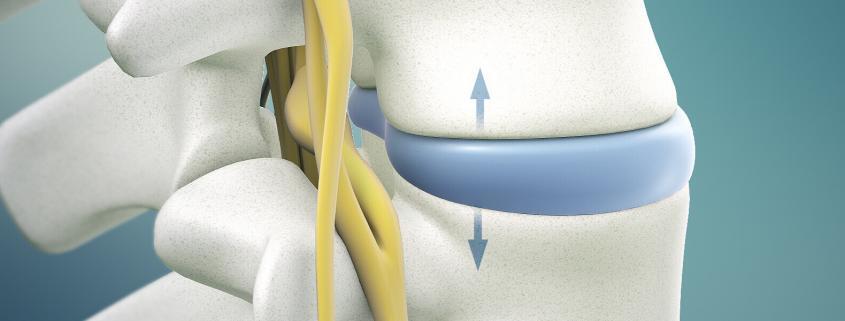
A herniated disc occurs when the soft, gel-like center of a spinal disc (the nucleus pulposus) pushes through a tear in the tougher outer wall (the annulus fibrosus). Think of it like squeezing a jelly doughnut until the filling breaks through the side.
When that displaced material presses on a nearby nerve root, it triggers sharp, radiating pain. In the lower back, this often means sciatica — shooting pain, burning, tingling, or numbness traveling down one leg. In the neck, a herniated disc can send similar symptoms into the shoulder, arm, and hand.
Here’s what many patients don’t realize: the herniated material itself triggers an inflammatory cascade that can be just as painful as the mechanical compression. This is why anti-inflammatory strategies are a critical part of effective disc treatment — not just structural correction.
Bulging Discs
A bulging disc is often a precursor to a herniation. The disc extends beyond its normal boundaries, but the outer wall remains intact — no tear, no escaped material. Think of it as the doughnut being flattened so it spreads outward, but the filling stays inside.
Bulging discs don’t always cause symptoms. A 2015 study in the American Journal of Neuroradiology found that nearly one-third of 20-year-olds already show disc bulges on imaging.² But when a bulge does become symptomatic — usually because it’s pressing on a nerve or causing local inflammation — the treatment approach differs from a true herniation.
Degenerative Disc Disease (DDD)
Degenerative disc disease isn’t really a “disease” — it’s the natural wear-and-tear process that affects spinal discs over time. Discs lose hydration, become thinner, develop small cracks in the outer wall, and gradually lose their ability to absorb shock. By age 60, some degree of disc degeneration is nearly universal on imaging.
DDD creates a cascade of problems: reduced disc height puts more stress on the facet joints behind the vertebrae, narrowing of the space where nerves exit the spine, and increased vulnerability to herniations and bulges. The discs that have been slowly degenerating for years are the ones most likely to eventually herniate.
Why This Distinction Matters for Treatment
A fresh herniation with active nerve compression needs treatment focused on reducing that compression — creating space for the disc material to retract. Spinal decompression therapy combined with careful chiropractic adjustments is particularly effective here.
A bulging disc without nerve compression responds well to chiropractic adjustments that restore proper alignment and take pressure off the disc, combined with therapies to reduce inflammation.
Degenerative disc disease requires a longer-term strategy: restoring hydration and disc height through decompression, reducing the chronic inflammation that accelerates degeneration, strengthening surrounding structures, and managing the facet syndrome or spinal stenosis that often accompanies DDD.
Treating all three the same way — which is what most clinics do — is why so many disc patients never fully recover.
What the Research Says About Chiropractic Treatment for Disc Problems
The evidence for chiropractic care in managing disc herniations is strong and growing.
A landmark study examined 27 patients with MRI-confirmed disc herniations in the neck and lower back. After a course of chiropractic treatment, 80% achieved a good clinical outcome — reduced pain and improved function. Even more compelling, 77% of those patients showed MRI-documented reduction or complete resolution of their disc herniation.³
A 2024 case series published in the Journal of Contemporary Chiropractic found that non-surgical spinal decompression combined with chiropractic care produced measurable herniation reduction on MRI. In one case, a herniated disc at L5-S1 decreased in size by 29.5% after just eight weeks of treatment. The patient reported 90% symptom improvement and was pain-free at three months.⁴
A large retrospective study from BMJ Open in 2022 analyzed over 101 million patient health records and found that adults who received chiropractic spinal manipulation for newly diagnosed disc herniation had significantly reduced odds of undergoing lumbar discectomy (surgery) compared to those receiving other care.⁵
The 2017 American College of Physicians guidelines recommend non-pharmacological treatments — including spinal manipulation — as first-line treatment for low back pain before medications.⁶ And the Spine journal study showing that patients who first see a chiropractor have a 1.5% surgery rate compared to 42.7% for those who first see a surgeon remains one of the most compelling arguments for trying chiropractic care before surgical consultation.⁷
The bottom line: chiropractic care isn’t just managing symptoms while you wait for surgery. For most disc problems, it’s actively helping the disc heal.
How Chiropractic Care Treats Disc Problems
Effective chiropractic treatment for disc problems goes far beyond the standard adjustment. At Synergy Institute, Dr. Wise uses a multi-layered approach that addresses every component of disc pathology.
Chiropractic Adjustments
Spinal manipulation restores proper vertebral alignment and joint mobility, which reduces abnormal pressure on damaged discs. When vertebrae are misaligned, they create uneven loading on the disc — one side gets compressed while the other gets stretched. Over time, this accelerated wear is often what causes a disc to bulge or herniate in the first place.
At Synergy, Dr. Wise selects from multiple chiropractic techniques based on your specific condition. As a Palmer College graduate trained in both Gonstead and Palmer methods, she chooses the approach that’s safest and most effective for your type of disc injury. For patients with acute herniations who need a gentler approach, the iQ Adjuster provides precise, instrument-assisted corrections without the rotational forces that could aggravate certain disc injuries.
This is an important point: not all adjustment techniques are appropriate for all disc problems. A technique that works perfectly for a facet joint restriction could worsen certain types of herniations. Dr. Wise’s 26 years of experience with disc patients means she knows exactly which technique to use — and which to avoid — for your specific situation.
Spinal Decompression Therapy
For disc herniations and bulges specifically, spinal decompression is often the game-changer. This non-surgical therapy uses precisely controlled traction to create negative pressure inside the disc. That negative pressure does two things: it draws the herniated or bulging material back toward the center of the disc, and it pulls nutrient-rich fluid into the disc to promote healing.
Synergy Institute has offered spinal decompression since 2002 — making us one of the first clinics in Illinois to provide this treatment. Dr. Wise has tested multiple decompression systems over two decades and selected the equipment that delivers the most consistent results across different disc conditions.
Research supports this approach. Studies show that 71–89% of spinal decompression patients experience significant improvement, and the 2024 Journal of Contemporary Chiropractic study demonstrated measurable herniation reduction on MRI after decompression combined with chiropractic care.⁴⁸
The Integrative Difference: Beyond Adjustments and Decompression
Here’s what makes Synergy fundamentally different from every other chiropractic office treating disc problems in Naperville: we don’t stop at adjustments and decompression.
A herniated disc involves mechanical compression, inflammation, nerve irritation, and muscle guarding — all happening simultaneously. Addressing only one or two of those components leaves the others to undermine your recovery. Dr. Wise — who holds credentials as both a Doctor of Chiropractic and an Acupuncturist — designs treatment plans that tackle all of them:
- SoftWave therapy — FDA-cleared acoustic wave technology that triggers cellular regeneration and modulates the inflammatory cascade around the damaged disc
- MLS laser therapy — Dual-wavelength laser that penetrates deep into spinal tissues to reduce inflammation and accelerate healing at the cellular level
- Acupuncture — Targets pain pathways, reduces the muscle spasm that’s compressing your disc further, and stimulates natural endorphin release
- HT Cellular Reset (Hakomed) — High-frequency electrotherapy operating at 4,000–12,000 Hz that restores cellular function at the voltage level, supporting tissue repair around the damaged disc
This multi-modality approach is exactly why patients who’ve failed at other chiropractic offices — where they received adjustments alone — often succeed at Synergy. Chiropractic care works for disc problems. But for many patients, chiropractic care combined with the right complementary therapies is what actually gets them better.
The Synergy Treatment Sequence: Why Order Matters
Most clinics jump straight to structural correction: adjust the spine, decompress the disc, hope for the best. At Synergy, we’ve learned over 26 years that the sequence of treatment matters as much as the treatment itself.
Phase 1: Calm the inflammation. An actively inflamed disc doesn’t respond well to correction. The swelling resists decompression forces, adjustments don’t hold, and the inflammatory chemicals around the nerve keep firing pain signals regardless of what you do structurally. We use SoftWave, MLS laser, Hakomed, and acupuncture to bring inflammation under control first — or alongside structural work.
Phase 2: Correct the structural problem. Once inflammation is managed, spinal decompression can effectively create negative intradiscal pressure. Chiropractic adjustments can restore proper alignment without fighting against swollen, resistant tissues. Corrections hold longer. The disc has space to retract.
Phase 3: Stabilize and strengthen. Corrective exercises, ergonomic guidance, and postural retraining help your body hold the corrections so the disc doesn’t re-herniate. Maintenance decompression sessions reinforce disc hydration and health.
This three-phase protocol is why our disc patients get better faster and stay better longer than patients receiving single-modality treatment.
Treatment Comparison for Disc Problems
| Treatment | How It Helps Disc Problems | Best For | Invasiveness |
|---|---|---|---|
| Chiropractic adjustments | Restores alignment, reduces uneven disc loading | Bulging discs, facet component, maintenance | Non-invasive |
| Spinal decompression | Creates negative intradiscal pressure, retracts herniation | Herniated/bulging discs, DDD | Non-invasive |
| SoftWave therapy | Reduces inflammation, triggers cellular repair | Chronic disc inflammation, failed conservative care | Non-invasive |
| MLS laser | Accelerates tissue healing, reduces nerve inflammation | Acute disc inflammation, radiculopathy | Non-invasive |
| Acupuncture | Pain pathway modulation, muscle spasm relief | Nerve pain, muscle guarding around disc | Minimally invasive |
| Epidural injections | Delivers steroids directly to inflamed nerve | Severe radicular pain unresponsive to conservative care | Moderately invasive |
| Microdiscectomy | Removes herniated disc fragment compressing nerve | Large extrusions, progressive neurological deficit | Surgical |
| Spinal fusion | Permanently joins two vertebrae | Severe instability, failed prior surgery | Highly invasive |
Who Is a Good Candidate for Chiropractic Disc Treatment?
You May Be a Good Candidate If:
- Your MRI shows a herniated disc, bulging disc, or degenerative disc disease
- You have back pain with or without leg symptoms
- You have neck pain with or without arm symptoms
- You want to avoid surgery and explore non-invasive options first
- Previous chiropractic treatment helped temporarily but the disc problem persists
- You’ve had epidural injections that provided only short-term relief
- You have sciatica or radiculopathy that hasn’t resolved with rest and medication
- You have a pinched nerve caused by disc compression
You May NOT Be a Good Candidate If:
- You have cauda equina syndrome (loss of bladder/bowel control, saddle numbness) — this requires emergency surgery
- Your herniation is causing progressive neurological deficit (worsening weakness)
- You have a severely sequestered disc fragment that has broken free and migrated
- Your spine is structurally unstable due to fracture, tumor, or severe osteoporosis
Here’s my philosophy on disc treatment: if I don’t think we can help your specific disc problem, I’ll tell you directly. I’d rather refer you to a surgeon who can address it than waste your time on treatments that won’t work for your particular situation. That honesty is something our patients consistently appreciate — and it’s something that sets Synergy apart.
🚨 When to Seek Emergency Care for Disc Problems
While most disc herniations are not medical emergencies, certain symptoms require immediate attention:
- Loss of bladder or bowel control
- Progressive weakness in one or both legs
- Numbness in the groin/inner thigh area (saddle anesthesia)
- Rapidly worsening neurological symptoms despite rest
- Severe pain following trauma (fall, car accident)
These may indicate cauda equina syndrome — a rare but serious condition where a large disc herniation compresses the bundle of nerves at the base of the spinal cord. This requires emergency surgical intervention within 24–48 hours to prevent permanent damage.
If you’re experiencing any of these symptoms, go to an emergency room immediately.
What to Expect at Your First Visit for a Disc Problem
When you come to Synergy Institute with a disc problem, the first visit is comprehensive and thorough — nothing like the rushed, production-line experience at most clinics.
Imaging review — If you have existing MRI or X-ray results, bring them. Dr. Wise reviews all imaging personally and explains exactly what it shows in plain language — not medical jargon. If you don’t have imaging and she suspects a disc problem, she’ll recommend the appropriate studies.
Detailed examination — Orthopedic and neurological testing helps determine exactly which disc is involved, what type of disc pathology you have (herniation vs. bulge vs. degeneration), and whether nerve compression is present. This matters enormously for designing the right treatment plan.
Honest assessment — You’ll receive a clear explanation of your disc condition, which treatment combination Dr. Wise recommends, and realistic expectations for recovery. If your disc problem is beyond what conservative care can address, she’ll tell you that directly and help you find the right surgical specialist.
Customized treatment plan — Based on your specific disc pathology, symptoms, and goals, Dr. Wise designs a multi-modal treatment plan. Every plan is different because every disc problem is different.
Why Patients Choose Synergy Institute for Disc Problems
- 26+ years treating disc conditions — Dr. Jennifer Wise has been helping herniated disc patients since 1999 and has seen thousands of disc cases across the full spectrum of severity.
- Dual credentials — As both a Doctor of Chiropractic and an Acupuncturist, Dr. Wise treats disc problems from multiple angles that most providers simply cannot.
- Spinal decompression pioneers — Synergy has offered decompression since 2002, making us one of the first clinics in Illinois. We’ve refined our protocols through two decades of clinical experience.
- Complete technology toolkit — Decompression, SoftWave, MLS laser, Hakomed, acupuncture — we have the tools to address every component of disc pathology, not just the structural piece.
- Diagnosis-driven treatment — We match specific treatment combinations to your specific disc condition rather than giving every disc patient the same protocol.
- Honest assessment — If your disc requires surgery, Dr. Wise will tell you. If chiropractic alone isn’t enough, she’ll explain exactly what additional treatments you need.
- Serving Naperville and surrounding communities — Conveniently located on Route 59 for patients from Plainfield, Bolingbrook, Aurora, Oswego, and the greater DuPage and Will County areas.
Frequently Asked Questions About Chiropractic Care for Disc Problems
Can a chiropractor fix a herniated disc?
Chiropractic care doesn’t technically “fix” a herniated disc the way surgery removes the protruding material. What it does is create the conditions for the disc to heal itself — restoring proper spinal alignment to reduce abnormal disc loading, using decompression to draw the herniation back toward center, and reducing the inflammation that drives ongoing pain. Research shows 80% of patients with MRI-confirmed herniations achieve good clinical outcomes with chiropractic care, and 77% show MRI-documented herniation reduction.³
Is it safe to see a chiropractor with a herniated disc?
Yes, when performed by an experienced chiropractor who selects appropriate techniques for disc conditions. The key is technique selection — not all adjustment methods are appropriate for all types of herniations. At Synergy, Dr. Wise evaluates your specific disc pathology and chooses techniques that are safe for your condition, including instrument-assisted adjustments for cases where manual manipulation isn’t appropriate.
How many visits does it take to treat a herniated disc?
Treatment timelines vary based on the type and severity of your disc problem. Mild bulging discs may improve in 6–8 visits over 3–4 weeks. Moderate herniations typically require 12–20 visits over 6–12 weeks, often combining chiropractic adjustments with spinal decompression. Chronic degenerative disc disease may need a longer course of care. Dr. Wise sets clear milestones and re-evaluates regularly.
What’s the difference between a herniated disc and a bulging disc?
A bulging disc extends beyond its normal boundary but the outer wall remains intact — the disc is flattened and spreading outward. A herniated disc has a tear in the outer wall, allowing the inner gel-like material to push through. Herniations tend to cause more severe symptoms because the escaped material is more likely to compress nerves and trigger inflammatory reactions. Treatment approaches differ for each.
Can spinal decompression help with degenerative disc disease?
Yes. Spinal decompression is particularly beneficial for DDD because it creates negative pressure that draws nutrient-rich fluid back into dehydrated, degenerating discs. This helps restore disc height and hydration. Research shows decompression can increase disc height and is associated with decreased discogenic pain.⁸ At Synergy, we combine decompression with complementary therapies to address the inflammation and joint dysfunction that accompany DDD.
Do I need an MRI before starting chiropractic treatment for a disc problem?
An MRI isn’t always required to begin treatment, but it’s extremely valuable for disc conditions. A thorough clinical examination can identify disc-related pain patterns, but an MRI reveals exactly which disc is affected, the type and size of herniation, and whether nerve compression is present. This information allows Dr. Wise to design the most precise treatment plan. If you don’t have an MRI, she can recommend one if clinical findings suggest disc pathology.
Should I try chiropractic before considering disc surgery?
For most disc problems, yes. Research shows patients who see a chiropractor first have dramatically lower surgery rates.⁷ The American College of Physicians recommends non-pharmacological treatments as first-line therapy before medications.⁶ Surgery should generally be reserved for cases with progressive neurological deficit, cauda equina syndrome, or structural damage that hasn’t responded to a full course of conservative care.
Can a herniated disc heal on its own?
Many disc herniations do decrease in size over time through a process called spontaneous resorption — the body’s immune system gradually breaks down the herniated material. However, “healing on its own” often means months of significant pain while you wait. Conservative treatments like chiropractic and decompression accelerate this process by creating conditions that promote faster disc healing while managing your symptoms in the meantime.
What makes Synergy different from other Naperville chiropractors for disc treatment?
Most Naperville chiropractors offer adjustments and maybe basic electrical stimulation for disc problems. Synergy offers a complete disc treatment toolkit under one roof: chiropractic adjustments, spinal decompression (since 2002), SoftWave therapy, MLS laser, Hakomed electrotherapy, and acupuncture — all delivered by Dr. Wise, who is both a Doctor of Chiropractic and an Acupuncturist. We match the treatment combination to your specific disc pathology rather than giving everyone the same protocol.
How do I know if my disc problem is getting worse?
Warning signs of a worsening disc problem include: increasing pain that doesn’t respond to rest, new or spreading numbness or tingling, progressive weakness in your leg or arm, changes in bladder or bowel function, and pain that wakes you from sleep and doesn’t change with position. If you notice any of these, contact your provider immediately — or go to an emergency room if you experience sudden loss of bladder/bowel control or rapidly progressive weakness.
Does insurance cover chiropractic treatment for disc problems?
Most major insurance plans cover chiropractic care, including many PPO and HMO plans. Spinal decompression may be covered under traction therapy benefits depending on your plan. Coverage varies, so we recommend calling our office at (630) 454-1300 to verify your specific benefits before your first visit.
Can chiropractic care prevent future disc herniations?
Regular chiropractic maintenance care helps maintain proper spinal alignment, preventing the uneven disc loading that contributes to herniation over time. Combined with core strengthening exercises, proper lifting mechanics, ergonomic modifications, and maintenance decompression sessions for patients with degenerative changes, chiropractic care is an effective strategy for reducing the risk of future disc problems.
Take the First Step Toward Real Disc Relief
If you’ve been diagnosed with a herniated disc, bulging disc, or degenerative disc disease — or if you suspect a disc problem is behind your back pain, neck pain, or radiating symptoms — we’re ready to help you find real answers and real relief.
Call or text (630) 454-1300 to schedule your consultation. You can also call our secondary line at (630) 355-8022.
At your first visit, you’ll receive:
- Personal review of any existing MRI or imaging by Dr. Wise
- A thorough orthopedic and neurological examination
- An honest assessment of your disc condition and whether we can help
- A customized, multi-modal treatment plan matched to your specific disc pathology
Synergy Institute Acupuncture & Chiropractic 4931 Illinois Rte 59, Suite 121, Naperville, IL 60564 Serving Naperville, Plainfield, Bolingbrook, Aurora, Oswego, and surrounding communities.
References
- WFNS Spine Committee. Lumbar disc herniation: Epidemiology, clinical and radiologic diagnosis. World Neurosurgery: X. 2024;22:100210.
- Brinjikji W, et al. Systematic literature review of imaging features of spinal degeneration in asymptomatic populations. AJNR Am J Neuroradiol. 2015;36(4):811-816.
- BenEliyahu DJ. Magnetic resonance imaging and clinical follow-up: study of 27 patients receiving chiropractic care for cervical and lumbar disc herniations. J Manipulative Physiol Ther. 1996;19(9):597-606.
- Dudum J, Gatterman B. Reduction of the size of a lumbar disc herniation using non-surgical spinal decompression combined with chiropractic care. Journal of Contemporary Chiropractic. 2024;7(1):146-155.
- Hincapié CA, et al. Association between chiropractic spinal manipulation and lumbar discectomy in adults with lumbar disc herniation and radiculopathy: retrospective cohort study. BMJ Open. 2022;12(12):e068262.
- Qaseem A, et al. Noninvasive treatments for acute, subacute, and chronic low back pain: a clinical practice guideline from the American College of Physicians. Ann Intern Med. 2017;166(7):514-530.
- Keeney BJ, et al. Early predictors of lumbar spine surgery after occupational back injury. Spine. 2013;38(11):953-964.
- Apfel CC, et al. Restoration of disk height through non-surgical spinal decompression is associated with decreased discogenic low back pain. BMC Musculoskelet Disord. 2010;11:155.
- StatPearls. Lumbar Disc Herniation. National Center for Biotechnology Information. Updated 2024.
- StatPearls. Disk Herniation. National Center for Biotechnology Information. Updated 2024.
Medical Disclaimer: This article is for informational purposes only and does not constitute medical advice. It is not intended to diagnose, treat, cure, or prevent any disease or condition. Always consult with a qualified healthcare provider before beginning any treatment program. If you are experiencing a medical emergency, call 911 immediately.